
Friday, October 13, 2006
Oneupsmanship
So from what your correspondent can gather, there was much fuss this summer in the U.S. about the clever/fun/campy title of the movie Snakes on a Plane. Well, I think the Guatemalans have won another small cultural victory. Now playing at a theater near us: Serpientes a Bordo. No, you're not missing any subtlety of translation -- it means "Snakes On Board."


Tuesday, October 10, 2006
Good Job, Chris

I may have mentioned before that one of the remnants of the pampered diplomat lifestyle is our enjoyment of both American and Guatemalan holidays. It couldn't be otherwise, as the Embassy is part of the Federal government, and thus American holidays are not optional, but would grind to a halt without its Guatemalan staff, who require their own little holidays, too. Well, we got another three day weekend this past weekend -- and those of you who live outside of Boston or DC may be surprised to know it was one of the American ones. Apparently government people, not just mailmen/letter carriers and bankers, still get Columbus Day off.
It may be a sign that we're exhausting the three-day weekend options around here that we didn't have a big plan set. We've got some things scheduled for a few months out, but this one was a blank space. It dawned on us that there were several volcanoes around Lake Atitlan that we had yet to climb. So we headed up to Santiago Atitlan, and started asking around about a guide to take us up Volcan San Pedro. The guide services seemed a bit more expensive than we had anticipated, given that being a guide for a Guatemalan volcano ascent basically has only one requirement: Machete ownership -- and not for chopping underbrush, but for scaring off brigands and thieves.
We dind't get everything firmly set the night before. We scurried from the restaurant to our room under umbrella and continued our plot to find a guide by the docks at sunrise the next morning. We contemplated the eight-hour climb as the sound of pounding rain beat on the roof of our bungalow. And then we realized that we hadn't planned our next volcano ascent for October because it's still as likely as not to rain cats and dogs on any given day. As we sipped beers by the sunny poolside and gazed up at the peak of San Pedro enveloped in cloud cover, we saluted our ability to come to our senses, better late than never.
We did manage to avoid a complete weekend of sloth by doing some canoeing. We've taken many opportunities to go kayaking on various Guatemalan bodies of water, but there were no kayaks to be had. So we did a spin around the inlet in a canoe, which had a kind of old-school charm. Which is very important in feeling more in touch the locals, who also use canoes, of sorts, such as the one pictured above. They didn't say it out loud, but you could tell by the look in their eyes, as we paddled by their wood-plank canoes and fishing nets floated with old milk jugs, that we were each celebrating Columbus's contributions to the Americas in our own way, and that they really felt the connection, too.
Friday, October 06, 2006
Banana Republic Indeed

So Chiquita apparently exports just a few bananas from Guatemala. If you don't have your glasses on, click the picture to see it a little bigger. This was docked in Puerto Barrios as we were shooting across the bay to Livingston. When we came back, there was an equally large boat called the "S.S. Dole" at the next pier over.
Wednesday, October 04, 2006
Time Waits for No Man
At the major crossroads in Guatemala City, where the main highway that takes you to Mexico or to El Salvador crosses the road that would get you pointed toward the main square or even the Caribbean, there is a monument known as the Obelisk. It's runty and more than a little disappointing, and in a few short weeks will be completely overwhelmed by the Gallo Beer Astroturf Christmas Tree. Also, as at major crossroads around the world, there's a big clock. Not surprisingly, when the rest of Guatemala gave up on its futile daliance with Daylight Savings Time, the clock failed to adjust accordingly. (Daylight Savings Time was last attempted five years ago, and when they implemented it this year, every gringo had a story about having to specify whether a meeting would happen at the "2:00, old time" or "2:00, new time," none of which matters, since all meetings start at the "hora chapin" aka "Guatemalan time" aka "20 minutes late," or "whenever we show up." Also common were tales of less sophisticated locals saying something to the effect of "I don't care what time they say it is, I'm still going to lunch at 12:30.")
Anyway, I can't say I changed every clock in our house right away. But then again, most of my clocks were correct at some point recently. The end of daylight savings time changed the giant display clock at the Obelisco from being 19 minutes fast to being 1:19 fast. Your correspondent cannot claim in this public space that this holds any significant insights into the Guatemalan national psyche, and if it did, whether it would mean that someone knows they're all 20 minutes late and is giving them a hand, or that someone just hasn't noticed or bothered to fix the inaccuracy.
Anyway, I can't say I changed every clock in our house right away. But then again, most of my clocks were correct at some point recently. The end of daylight savings time changed the giant display clock at the Obelisco from being 19 minutes fast to being 1:19 fast. Your correspondent cannot claim in this public space that this holds any significant insights into the Guatemalan national psyche, and if it did, whether it would mean that someone knows they're all 20 minutes late and is giving them a hand, or that someone just hasn't noticed or bothered to fix the inaccuracy.
Monday, October 02, 2006
Of sleepless cats, spectacles, and America's Most Wanted

It seems like weeks ago that we went to the Rio Dulce for one of those crazy made-up Guatemalan holiday weekends. And in fact, it was. Affairs of State have kept me away from reporting promptly. But go we did.
We were slightly worried about the traffic, as in a pre-election push, the Government of Guatemala has announced that they are widening the major highway heading to the Caribbean to an unheard of three lanes. Luckily, the project was on a predictably inactive.
We arrived without major incident in Puerto Barrios and zipped by ferry over to Livingston, Garifuna capital of Guatemala. We found a place that looked like a good place for some caribbean-style seafood. It turns out that the "Happy Fish" was out of fish, among many other things, but they did have plenty of warm beer, as well as whole crabs and under-ripe platanos for their tapado, and a 70-year-old guy who tried to get the Lovely Katherine to dance with him. After a bit of wandering and soaking in the sights, we hopped the boat for the trip upriver to our weekend destination, the Finca Tatin.
Tatin is a small lodge on a tributary of the Rio Dulce. It's run by a few gringo expats of exactly the type you would expect to drop out and go run a jungle lodge in the middle of nowhere, Guatemala. They had family-style dinners and a fridge full of cold beer for guests, which one could grab and will on the honor system. They also had a sign full of suggestions of things you might want to do to fill your days at Finca Tatin, such as "go for a hike," "swim off the dock," or "do nothing." Good to keep the list complete.
The laid-back attitude extended to the finances. The management apparently doesn't worry about filling up the lodge, telling your reporter, "If we cared about money, you think we'd be down here?" However, on the occasional holiday weekend, it does fill up, as it did on this weekend. The Lovely Katherine and I got the "Alacrán (Scorpion) Lodge," which hadn't been used in a while. You would think these two factors might add up to a lot of vicious scorpions, but rather, the room was occupied by a very friendly cat. The cat seemed delighted to have guests in the room with him, and was eager to cuddle. Very cute. At first. After a few beers from the honor fridge, we returned to our room, tucked in under the mosquito netting, and were promptly landed upon by a cat jumping off the rafters on top of the mosquito net, and onto our heads. We gently removed him from the bed (and from the room). Then we successively less gently removed him from the bed about five thousand more times that night, but he never got the lesson; he just kept kneading at our legs with his claws, through the mosquito net. The laid-back attitude was called into question the next morning, when the staff was surprisingly responsive (if not quick) in our requests that they cat-proof our room. We managed to recover with some time in a hammock the next day.
The first order of each day there was kayaking along the river. The canyon walls are carved from limestone and are impresively steep for a while, plied by fishermen in dugout canoes, and occasionally grafittied by other passers-by. The canyon then opens out into the flatlands, resulting in a big lake ringed with mangrove swamps and tiny tributaries and lagunas to explore. It was gorgeous, but I didn't bring my the staff photographer. I did bring him along the second day, when we paddled back to Livingston, and he got us in trouble by delaying to take pictures of rusted out boats and seabirds near the town. The karmic debt was swiftly repaid as at some point in the day's paddling, I lost my glasses to the briny deep, and looked like a tool wearing my prescription sunglasses the rest of the day, whether inside or several hours past sunset. A hopefully brief recount of adventures in replacing the spectacles will have to wait for the next entry.
In any case, we arrived back in Livingston, one pair of glasses lighter. We walked the length of the town, which somehow seemed much longer than it possibly could be, to arrive at what we had heard was a far superior restaurant, one that unlike the Happy Fish, actually had fish. This spot was a few blocks away from tourist-trap central, on Livingston's beach, such as it is. It's actually across the street from the beach, but the owner carried a table out to the beach for us, perhaps because she didn't want to use the electricity to run her fan. It was a great spot for watching the boats come in and go out again, and the pelicans skimming across the water, and chatting with the local characters. First and foremost among them was the owner of the dining establishment in question. The menu featured local dishes, mexican dishes, and Indian curries; because she was born in Mexico and married in India, she guaranteed at some length that all her food was 100% authentic (and to be honest, for Guatemala, it was pretty darn good). She listed for us, and apologized for not having copies handy, the 19 different guidebooks to Guatemala and/or Central America that mention her restaurant. Best of all, when she discovered that I work at the Embassy she brought out two framed articles describing how she had once had a local gentleman come to her restaurant looking for work, and how she had recognized something fishy and strung him along long enough to realize that she knew him from America's Most Wanted. So she had called the Embassy, which had dispatched a law enforcement agent to come get him; but she warned that he was super-dangerous, so the Embassy apparently sent 10 guys to get him. (Or was it 10 battallions? Or ten bombers and an Iowa-class Battleship? Memory fails me.) She sent her regards to the law enforcement staff at the Embassy, and assured us that she was cooking up some more traps to ensnare the swarms of felons that apparently come drifting through Livingston, stealing innocent kayakers' glasses and such.
Her lengthy tales delayed our departure a bit, and we didn't get to see the Guatemala Dinosaur Museum on the way back. But perhaps it's better to leave some things to be explored and faithfully reported on future holiday weekends.
The Spirit of Equestrian on ESPN
...is brought to you by Rolex. This is, so far, the only ad during Monday Night Football that isn't just a promo for ESPN. Does that say something about the audience that watches American football in Guatemala, or does it just say something about the incompetence of the ESPN Latin America advertising department?
Monday, September 25, 2006
Third Place Is Just the Second Loser
By dint of not getting fired for 18 consecutive months, I've earned a major promotion. You should no longer address me as "Third Secretary and Vice-Consul." That's right, your humble servant is now a "Second Secretary and Vice-Consul." I'm a little hazy on the hierarchy, but I think next is "Ambassador Plenipotentiary" or maybe "Senator for Life."
More thorough updates on recent adventures coming soon.
More thorough updates on recent adventures coming soon.
Sunday, September 10, 2006
There is Water Underground

The editorial staff would first like to apologize for another extended break in the publication schedule. We know there is a lot of detritus on the internet you could be wasting your time with, and appreciate your dedication in coming back here from time to time.
Our most recent expedition in Guatemala took us to the Cuevas de Candelaria, which is Spanish for "Caves of Candelaria." The area north of Cobán is pure limestone, and it makes for some amazing landscapes. As reported earlier, there are some amazing cave formations in the region. Our deep inside sources reported that Candelaria, another ninety minutes past Cobán, was the best. Even though we're just barely past the halfway point in our two years in Guatemala, your correspondent is already counting up the three-day weekends we have left and prioritizing which unexplored corners of the region merit a valuable long weekend away. We decided the caves would be worth it, even though the agenda for Labor Day weekend wound up being: Saturday - drive; Sunday - see caves; Monday - drive back. Because your correspondent and his wife both have fully acclimated to the insane driving style of Guatemala, we arrived early and managed to have alittle extra time for relaxation on Saturday.
We stayed at a eco-tourism facility in what might as well be signposted "Middle of Nowhere, Guatemala." Instead, the actual sign read, "Candelaria Ecological and Touristic Complex -- Right 100 meters." There was no road to the right, only cow pasture and jungle. It turns out that the most accurate sign might have read, "Candelaria Ecological and Touristic Complex -- Park Your Car in the Rancher's Driveway, and Start Walking Into the Jungle Here." The walk surely seemed longer than it was, because we were prepared for the Middle of Nowhere, carrying food and wine to last for the long weekend, along with your standard clothes, toiletries, and Boggle. Of course, we arrived at the front gate to find that no outside food or drink would be allowed on the premises. In perhaps not our finest diplomatic hour, we stuffed the wine and other provisions in our packs, choosing to violate their rules rather than walk all the way back to the car. This turned out to be wise, because the food was unsurprisingly expensive and of modest quality, and more crucially, they wouldn't serve you at all outside of the appointed breakfast, lunch and dinner hours. And they had apparently purloined all their silverware (at least they stole it from state sponsors of terrorism).
In any case, we had a fine time relaxing in the gardens surrounding the surprisingly nice accomodations, although to avoid being reprimanded for drinking contraband wine we had to spend a little more time inside than might have been ideal. The clean air was fantastic, and the peace and quite interrupted only by bird calls and the rattling dice preceding each time I crushed Katherine at Boggle. (To be fair, she crushed me at card games, but those are a lot quieter, other than my whimpering.)
So all that is prelude to the actual caves. Unlike the caves in Lanquin, there was no electric lighting and no boardwalks interupting the beauty of the caverns. There were a number of natural "windows," letting in light filtered through the foliage outside. While impressive, your correspondent wasn't sure they were that much cooler than the caves at Lanquin -- but in the afternoon we hiked in to another "ecological and touristic complex" where they offered tours tubing through about a mile-long stretch of river running through the caves. For reasons that I though were obvious, I did not bring the camera on the river-tubing portion of the trip. Apparently not everyone feels this way about taking their camera near water, since our pre-teen local guides asked us why we didn't have a camera along. So, again, you'll have to excuse this writer's lack of flair for capturing the breathtaking, uh, awesomeness of the sights deep inside an underground river where the light would slip in through a small opening far above. You would think that after having a week to think about it, I could do better than that.
Sunday, August 27, 2006
Return to Pacaya

Among the very small disappointments regarding our apartment (yes, this is the apartment that is too big for us to clean ourselves, and basically has two entire rooms dedicated to storage of a few scattered items) is the view. We have a lovely view of the hills to the east, but we have only obstructed views of the three volcanoes visible from Guatemala City. However, from our balcony one can see the top of Pacaya, and of late that has included a plume of smoke rising off its peak and even a red glow faintly visible some nights. Having climbed Pacaya and other volcanoes before and having been denied any views of bubbling hot lava, your correspondent knew that the time was right for another trip -- and unlike our recently wed friends Paul and Lisa, we would not be defeated by a pile of dirt.
The climb up Pacaya is actually quite easy, but that doesn't stop enterprising local horse owners from offering rides up the top by trotting up to you on the trail and asking, "Taxi?" It's only an hour or ninety minutes of hiking to the bottom of the recent lava flow, where cows graze near a river of black rock that is a month old but still steaming in places. Another half hour gets you up to where you can see the rocks cracking and tumbling due to the lava flowing underneath. Here and there bright red spots of oozing lava would spill out of the rock, and quickly cool and turn grey. In the center of the river of rock, one could still spot a stream of constantly flowing lava running down the mountain. The staff photographer found it difficult to capture how amazing the sight was, since without the sound of rocks creaking under the stress of heat and pressure, and the motion of the lava breaking through the stones, the volcano looks a lot like a bunch of rocks. Your correspondent's attempt to translate the experience may not be much more artful, but that makes it no less true: Seeing hot lava is awesome.
For many a lava-loving tourist, this was the end of the road, but being the superbly fit and adventurous souls that we are, we continued up the sandy cone to the summit, where views were often completely obscured by the steam pouring out of various cracks in the mountaintop. But the crazy colors and rock formations resulting from sulphur deposits were also noted as "awesome."
The trip back down was much more crowded, as large groups of climbers were gathered near the lava flows. Many American tourists clambered out on the still-cooling lava, often just a few feet away from fresh flows, apparently unaware that in a Guatemalan National Park, unlike Yellowstone, there may not be a sign saying "CAUTION: DO NOT TOUCH BURNING LAVA," or even a fence to protect people from their own curiosity. The Americans were not unique in their foolishness. The majority of the crowd was Guatemalan, and they were doing the same stuff. But your correspondant, who moonlights as an ever-vigilant Vice Consul and Third Secretary, couldn't help but distinguish the two: none of the Guatemalans were going to require Embassy emergency assistance when their five-year-old fell in a stream of burning lava.
A lot of the Guatemalans seemed to be making a day of the short hike, which was a pleasure to see. There really aren't very many safe outdoor spaces in this country, so it appeared that many families were enjoying the safety of the crowds to get outdoors for a day. On the way down, we passed people carrying all manner of things up the mountain. In addition to a couple women wearing flip-flops and carrying babes-in-arms, we saw people hauling up picnic items like plastic grocery bags full of supplies, two-liter bottles of pepsi, and a boom-box blasting out some unidentified soft-rock tune from the '80s in the vein of Jefferson Starship. Those were topped by vendors carrying up baskets of tortillas, pre-made platters with chicken and rice, and one entrepreneur carrying fifty or so bags of cotton candy for sale. Just when we thought we had seen it all, we saw two women carrying between them a platter of souvenir plates reading "Volcan Pacaya" and each bearing what was presumably an actual rock from the mountain. I didn't have the heart to tell them that there were already plenty of rocks on top of the mountain, but I assume they already knew that because they had clearly been up before to carry these very rocks down in order to glue them to the little plates. Even if the letigiousness that would lead to more warning signage isn't present yet, the Guatemalans are surprisigly ahead of us in presenting National Park visitors with convenient consumer opportunities.
Wednesday, August 16, 2006
Helpless
Yesterday was Guatemala City's Saint Day holiday. I don't know who the patron saint is. There didn't seem to be much revelry in the streets -- it was a pretty relaxed holiday. The important factor in yesterday's observance is that it was on a Tuesday, which is the one day a week that Sylvia comes by. She didn't come this week. This place is a disaster. I have totally forgotten how to operate a broom, let alone the dishwasher. The kitchen floor has a noticeable level of grime. The laundry is piling up -- I had no choice but to wear my 8th most favorite pair of underwear today, which I had totally forgotten existed after going to a steady seven-day rotation. My world is falling apart around me. Why does everything have to be so difficult? Why does fate mock me so?
Sunday, August 13, 2006

Thursday, August 10, 2006
My Day in Court
Your correspondent's current daytime assignment is supporting American citizens who run into trouble here in the Land of Eternal Spring. Mostly, that means replacing passports for long-term residents or those who are pickpocketed or careless. Sometimes it involves more serious trouble, like those who wind up in jail, or worse.
I was recently sent in the role of moral support for an American who was testifying in a murder trial. He had been here once before, but the Guatemalan court wouldn't let him testify because his passport only had one last name on it. Now he was back to suffer through more legalistic wrangling and questioning in what was clearly not his primary language. Because I was there in an official capacity, I probably shouldn't comment on any more details of the case, or present any opinions on the fairness or efficiency of the Guatemalan legal system that could be in variance with the official opinion of the United States. Ahem.
Stating the pure objective facts, it was interesting to see the less-than-imposing courtroom they used, which was your basic plaster-and-flourescent-light office space, with a panel of theree judges, and two lawyers each for the prosecution and the defense each sitting at what looked like 1970's-era standard issue government desks. The lawyers sat on opposite sides of the judges, facing their opponents. The really stylish touch was the sign behind each team of lawyers -- one reading "defensa" and the other reading "Ministerio Publico" (the Guatemalan version of the attorney general's office) -- printed by dot-matrix printer on 8 1/2" x 11" inkjet paper, held to the wall with strapping tape with the glue leeching a yellow cast into the paper, and each bearing it's own Powerpoint-style clip art of a group of men in suits (presumably lawyers). On the Clip-art for the Defense, some long-gone grafitti artist had darkened in the glasses of one of the lawyers, giving their team a certain bad-ass flair.
The event was extremely well documented, with a photographer and reporter there from every newspaper and TV station. They took a few pictures of the accused, and a lot more of the young witness, striking a blow for accurate reporting by thrusting their cameras within a couple feet of the subject's face, in case any of his pores or blackheads becomes a critical detail in the trial. Then they sat around, generally bored, while the judges debated points of procedure, and the prosecution asked a series of background questions. They sprung back into action in unison when the judges announced the decision on allowing the young man to testify even though his passport only had three of the required four names on it (they decided to provisionally allow him to testify for now, but if they could not provide further documentation of his identity soon, the testimony would be disregarded). And when the prosecution asked particularly pivotal questions, the cameras would start snapping, as if the picture of the witness responding to an important question would be substantially different than the hundred other pictures of him they already had.
Several of the key witnesses "could not be located," so the prosecution was given another date in two weeks to get them to turn up, so there was no resolution on this day. So the report will have to end there, possibly to be continued, but given the circumstances, probably not.
I was recently sent in the role of moral support for an American who was testifying in a murder trial. He had been here once before, but the Guatemalan court wouldn't let him testify because his passport only had one last name on it. Now he was back to suffer through more legalistic wrangling and questioning in what was clearly not his primary language. Because I was there in an official capacity, I probably shouldn't comment on any more details of the case, or present any opinions on the fairness or efficiency of the Guatemalan legal system that could be in variance with the official opinion of the United States. Ahem.
Stating the pure objective facts, it was interesting to see the less-than-imposing courtroom they used, which was your basic plaster-and-flourescent-light office space, with a panel of theree judges, and two lawyers each for the prosecution and the defense each sitting at what looked like 1970's-era standard issue government desks. The lawyers sat on opposite sides of the judges, facing their opponents. The really stylish touch was the sign behind each team of lawyers -- one reading "defensa" and the other reading "Ministerio Publico" (the Guatemalan version of the attorney general's office) -- printed by dot-matrix printer on 8 1/2" x 11" inkjet paper, held to the wall with strapping tape with the glue leeching a yellow cast into the paper, and each bearing it's own Powerpoint-style clip art of a group of men in suits (presumably lawyers). On the Clip-art for the Defense, some long-gone grafitti artist had darkened in the glasses of one of the lawyers, giving their team a certain bad-ass flair.
The event was extremely well documented, with a photographer and reporter there from every newspaper and TV station. They took a few pictures of the accused, and a lot more of the young witness, striking a blow for accurate reporting by thrusting their cameras within a couple feet of the subject's face, in case any of his pores or blackheads becomes a critical detail in the trial. Then they sat around, generally bored, while the judges debated points of procedure, and the prosecution asked a series of background questions. They sprung back into action in unison when the judges announced the decision on allowing the young man to testify even though his passport only had three of the required four names on it (they decided to provisionally allow him to testify for now, but if they could not provide further documentation of his identity soon, the testimony would be disregarded). And when the prosecution asked particularly pivotal questions, the cameras would start snapping, as if the picture of the witness responding to an important question would be substantially different than the hundred other pictures of him they already had.
Several of the key witnesses "could not be located," so the prosecution was given another date in two weeks to get them to turn up, so there was no resolution on this day. So the report will have to end there, possibly to be continued, but given the circumstances, probably not.
Saturday, July 29, 2006
We Are About to Begin Our Final Descent
If you thought that we could sink no lower after joining the ranks of SUV owners, think again.
There are certain hardships involved with living far away from one's family, in a strange culture, in a city with a crime rate so high that it makes Detroit look like Dekatur. But when one's cheif complaint about his living situation is that the apartment is so big he can't keep up with sweeping the floors, one can't help but start counting the days until he fully embodies the charicature of the pampered ex-patriate sipping cocktails and complaining about how hard it is to find good help.
To ease the terrible burden of sweeping our own gargantuan apartment (or more accurately, the burden of walking around with blackened feet because we haven't bothered to sweep the layer of settled diesel particulate and volcanic ash off our floor in a week (and further to avoid looking at the grime on our feet and thinking about how that stuff winds up on our floor because it's so prevalent in the air we breathe every day)), we hired a maid. Sylvia comes by once a week, and we pay her a ridiculously small amount to spend a whole day cleaning our kitchens and watering our plants, doing laundry and breathing the toxic fumes of the solvents used to clean a whole bottle of purple nail polish (not mine) off the bathroom floor. And yet if you told the Guatemalan families who live above and below us what we pay Sylvia, they would either pity us for getting suckered into such a terrible deal, or scorn us for driving up wages for the whole neighborhood. Or both. Not unlike the SUV, we wound up hiring Sylvia because one of our colleagues who had formerly employed her was departing. He recommended her highly and we almost felt responsible for what would happen to her without income every Tuesday, and there was that quarter inch of soot lining every flat surface in our apartment, so you can see we really had no choice.
I think we were the only couple in the entire Embassy that didn't have a maid yet. Some families with small children have a full-time nanny plus a maid and maybe a gardener, as well. In fact, fairly often someone either from the embassy or the outside world would want to come by to do some maintenance on the apartment, and ask when someone would be around to let them in. We would reply that we both work, and can't take time off to come hang out and wait for the cable guy, to which they would explain, "You don't have to be there, the maid can let us in." When we revealed that we didn't have a maid, we would get a look of confusion, and then the service provider would just give up, which is why we've been "borrowing" wireless internet from the neighbors for longer than I should probably admit in this public forum.
Now we've had a one-day-a-week maid for several weeks. It does feel like we're living someone else's life. At first, it grated on our American sense of rugged individualism and our distrust of snobbery and noblesse oblige and the Coastal Liberal Elites Who Are Tearing Our Country Away from the Heartland Values that Made Us Great. But it is effing awesome to come home on Tuesdays and have the house spotless and the laundry folded and the dishes done. And to spend all those hours that could have been wasted on sweeping instead on composing a thousand-word blog entry about not sweeping, or other such productive pursuits.
It is, at times, a little weird to find all of the pants, both male and female, mixed in one stack on the Lovely Katherine's side of the closet; or that rather than our fluffy neutral-colored bath towels, the bathroom has been restocked with ratty rainbow-colored beach towels and a golf towel that says "Fox Hill Country Club;" or that we're still not sure where she decided the measuring cups are stored, so your correspondent just figures a coffee mug must be about one cup and wings it at least until we hire a cook. But do not misconstrue such notes as greivances. At least in your correspondent's mind, he has not yet crossed the at-least-internally-important line between hiring help and complaining about it -- I figure we have to maintain some milestones for the second year of our descent.
There are certain hardships involved with living far away from one's family, in a strange culture, in a city with a crime rate so high that it makes Detroit look like Dekatur. But when one's cheif complaint about his living situation is that the apartment is so big he can't keep up with sweeping the floors, one can't help but start counting the days until he fully embodies the charicature of the pampered ex-patriate sipping cocktails and complaining about how hard it is to find good help.
To ease the terrible burden of sweeping our own gargantuan apartment (or more accurately, the burden of walking around with blackened feet because we haven't bothered to sweep the layer of settled diesel particulate and volcanic ash off our floor in a week (and further to avoid looking at the grime on our feet and thinking about how that stuff winds up on our floor because it's so prevalent in the air we breathe every day)), we hired a maid. Sylvia comes by once a week, and we pay her a ridiculously small amount to spend a whole day cleaning our kitchens and watering our plants, doing laundry and breathing the toxic fumes of the solvents used to clean a whole bottle of purple nail polish (not mine) off the bathroom floor. And yet if you told the Guatemalan families who live above and below us what we pay Sylvia, they would either pity us for getting suckered into such a terrible deal, or scorn us for driving up wages for the whole neighborhood. Or both. Not unlike the SUV, we wound up hiring Sylvia because one of our colleagues who had formerly employed her was departing. He recommended her highly and we almost felt responsible for what would happen to her without income every Tuesday, and there was that quarter inch of soot lining every flat surface in our apartment, so you can see we really had no choice.
I think we were the only couple in the entire Embassy that didn't have a maid yet. Some families with small children have a full-time nanny plus a maid and maybe a gardener, as well. In fact, fairly often someone either from the embassy or the outside world would want to come by to do some maintenance on the apartment, and ask when someone would be around to let them in. We would reply that we both work, and can't take time off to come hang out and wait for the cable guy, to which they would explain, "You don't have to be there, the maid can let us in." When we revealed that we didn't have a maid, we would get a look of confusion, and then the service provider would just give up, which is why we've been "borrowing" wireless internet from the neighbors for longer than I should probably admit in this public forum.
Now we've had a one-day-a-week maid for several weeks. It does feel like we're living someone else's life. At first, it grated on our American sense of rugged individualism and our distrust of snobbery and noblesse oblige and the Coastal Liberal Elites Who Are Tearing Our Country Away from the Heartland Values that Made Us Great. But it is effing awesome to come home on Tuesdays and have the house spotless and the laundry folded and the dishes done. And to spend all those hours that could have been wasted on sweeping instead on composing a thousand-word blog entry about not sweeping, or other such productive pursuits.
It is, at times, a little weird to find all of the pants, both male and female, mixed in one stack on the Lovely Katherine's side of the closet; or that rather than our fluffy neutral-colored bath towels, the bathroom has been restocked with ratty rainbow-colored beach towels and a golf towel that says "Fox Hill Country Club;" or that we're still not sure where she decided the measuring cups are stored, so your correspondent just figures a coffee mug must be about one cup and wings it at least until we hire a cook. But do not misconstrue such notes as greivances. At least in your correspondent's mind, he has not yet crossed the at-least-internally-important line between hiring help and complaining about it -- I figure we have to maintain some milestones for the second year of our descent.
Wednesday, July 12, 2006
Another boring church

The facade of the church in San Andres Xecul, a small town outside of Quetzaltenango. Fortunately there wasn't direct sunlight on it or our eyes might have been permanently damaged.
Tuesday, July 11, 2006
A Superhero for Our Times
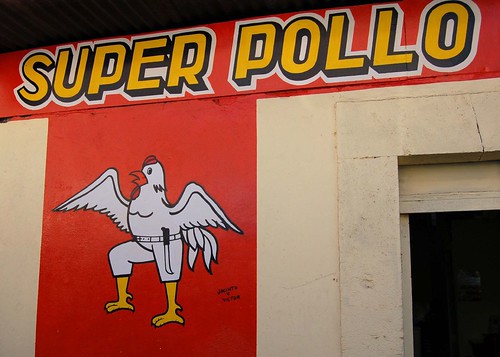
Enemies of fried food beware -- Super Pollo is packing a machete! Once he works out the opposable thumb, you're in real trouble!
Thursday, July 06, 2006
On the Road Again
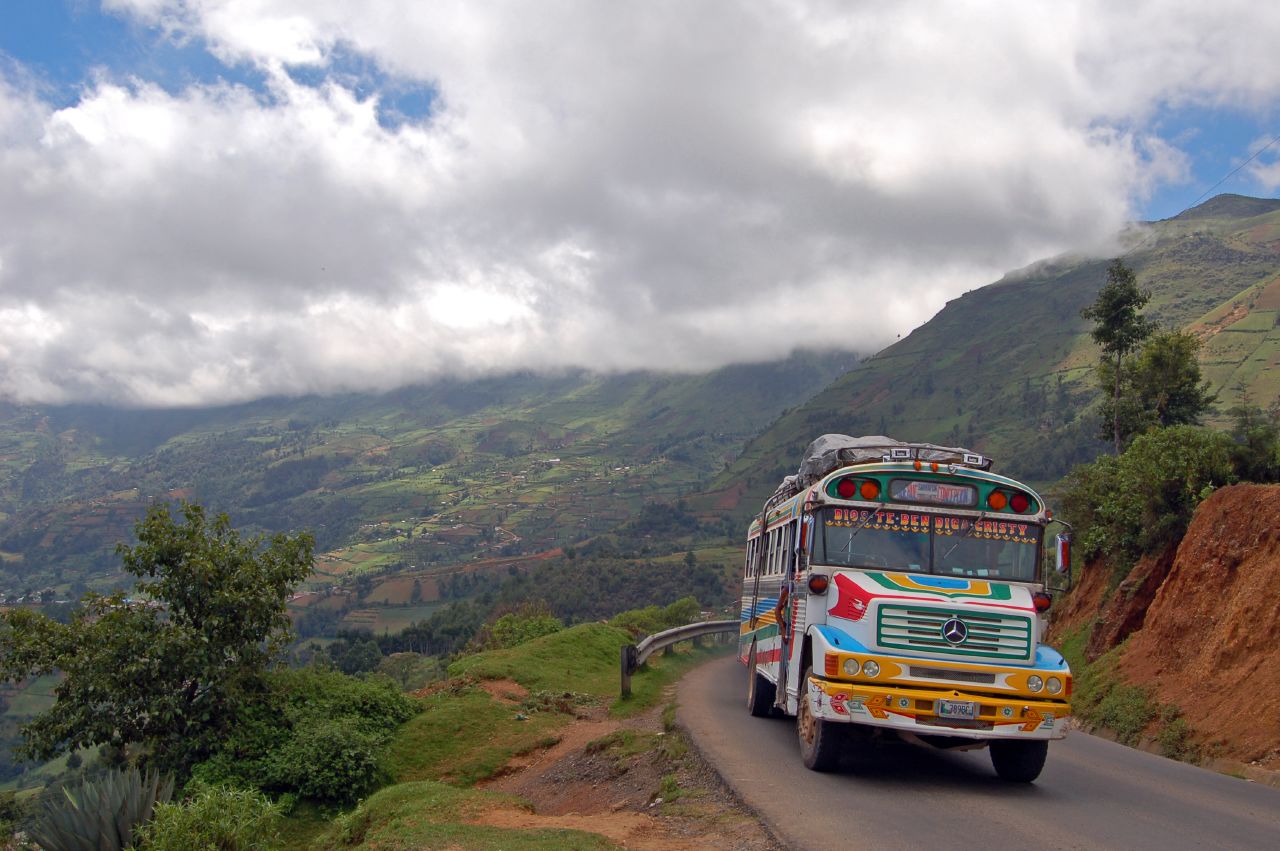
We enjoyed a cleverly constructed almost-four-day weekend a few days ago. Friday, June 30 was Army Day or War Day or Tank Day or something. On Thursday, the American People needed me in Sololá, near Lake Atitlán, a couple hours away from Guatemala City. So, I went and conducted the business I had at the Sololá jail (which, like most modern prisons, is practically indistinguishable from a country club) on Thursday morning and then took the afternoon off.
Equipped, as we were, with our new and insufficiently tested mini-SUV, we declared, "Screw the rain and the mudslides." The Highlands were calling our names. We checked to make sure none of the roads we were planning to travel were closed at the particular moment, and after a stroll through Sololá, continued West to Quetzaltenango.
Quetzaltenango, also known as Xela, is Guatemala's second city. It's a fair sight nicer than Guatemala City, with an actual Indian restaurant and an attractive downtown. We enjoyed a quick meal and then headed for Zunil, a small town that's supposed to have a pretty church and their own version of the local idol Maximón. As we passed through Almolonga, another tiny town on the way, we spied ferris wheels over the rooftops, and screeched to a halt to check it out. It must have been the town's annual fair, as the streets were packed with midway games and amusement park rides. We saw a dance performance featuring costumed characters, a performance by Guatemala's most famous modern marimba band, and the candle- and neon-lit church. We also played a quick couple games of Lotería, a bingo game for players of all education levels that uses pictures instead of letters and numbers on the grid. The Lovely Katherine, being a master of all bingo-related games, promptly won the second game. She was awarded a prize of five drinking glasses decorated with a daffodil pattern. She denied that she had attempted to throw the game, and passed on her prize to a young volunteer who had aided her in avoiding some obvious strategic blunders when her victory drew near.
The next day we enjoyed a luxurious breakfast in an almost American-quality coffee shop, and then plotted a course through Huehuetenango for Todos Santos Cuchumatan. Todos Santos is on the far side of a precipitous climb up the mountainside from Huehue, and then a dirt road back down the other side. It is a tiny town in a gorgeous valley, and draws a modest but disproportionate number of tourists because the men as well as the women still dress in their traditional colorful garb. The place couldn't have been more picturesque, nor the residents more tired of having their picture taken. One highlight was a dinner in a tiny comedor, where we ate fried chicken and were joined at the dinner table by one of the main course's survivors.
The weekend had been a smashing success, and wasn't over yet. We went back south along the highway and then turned east to climb another pretty mountain ridge and arrive in Momostenango, which we selected because they supposedly make the finest blankets in Guatemala, and it's a funny place name, to boot. We pulled into Momostenango at about 3:00 on Saturday. At about 3:15, we decided to spend another evening in Xela, and then back to Guatemala the next day, figuring that having a fantastic time at two of our three intended destinations would have to be enough for one trip.
[Photo department note: Due to the new camera, the photo department is taking more pictures than ever, and spending more time than ever trying to edit them. These photos were grabbed for the purpose of illustration, actually carefully selected photos coming soon.]
Tuesday, July 04, 2006
In which we surrender
The Lovely Katherine and your correspondent have a long-running disagreement as to whether we live in "the suburbs" or not. In a political sense, we live well within the boundaries of Guatemala City. In an aesthetic sense, there's not much in terms of street-level retail, pedestrian infrastructure, or other markers of true urban living in our neighborhood. In a criminal sense, some not-too-distant neighbors were recently followed into their garage by armed goons and tied up while their jewelry and electronics were stolen, which seems pretty urban to me. (Note to worried relatives: we live in an apartment building with security features that would make such a robbery attempt much more difficult, and thus extraordinarily rare.) In the end, it doesn't matter whether we classify as "suburban" or not, and I keep up the semantic fight just because my inner urban hipster is screaming about the implications of living in the suburbs: that we're old and have had all our rough edges sanded off.
But it's impossible to fight the facts any more. Katherine works at a school a few miles north of the city proper (but decidedly not suburban), and the last bit of her daily commute is on a dirt road that gets pretty treacherous during the rainy season. We also do a fair amount of bumping around the precipitous, unmarked speed bumps and domestic-appliance-sized potholes of Guatemala's highways and small towns. Which is all rationalization, powerless to stop the pure cold facts of our yuppie-dom:
We bought an SUV.
It's a small SUV, but an SUV nonetheless. A departing embassy employee was trying to unload his Kia Sportage before moving back to DC. The car does not meet US emissions standards (and also has windows tinted well past what seems reasonable, but I'm not sure if they would be technically street-legal in the US or not), so keeping it wasn't an option for him, and he was in a mood to sell. I don't suffer any illusions that a Kia Sportage is a particularly manly SUV (especially if you pronounce it in the French manner - "sport-AAAHJ"), it just seemed like a smart purchase in terms of safety. Of course, I'm sure that's just what you would hear from my SUV owning brethren, cruising the highways of America in their Expeditions and Yukons and Hummers.
But it's impossible to fight the facts any more. Katherine works at a school a few miles north of the city proper (but decidedly not suburban), and the last bit of her daily commute is on a dirt road that gets pretty treacherous during the rainy season. We also do a fair amount of bumping around the precipitous, unmarked speed bumps and domestic-appliance-sized potholes of Guatemala's highways and small towns. Which is all rationalization, powerless to stop the pure cold facts of our yuppie-dom:
We bought an SUV.
It's a small SUV, but an SUV nonetheless. A departing embassy employee was trying to unload his Kia Sportage before moving back to DC. The car does not meet US emissions standards (and also has windows tinted well past what seems reasonable, but I'm not sure if they would be technically street-legal in the US or not), so keeping it wasn't an option for him, and he was in a mood to sell. I don't suffer any illusions that a Kia Sportage is a particularly manly SUV (especially if you pronounce it in the French manner - "sport-AAAHJ"), it just seemed like a smart purchase in terms of safety. Of course, I'm sure that's just what you would hear from my SUV owning brethren, cruising the highways of America in their Expeditions and Yukons and Hummers.
Saturday, June 17, 2006
Trapped in Guate
Our normally frenetic pace of Central American exploration has ground to a halt of late. In part, we've seen everything that's easy to see on a two-day weekend trip. But return visits or slightly more ambitious expeditions have been stymied by harsh reminders that we are in the developing world. Most of the major roads out of town have suffered either derrumbes (landslides onto and blocking the road) or hundimientos (landslides out from under the road, often taking a good chunk of the road with it).
Tropical Storm Stan (also alternately known as Hurricane Stan, because it sounds better though it may or may not be technically accurate) caused many of these roads to wash out, and the Guatemalans responded with an aggressive chewing-gum-and-duct-tape campaign to patch the roads up. Being fair, there's just no money in the coffer to do much else. Be that as it may, it's not surprising that one month of the six-month-long rainy season has already washed away most of their jury-rigged repairs so much as it's surprising that the repairs lasted this long to begin with.
In any case, there is still plenty to be seen, we'll just have to refocus our efforts on the pleasures of the more immediate region.
Tropical Storm Stan (also alternately known as Hurricane Stan, because it sounds better though it may or may not be technically accurate) caused many of these roads to wash out, and the Guatemalans responded with an aggressive chewing-gum-and-duct-tape campaign to patch the roads up. Being fair, there's just no money in the coffer to do much else. Be that as it may, it's not surprising that one month of the six-month-long rainy season has already washed away most of their jury-rigged repairs so much as it's surprising that the repairs lasted this long to begin with.
In any case, there is still plenty to be seen, we'll just have to refocus our efforts on the pleasures of the more immediate region.
Wednesday, June 14, 2006
Big ups to the family
About six weeks ago, I gave up on the visa interviewing bit. Or rather, I rotated into the American Citizen Services section. "What the hell does that mean?" I can hear you asking. Mostly it means that instead of doing interviews to see if Guatemalans qualify for visas, I do interviews to see if purported Americans qualify for passports. This breaks into three types of interviews:
1. Obvious gringos who got pickpocketed or robbed while on vacation, and need a new passport to get home. These interviews are easy and boring.
2. Ex-pats who may look like gringos or may be of mostly Guatemalan blood in for routine renewals. These interviews are easy and boring.
3. Kids ranging from age two to age eighteen claiming that they were born in the US when their parents were there illegally, and then they were sent off to live with Grandma in Guatemala when they were a few months old and now they want a US passport for the first time. These interviews are nearly impossible.
The other part of the job is being on call at all hours in case any American is arrested, hospitalized, victimized, or killed. The two big cases I've had to work on so far have been gentlemen with various forms of mental illness who have been living on the streets of Guatemala for an unknown period of time, and now need help getting back to the US.
(Little known fact for US Citizen readers: if you are destitute in a foreign country, your government will pay to send you home. Until doing the training for consular work, it never would have occurred to me if I completely ran out of money to go to the Embassy and ask for a ticket home. A lot of folks apparently have no such mental barriers, and come in asking for money until they realize that we're going to call their mommy first, then loan them money and cancel their passport for further adventures.)
These gentlemen were true hard-luck cases, and the worst part was that they had nobody in the world who would help them. We contacted each of their parents, none of whom were willing to provide any assistance in bringing their kids home. I guess I was hoping for a somewhat higher level of diplomacy then trying to get mom and son to patch things up when I signed up for this gig. Anyway, a big thanks to all the folks back home who would spot me airfare to get home if I fell and hit my head on the sidewalk in Guatemala, which is sadly not something everyone can count on.
1. Obvious gringos who got pickpocketed or robbed while on vacation, and need a new passport to get home. These interviews are easy and boring.
2. Ex-pats who may look like gringos or may be of mostly Guatemalan blood in for routine renewals. These interviews are easy and boring.
3. Kids ranging from age two to age eighteen claiming that they were born in the US when their parents were there illegally, and then they were sent off to live with Grandma in Guatemala when they were a few months old and now they want a US passport for the first time. These interviews are nearly impossible.
The other part of the job is being on call at all hours in case any American is arrested, hospitalized, victimized, or killed. The two big cases I've had to work on so far have been gentlemen with various forms of mental illness who have been living on the streets of Guatemala for an unknown period of time, and now need help getting back to the US.
(Little known fact for US Citizen readers: if you are destitute in a foreign country, your government will pay to send you home. Until doing the training for consular work, it never would have occurred to me if I completely ran out of money to go to the Embassy and ask for a ticket home. A lot of folks apparently have no such mental barriers, and come in asking for money until they realize that we're going to call their mommy first, then loan them money and cancel their passport for further adventures.)
These gentlemen were true hard-luck cases, and the worst part was that they had nobody in the world who would help them. We contacted each of their parents, none of whom were willing to provide any assistance in bringing their kids home. I guess I was hoping for a somewhat higher level of diplomacy then trying to get mom and son to patch things up when I signed up for this gig. Anyway, a big thanks to all the folks back home who would spot me airfare to get home if I fell and hit my head on the sidewalk in Guatemala, which is sadly not something everyone can count on.
Tuesday, June 06, 2006
Appropriate Force
Today I felt like a true diplomat. Or was it a cop? I represented our country in formally signing the papers to accept custody of a guy who was being extradited from Guatemala to the United States. The handover happened in a room probably no bigger than 12 feet on a side, which turned out to hold at least nine Guatemalan National Police carrying automatic weapons, wearing helmets, with faces covered, as if there might be a riot in the airport. These nine heavily armed guys, plus a couple of my fellow bureacrats, handed over the prisoner to the US, represented by me and two Deputy US Marshals who were dressed like they were going to the beach. I guess the beach attire made them inconspicuous on the airplane, to whatever extent you can blend in when you're leading around a guy in handcuffs.
Subscribe to:
Posts (Atom)

 Posts
Posts


