Thursday, June 14, 2007

Inclusivity


We went to an all-inclusive resort. We drank fruity cocktails. We lounged.

One of your correspondent's colleagues departed Guatemala for good today, and to send her off in style, a crowd of hearty diplomats rushed the Royal Decameron Resort in Salinitas, El Salvador. For your correspondent, and his faithful traveling companion, this was something of a change of pace. We're more accustomed to $20 middle-of-nowhere lodges where one prays there is hot water. Many in our traveling party raved about how great the price was at the Decameron, whereas your correspondent was suffering a bit of sticker shock. Traveling party responded to any hesitation with the irrefutable reply: "But it's all-inclusive!"

Faithful readers may recall our previous visit to a resort-style destination. But that trip was Scuba-focused. This resort is rather more for the "sit in a beach chair and drink Mai-Tais" inclined. Which suited us mostly fine, and we had a great time sitting in the pool and chatting with our friends and enjoying ridiculously named drinks like the Banana Mama and the Pasión Tropical.

Ridiculous activities were available for the more active set, such as water aerobics done to deafening 180 beat-per-minute techno music (which appeared to be mostly just an excuse to have one extremely fit "instructor" of each sex to girate rhythmically at poolside for the viewing pleasure of participants and non-participants alike (mostly non-participants)), or some game where teams of two use towels to toss volleyballs around a circle. We, despite considering ourselves "active," declined to participate.

This is apparently not a top-notch, five-star resort, as evidence by certain online reviews bemoaning the lack of "towel art" in the rooms. I would guess at the really pricey resorts of the Caribbean, you needn't leave your lounge chair to order another Makers on the rocks. That was not true here. This resort's tactical response to all-inclusivity was a three-pronged attack of cheap plastic-bottle booze, dixie cup servings, and no waiters. Here, we counter-attacked by bringing our own Big-Gulp sized cups to minimize trips to the bar and befriending the bartender so we could without hesitation ask for just a bit more vodka and tabasco in that Bloody Mary. (By Sunday, your correspondent had consumed as much rum and citrus juice and pre-mixed colada as he could handle and had to stick to vodka, perhaps a positive sign for Northeastern European days to come.)

In any case, your correspondent values the rich tapestry of personalities that makes the human experience so varied and interesting. But people who choose to go to places like this for their whole vacations leave me baffled. Though the staff photographer did enjoy the near-studio light on our balcony, as seen above, your correspondent was getting a bit itchy about all the doing nothing on day two. A whole week would be fatal.

Monday, June 11, 2007

Belize, Part Two

We now present part two of this unintentionally serialized story of our brief trip to Belize. When we last left your correspondent, we was describing the group's arrival in Belmopan...

... Maybe we were just punchy from the drive, but we laughed and laughed. Such is the result of wandering off into the jungle for hours, only to reach the exotic post of assignment that would, in fact, not look out of place along the interstate beltway circling any American sun-belt city. Except that instead of having a highway next to it, it had a dirt road cutting through scrubby secondary growth. To some extent, the joke was on us, as in our 90 minutes in Belmopan we ate at a Chinese restaurant that was far, far better than anything in Guatemala City, and actually would give most any option in Washington, DC a run for its money; coupled with beer that proved without a doubt that Belize was a British colony, not a Spanish possession (despite some continued Guatemalan opinion to the contrary).

After this delicious feast, we really had seen just about everything there is to Belmopan. Our traveling companion shuttled us through Belize City and off to the airport in her beau's stylish Jeep. And, as we were getting the autograph of legendary Belize City airport bartender named "Jet," our friend was driving said Jeep back to her sleepy little gated community. And as we were possibly in the air on the way to Guatemala via El Salvador, she blew out a tire (or something) on the wide Belizean highway, flipped said Jeep and rolled it several times on the Nebraska-flat landscape near Hattieville, totalled the S.O.'s Jeep, and walked away while various Belizean on-lookers gathered to dig through the glove box for anything portable and valuable. She spent a night in the hospital and a week away from work, but the bigger tragedy is that now she's trapped in Belmopan without a car, despite all our efforts, and nothing to do but eat the best Kung Pao Chicken this side of California.

Thursday, June 07, 2007

Belize

It has indeed been forever since I rapped at ya. There has been some amount of nothing happening. And I've been laid low by some of the things that have happened. But this last weekend, we checked off one of the final Central American destinations we had yet to visit, the erstwhile 22nd province of Guatemala.

Many think of Belize as a destination for lazing on the beach or snorkeling from one of its many Caribbean islands. Not your intrepid correspondent. One of our dear friends from the Embassy is being temporarily assigned to Belmopan, Belize for six weeks while they are desperately understaffed. Recognizing the islands as the primary attraction of the location, she was dedicated to driving so as to avoid being trapped and car-less in the jungle interior. This involves some amount of remote highway frequented by brigands and highwaymen. So we agreed to pile in the 1998 Chevy Lumina with her and trek down the mountains, across the desert, through the jungle, and on to Belize, seeing some of the Guatemalan countryside we had not yet enjoyed. The Lumina was a late scratch, and a gentleman friend of our colleague agreed to loan her his Jeep (for the whole six week assignment!). Slightly later than originally planned, we set off down the treacherous mountain. Hours of highway driving stretched on, and we eventually met the owner of the Jeep in the remote jungle lair where he was training with the Guatemalan equivalent of the Green Berets. (No, really. More on this later.)

After a day of not really that many hours on the road, we were nevertheless drained by the challenging road conditions upon our arrival in Flores, Peten. The travelling party was dedicated to enjoying our last evening together for six weeks, and so managed to drink a variety of tasty beverages while barely keeping our eyes open. The next morning, we met up with our police escort for the notorious final two hours to the border, crossed into Belize with just about the expected amount of hassle, bought Belizean car insurance, and pushed on for the capital city of Belmopan.

The exhausting weekend of driving was proved entirely worthwhile upon seeing Belmopan. The city was created in the middle of nowhere when the government grew weary of the capital, which was then located on the coast in Belize City, getting knocked over by every hurricane that passed by. As capitals go, you might say it is a little sleepy. There may be as many as 15,000 inhabitants, but I doubt it. There is a modest city center, a few blocks of small residential developments, and then a few blocks of scrubby undeveloped land split by dirt roads, and then one runs into the massive, thoroughly modern U.S. Embassy. Then, after a few more blocks of scrub and jungle and dump, one finds the U.S. Embassy employee housing complex, built half a mile away from the nearest development, surrounded by a 10-foot-high, bright yellow wall and containing 14 identical tract houses. Maybe we were just punchy from the drive, but we laughed and laughed. Such is the adventure of venturing off into the jungle for hours to reach the exotic post of assignment that could possibley

Saturday, May 19, 2007

Technical Difficulties

It has been brought to the editor's attention that the slideshow link in the previous post is not working for some and maybe all viewers. We regret the inconvenience. If you're not seeing any pictures on the slideshow link, perhaps you would like to just go to a page where you can click on each picture? Probably not. Better luck next time.

Wednesday, May 16, 2007

Capabilities

A few years ago, they came out with one of those studies that they do apparently for the sole purpose of landing a crazy story in the newspaper. Scientists discovered that people's self-assessment of how good they are at a given task is inversely related to how good they are at the task. I.e., enthusiastic amateurs who know just enough to be dangerous think they are pretty darn good at stuff; whereas near-masters have a deep understanding of just how far they are from true mastery. I loved that study.

From a world of less rigorously tested yet more certain knowledge, it's easy to get bored looking at other people's vacation photos.

Flying in the face of these two important lessons: I think I take more interesting vacation pictures than a lot of people. And Flickr just released a significantly improved version of their slideshow viewer. So if you've got 30 seconds to kill please breeze throught 18 pictures from Mexico.

Tuesday, May 15, 2007

Holla Staff Lavished with Further Awards

Guatemalans love recreational sports leagues. I actually don't have any evidence to support that claim, but it sounds better than the statement I can support: Guatemalans who play recreational sports leagues get really into them. Your correspondent is now proud owner of a medal, awarded by the appropriate sanctioned authorities. The obverse of this medal reads, in its entirety: "Gatorade" with the little Gatorade lightning-bolt logo. The reverse reads, in part, "Pollo Rey" with a little picture of a chicken wearing a crown; then, smaller, "Champions, Group C." I earned this prize for playing sporadically on 7-man soccer team, which won the title for the entry-level division.

I guess I haven't really played organized sports as an adult in the U.S. But most leagues I'm aware of might involve everyone chipping in for a team t-shirt, and the teams might win a chintzy trophy at the end of the season. In this, and several other Guatemalan leagues I'm aware of, the rec league is like a full-blown pretend version of the real thing. There are full teams of referees (of questionable quality), medals for the winners (?!), games happen during prime evening and weekend hours, and most unusual of all, everyone has to buy full-on matching uniforms. For example, a friend joined up with the Embassy-associated softball team and was not allowed to play at first because he didn't have full-on sliding pants. The uniforms that the softball team have to invest in are ridiculous Triple-A caliber getups with matching socks and everything.

The soccer league your correspondent (sporadically) participated in was particularly funny because you need to buy a full uniform, but apparently nobody could think of a uniform that didn't already exist. Or maybe everyone just wanted to play out their fantasies of being on a famous international soccer team. As a result, all the teams in the league had uniforms that were direct copies of Real Madrid, Juventus, or in one case, the English national side, with the little St. George's Cross and everything. In one particularly storied evening, your correspondent's team, decked out like a little 7-man version of FC Barcelona in their blinding yellow alternate kit. We faced off against our hated rivals, a less talented 7-man version of FC Barcelona in their blinding yellow alternate kit. After a full (short) half of very confusing football, someone pulled out seven of those pull-over tank top things that you use to designate the second team at a practice where everyone is normally on the same team and therefore wearing the same uniform on purpose. Despite an especially hard-fought game, with the blinding yellow unis of our oppenents topped with hunter-safety blaze-orange tanks, the only injuries were to the eyes of unfortunate spectators. And the lesson (hopefully) learned is to not pick the uniform of last year's European Champions for your team kit.

Sunday, May 13, 2007

Of Acatenango


There are three major volcanos (or four, really) visible from Guatemala City on a clear day: Agua, Pacaya, and Fuego/Acatenango (twin peaks, one active volcano and one dormant volcano, connected by a small saddle). As previously reported, your faithful correspondent has summited the first two of these. The latter was conquered this past weekend.

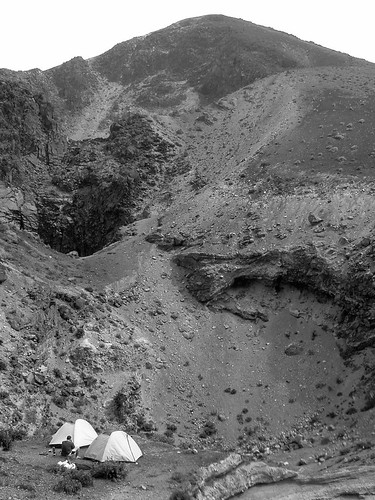
It was a fairly early start, a steep climb, cold weather, and some nice scenery. The best part was the opportunity to camp at the (almost) top of the mountain, doing the last half hour of climbing at dawn to watch sunrise from the summit of dormant Acatenango. From there, one could look down at the smoldering cone of active Fuego, poking out of the early-morning clouds. Of course, the staff photographer didn't get any shots of it; he brough only the cheap back-up camera due to concerns about robbery of the expensive primary camera, which back-up camera, of course, failed prior to reaching the top.

Given reports of theft on the trail, we hired a capable guide at the tiny town at the bottom of the hill -- as with most climbing expeditions in Guatemala, the primary purpose of the guide is to carry a machete and scare off possible theives. He hiked to the top in his loafers, apparently bringing nothing more than a little white bread and an orange to eat. Each time we pulled out snacks or dinner, we offered him some, which he gratefully accepted, and then as near as we can tell, squirreled away in his pack to give his family when we got back to the bottom, content to mostly just eat white bread. Exactly why we were carrying all this food to the top of the mountain for him didn't quite make sense, but it was probably a better workout that way.

Sunday, May 06, 2007

DF


Sometimes better things come in bigger packages. Guatemala City is estimated to have a population around 2 or 3 million people. But it punches below its weight compared to smaller cities culturally, culinarily, architecturally, &c. While it is the firm belief of the Holla that the rest of Guatemala more than makes up for the capital's shortcomings, the city's failings are not uncommon among developing-world metropolies. Millions of rural immigrant laborers moving to the city don't necessarily make up a market for great pad thai. Except maybe in Bangkok.

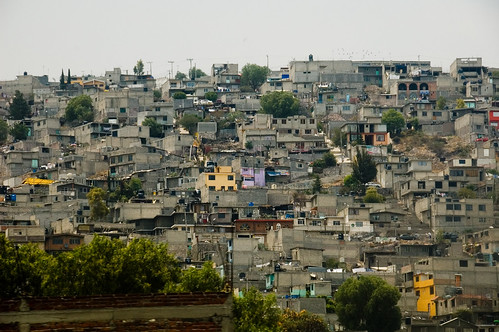
In any case, on our recent trip to Mexico City, I wasn't sure if we would find a city of 20 million people subsisting on beans. Any fears were misplaced. While Guatemala is a fantastic place to visit if you have some time to get out into the sticks, Mexico City (or "the D.F." as those in the know call it) is a fantastic location for a long weekend visit. It has varied neighborhoods, amazing museums, a rich street life, and an actual middle class and the attendant restaurants, bars and cafés. Since we explored only the center of the city and a few of the nicer outlying neighborhoods, we can't rule out the possibility that there are still 18 million people outside the center subsisting on beans, but there is a Guatemala City-sized core that ranks alongside Buenos Aires at the top of the Latin American city list.

Of course no city of 20 million people is without its attendant difficulties. On wour way into the city from the airport, traffic delays were signifcant. The airport taxis have a central-dispatch system, and when the dispatcher assigned us, and our city-center destination, to the cabbie, he complained loudly that it would take him several days to get there and back. Each time the traffic report came on the radio, he cranked the volume to full blast, possibly to glean any route-finding details possible, but it seemed to be more to make a point that we were idiots to have reserved a hotel downtown. The radio reported that there was a quinceañera parade making its way to the central square, jamming traffic all over. A quinceañera is a girl who is turning 15, which is a huge deal in Latin American cultures - beyond a huge deal. The same way Americans spend ridiculous sums of money on weddings, latinos do the same for 15th birthday parties. We asked the driver who was having a quinceañera parade big enough to shut down most of the city. "Everyone," he replied. We later saw open-top double decker buses packed to bursting with girls in prom dresses being carted into the main square for whatever the event was.

Fortunately, traffic was aviodable because the city has a clean, efficient, and -- as far as our experience went -- safe, Metro. It even provided entertainment, of a sort. On many trains, people hawk their wares on the train cars, always waiting until the second the doors close to start and stopping the second they open again, giving the impression that the law didn't smile on their activities. Nonetheless, we had one ride where over the course of a few stops we had someone trying to sell sharpie markers (two for a dollar!), then someone trying to sell a small radio (this amazing small radio comes with its own earphones!), then someone selling compact discs (with a little backpack sound system blasting), and finally DVDs (actually holding a portable DVD player over her head as she made her way up the train car to demonstrate the quality videos on offer).

Among the tourist-attractions of note, the pyramids at Teotihuacán are magnificent, and very different from the Mayan ruins in Chiapas and Guatemala -- although they do share the crowds and junk peddlers of Mexico's Mayan ruins. The museum of anthropology is an amazing collection in a world-class facility. We overheard one guide lecturing his Hungarian charges about how certain Aztec artifacts were damaged in the "American Invasion." Which of course each side will have a different view of the war, but he went on to emphasize for his Magyar guests: "You are Hungarian. Germany invaded Hungary. The same way, the U.S. invaded Mexico in 1847." Deciding discretion in correcting flagrantly off-base analogies the better part of valor, your correspondent wandered to another of the myriad displays rather than pursue the issue. On the other side of the American-baiting coin were Diego Rivera's masterpiece murals in the public buildings of the city. They were almost uniformly magnificent, although I don't remember from Art History 102 the one with the happy laborers gleefully crushing capitalist skulls with hammers and chopping them up with scythes. Maybe better to stick with Siquieros.

Friday, May 04, 2007

Nothing to See Here


We haven't published anything in a while. We ran off to Mexico. But we're back, and will tell you all about it soon.

Tuesday, April 17, 2007

Fulfilling our Obligation to Cultural Exploration


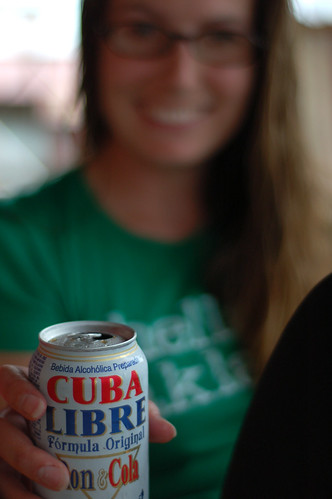
Your intrepid correspondent and his trusty traveling companion take very seriously our commitment to serving international understanding by reporting on the subtle differences in culture between Central America and the United States. It is the small wrinkles that make the tapestry of our continent so rich. In Panama, when trying to purchase ourselves some watery local lager to enjoy in the hammocks on our balcony, we were reacquainted with the joy of buying loose cans of beer for 50 cents apiece. But more importantly, just next to all the essentially equivalent brands of beer, we saw a Unique Cultural Experience we had to try: Cuba Libre (TM) Original Formula Rum and Cola Prepared Alcoholic Beverage, pre-mixed and sold in pop-top cans for your drinking convenience.

Do we do this in the U.S.? Maybe I've just never shopped in the right package shops to do all the cultural investigation I should have back in my native land. Or maybe I just walk right by it on the way to the cooler with the Sierra Nevada in it. The only equivalent I can think of is something like wine coolers or pre-mixed mudslides or something girly like that. But how can the homeland of consumer convenience have been bested by its one-time de facto colony in providing a product for people who don't have it in them to mix their own Bacardi and Coke? I demand a Congressional investigation!

There is also an economic angle, of course, as the price point on Cuba Libre (TM) Original Formula Rum and Cola Prepared Alcoholic Beverage suggests that they may not be using top-shelf Zacapa rum, nor true high-test Coca-Cola. (Although since it is billed as "Original Formula," perhaps they had a New-Coke-style failed rejiggering of their secret ingredients at some point.) Your correspondent, having dutifully experienced the joys of said beverage and allowed its cultural significance to fill his senses briefly, moved on to research on the local beer and delegated his trusty traveling companion to do the further required investigation of the effects of consuming an entire can of Cuba Libre brand beverage. Both investigators somehow fell asleep in their hammocks, leaving scant written record to document the encounter fully. The Holla pledges to strive to avoid such lapses in the future, to the extent that seems appropriate at any given locale.

Tuesday, April 10, 2007

Yeah, We're Running a Little Bit Hot Tonight


Your correspondent recently returned from a gruelling nine-day expedition to Panama, and after the preceeding one-note entries, has finally completed the traditional too-long Holla trip report.

While our trip to Panama seems to fit into the mission of this journal, because it's sort of Central American (although, historically, and in many ways, culturally, a lot more South American), it really was a week of vacation. The editorial board is somewhat distressed by the fact that Guatemalan life has become so routine that this journal has become little more than a record of our weekend trips, but until we find some more talented writers, that may be unavoidable. In any case, a full week of vacation run-down may be more than all but the most patient and closely-blood-related of readers can bear, so we'll endeavor to hit the highlights of general interest.

First, and quite possibly foremost, Guatemala finally has a competitor for the coveted title of "worst national beer in Central America." Panama Lager is just as watery and flavorless yet aftertaste-ridden as Gallo. And yet, Gallo still holds the title as the worst because Panama lager was usually $1.00, except in happy hour, when it was 75 cents, which is a much fairer price than what one shells out for a Gallo.

With that sad discovery taken care of in our first night in Panama, we were ready to do further exploring, and took a boxy prop-plane to the Bocas del Toro islands, on the Caribbean side of the isthmus, near Costa Rica. After getting the lay of the land and taking care of important business such as re-confirming that the local beer was not noteworthy but was cheap, checking the functionality of the hotel hammocks, and eating a couple delicious meals, we rented bikes to head for the beach.

Although the bike that The Lovely Katherine was stuck with dropped its chain every five minutes, and your correspondent chivalrously took a turn on said bike only to have the chain pop off on the steepest dirt-road downhill of the trip, rendering the coaster brakes useless and forcing an emergency braking procedure courtesy of a knee-deep puddle at the bottom of the hill, the travelling party survived to find a beautiful deserted beach of soft sand and pleasant surf an hour from town. The joy of finding a deserted beach such a short flight from hundreds of millions of North American beach-seekers was immense; of course, there is a multi-story luxury condo development planned for Bocas del Toro town starting any day now. In any case, it was good to be there when we were. The tourist infrastructure was enough to offer a Thai restaurant and two competing dive shops, but not so bad that everything felt manicured yet.

Other activities over the next few days included scuba diving, kayaking, and snorkeling. Animals spotted included tiny red tree frogs, sharks, stingrays, dolphins, and the elusive (no, really) ocellated frogfish.

We moved on to Boquete, a smallish town in the Panamanian Highlands. We went for a hike that turned out to follow a road past endless lots that were either for sale, or featured a huge, modern home with an SUV parked in the drive, or in some cases, both. This was not the only place along our trip where we calculated that given different circumstances we would definitely buy property, as the market was clearly going nowhere but up. There are apparently a lot of Americans buying retirement homes in Boquete, or rich Panamanians buying second homes there, or probably, both. As such, there is a new mini-mall in town, including a wine shop selling Wente Zinfandel from beautiful Livermore, CA. We sat out on our deck, gazing at the Pacific tens of miles away and enjoying the first California wine we've purchased in Central America. The Panamanian Highlands may not have much on the Guatemalan highlands, but they do have good wine, and they have the national bird of Guatemala. We went on a hike specifically to spot the elusive (no, really) Resplendent Quetzal, on a trail specifically called the "Trail of the Quetzales." We were pretty sure we would be let down, as we've heard of many foiled attempts to find quetzals in Guatemala. I literally gasped with suprise and excitement when we managed to track down a group of a few quetzals based solely on the approximation of their call that the ranger had given us. The Staff Photographer provided more excuses about photographic conditions than he did good pictures of quetzals.

Nonetheless, we considered our mission accomplished and climbed onward to the scenic viewpoint and allowed the photographer to focus on more stationary subjects. We started in on our picnic lunch and it began to rain, so we took shelter and waited for it to pass. It did not pass. The "cloud forest" did its best impression of a full-on "rain forest" as it poured on us the whole way down. Being experienced hikers, we would have been fine with a little rain, but the Panamanian philosophy of trail maintenance was a bit shy of American standards. The trail was eroded into a gully the whole way down, which flooded with running water, becoming possibly the largest river in the department. We hiked down in several inches of rushing water, and arrived at the bus stop back to town soaked to the bone.

Luckily, we didn't have to wait long for a collectivo bus to come by, and we were soon cheered by the thoughts that we would soon be warm in our hotel room with another bottle of delicious California wine. We enjoyed and/or endured the views on the bus trip back into town, and apologized that we were still dripping water on the floor when we went into the gourmet deli to select a vintage for the evening. They, in turn apologized that the mayor of town had banned all liquor, beer, and wine sales from Holy Thursday through Easter Sunday in order to ensure that all residents showed proper respect for the highest of high holy holidays. We literally had to have them explain it to us a couple times, and they showed us where the mayor's decree was posted on the wall near the wine section.

There is a popular theory that life in the Foreign Service leads to high levels of alcoholism due to job demands including regular cocktail parties, on top of the isolation and boredom of living in certain remote posts. I don't think your correspondent is contributing to that statistic just yet, but after hiking for hours in the rain and then being told they would not be allowed a celebratory tipple to top it off, the entire travelling party was perhaps irrationally upset about the situation. Our vacation - ruined! What on earth were we going to do in Boquete for an evening if not split a bottle of wine? What kind of self-defeating mayor bans alcohol in a tourist town in one of the busiest travel weeks of the year? And what kind of liquor store puts up with it -- and doesn't even bother to tell customers on Wednesday that this is their last chance to stock up for the next few days? Resourcefulness prevailed and disaster was averted as we eventually found an Italian restaurant where the waitress was either ignorant of the law or rebellious enough to break it and we managed to have some wine with our saltine-crust pizza in the end, without having to knock over any convenience stores.

We'd had enough, and decamped the next morning for a long bus ride to Panama City, featuring a brief spell of sitting on the floor of the aisle in the middle of the sold out bus, and a not-so-brief spell of sitting on milk crates in the aisle that the bus driver helpfully stopped to pick up.

We got to Panama City, picked what seemed like a couple good restuarants in the bustling, cosmopolitan city, and discovered that they had one-upped Boquete by closing down entirely for Good Friday. Apparently pizza places are the least pious eateries in Panama, as we once again were saved by middling pizza, although this time they would not relent on the liquor. We spent Friday, a day of our precious vacation, entirely alcohol-free. As you know because I'm writing this now, we survived for a final day of sightseeing at the Canal
(pictured above) and other sites, but I swear I don't know how we did it.

Gonna Fly Now


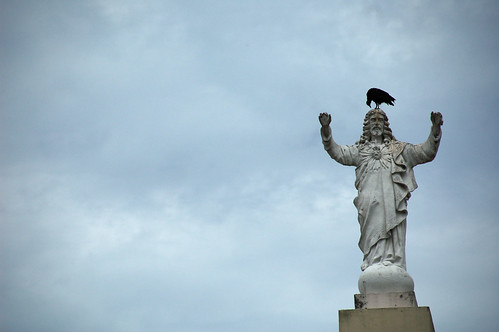
Another one-off photo from Panama. Somehow the photo doesn't look quite as much like it's Jesus flexing his biceps as it did in person. The staff photographer obviously needs a more expensive camera.

Monday, April 09, 2007

Mr. Peanut, I presume?


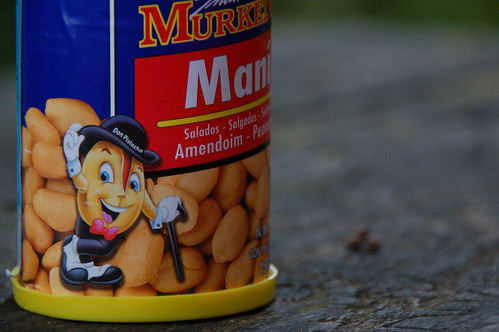
Not so. As the copy is finished on the epic Holla missive on Panama, one small item of note. The Holla editorial board would like to express our hopes that the potential free trade agreement between the U.S. and Panama does not lead to any ugliness between Mr. Peanut and Don Pistachio. We have our suspicions as to who was the original nut-based gentleman, but who is to say for sure? Surely this world is big enough for both.

Note: TheHolla editors searched in vain for a word meaning "of or relating to nuts" to use in lieu of the somewhat clunky "nut-based." If any of our more lexicographically inclined readers have any suggestions, please do not hesitate to suggest them.

Sunday, April 08, 2007

Honduras


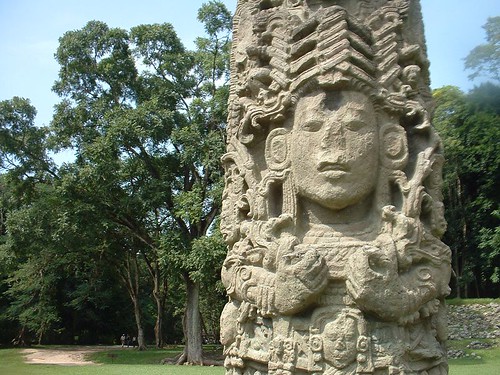
Did we mention that the Holla staff, accompanied by the Staff Mum, went to Honduras two weeks ago at this point? We regret the error. But we haven't had a moment to spare of late, what with the visit of the Staff Mum, and other visitors, and our recently completed trip south, which will be detailed shortly. It didn't help efforts to get an account of the trip to Honduras published that the Staff Photographer didn't bring all the gear he needed to effectively complete his assignment in Honduras, and thus there were no photos to augment what would have been a fairly brief dispatch to begin with. Above appears an archival image from a previous trip.

Wednesday, March 21, 2007

Gaia Theory


We went back to the beach last weekend. (Note: It's been over a week since this was composed - ed.) The beach here is kind of an un-Guatemalan experience. Which can't really be true, because technically, we were in Guatemala. But the beach in Guatemala feels a lot more like Getting Away from It All than the beach in the U.S. often does, as many sunny beaches in the U.S. are overflowing with people Getting Away from It All and the people selling things to the people Getting Away from It All.

Here, the beach at Las Lisas is pleasantly close to the middle of nowhere. Maybe because the sea helps to keep fellow leisure-seekers at bay by killing someone in the undertow a few times a year. Nevertheless, the stars at night were fabulous, and there wasn't much to do except lounge around and take pictures of the wrecked buildings that would never fall into such disrepair on a prime stretch of beachfront property back home.

Of course, it was too good to last, and on the way home, we got to get back into it all with a taste of Guatemalan traffic. In one stretch of a few miles, the two city-bound lanes merged into one three separate times, but rather than just close one lane and leave it closed, they let the traffic un-merge each time, causing yet another bottleneck as impatient drivers refused to yield. To add insult to injury, the last merge was the result of a "police checkpoint" that served no ostensible purpose and was right next to a twenty-foot wide shoulder that would have worked just as well. Somebody needs to get to work on a teleportation device so relaxing beach weekends aren't instantly dissolved by traffic jams on the way home.

Wednesday, March 14, 2007

The Boss's Boss's Boss (and the Boss's Boss)


It has been a somewhat busy ten days here in Guatemala.

The media here have been pretty much wall-to-wall on coverage of President Bush's visit to Guatemala. In the U.S., with some other news stories taking precedence, the Guatemala stop on the Latin American tour seemed to be treated almost as a day off. Or maybe that's just me being defensive because I've been working like a dog, living in a rinky-dink cabin with three roommates for a week, all to put together the President's visit to the rural hamlet of Santa Cruz Balanya. And it didn't even make the front page of the New York Times. I guess I'll settle for inside the front section.

It actually was a very interesting lesson in the difference between what happens at a press-worthy event and what actually gets reported, but those comments will have to wait for another time. It's a bit of a challenge to write, in a forum where I'm not supposed to say much about work, about two weeks that were dedicated almost exclusively to work . And even more difficult when the work regards something so politically sensitive as a Presidential visit, where writing anything untoward might seriously land me in some heap of trouble. But I'll venture a few comments none-the-less, even if they won't add up to any kind of coherent thought:

The President (or POTUS, as he is actually no-kidding called for short in any number of meetings and such) does not often go to the sticks in a foreign country, and Santa Cruz Balanyá is seriously the sticks. The town has a population of about 6,000, and is surrounded by lettuce fields as far as the eye can see. The challenges of safely getting the President in and out of such an area were substantial. My most important function was serving as a translator not just between English and Spanish, but between the perspectives of a (very) young White House staffer and the mayor of a small Guatemalan farming town. They're even less similar than you might think.

I also had the pleasure of having a conversation that went something like:
Me: "These pots are very nice."
Guy selling pottery on the town square: "Thanks."
Me: "Did you make them yourself?"
GSPotTS: "Yes."
(uncomfortable silence)
Me: "So, do you want to come to Santa Cruz Balanya on Monday and show your pottery to the President of the United States?"
GSPotTS: (stares for a moment then starts talking to the potential customer next to me).
Next time the voice of experience will surely help me come up with a more natural segue.

The day of the trip, I was within ten feet of Bush and Condi, and found myself with nothing but my camera-phone. So I captured a few shots of vaguely Bush- and Condi-shaped blobs, which the photo department has determined to be sufficiently vague as to be unpublishable. The Staff Photographer did manage to get some more traditional but ultimately boring shots in the controlled environment of the Embassy Meet 'n' Greet, wherein grown Embassy employees, both Guatemalan and American, had a chance to possibly shake the President's hand, and treated the event like teenage girls trying to get Ringo's autograph in 1966.

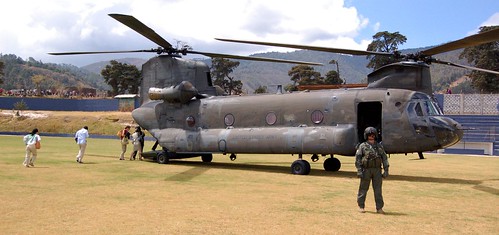
As cool as it was spending a few fleeting minutes hanging around the Prez, the undisputed highlight of the visit was the twenty minutes we spent coming back from our rural site courtesy of the United States Army. I don't know why it was so cool to ride in a Chinook, other than for those of us lucky enough to not have had to serve in our Armed Forces, riding in a tandem-rotor "helo" (anyone who says "helicopter" around the White House staff is roundly derided) is one of those things you figured you'd only ever see in movies. Also, they leave the ass end hanging open, so you get some crazy views if you're in the way back.

And that's it. Maybe more next time he swings by Santa Cruz Balanya.

Sunday, February 25, 2007

Of the Ixil Triangle


The Ixil Triangle is a great place name. While many Guatemalan place names are nice because they seem goofy to us, "The Ixil Triangle" sounds exotic and mysterious. And to a certain extent, it is. Your correspondent will not be so brash as to claim that we were charting new territory unspoiled by tourism, but Ixil is definitely a fair stretch off the main Guatemalan tourist trail. The steep hills and plunging valleys that make the region so beautiful are also the reason it is so hard to get to, and you have to spend several hours driving off the main highway to arrive. It is developing a reputation for that beauty, and for hiking in the nearby hills, and as with many places Guatemalan, as a spot to (perhaps rudely) gawk at the unique clothes worn by the many steadfastly traditional denizens. But it is most famous as the area where many of the very worst attrocities of the long, brutal internal conflict occurred.

In fact, as soon as we got into town on Saturday, we went hiking up and over a mountain ridge and down to the town in the next valley. Acul was founded at the height of the war as a "pole of development," which was the euphamism for a resettlement camp for the people whose entire villages were destroyed by the Army out of suspicion that they may have provided some support to the guerrilla groups that mostly lived out in the hills. Of course, the guerrillas were busy with their own ways of making life hard for the subsistence farmers of the region, too.

On our way up the ridge, we met a guy coming down with his granddaughter. He was dragging behind him a long pole -- a tree limb he had just cut down for firewood or fenceposts or who knows what. It was at least 25 feet long, and five inches in diameter at the wide end. His granddaughter was doing her part, dragging her own pole, which was only half as long and half as wide, but a lot more than I would have been willing to haul down a mountain at age five. As we approached, we asked the guy if we were on the correct path to reach Acul, and he turned off his transistor radio and sat down to chat for a spell. I would guess he mostly wanted an excuse to rest for a bit, but we nevertheless enjoyed chatting with him about how much we liked Guatemala, and then about how hard things were when the Army was bombing the area during the civil war, and then about his son (and the little girl's father) who was in the U.S. working illegally, having paid Q35,000 (about $4,500) for a coyote to smuggle him up there. The gentleman, like others your correspondent talked with over the course of the weekend, was very interested in how we came to Guatemala, and how long does a plane ride to the US last, and how much would it cost? And a bus ride through Mexico, how long is that?

Once we arrived in Acul, we were greeted by many people with at least a polite "Buenas Tardes," and even the occasional "Bienvenidos! (Welcome!)" It was a bit odd, given that Guatemalans are almost all extremely polite in a formal sense, but almost never very warm in an outgoing way. There isn't much to Acul, but getting there is a nice hike and is described in a popular guidebook, so it was nice to see that the flow of tourists wandering through their town hadn't worn them down yet.

For the following day, we planned to continue to take advantage of the lovely setting and the unusual chance to go hiking without fearing for one's life, as one must in some of the hills nearer to the capital. Unfortunately, the weather did not accommodate us. A thick fog descended over the region, bringing drizzle and cold. Those reading this from the wintry climes of United States may scoff -- surely it couldn't be that cold in the tropics! That is precisely the mistake we made. We packed as if we were visiting a tropical locale in the dry season. Of course, we were at 7,000 feet of elevation, so it can rain any time. And yet, being remote and desperately poor, heating for the cinder-block buildings of Nebaj was a luxury not many had invested in. For the portion of the afternoon that we spent in a cafe, hands wrapped around mugs of hot chocolate, we were each wearing every scrap of clothing we had packed -- a couple shirts, a sweater, a fleece vest -- and were still shivering with cold. We could see our breath indoors. Your correspondent calculated that it could not have been more than 40 degrees Fahrenheit. It got even worse when we your correspondent, perhaps suffering from the judgement-impairing effects of frostbite, decided he could not stand hot chocolate any more and switched to cold beer.

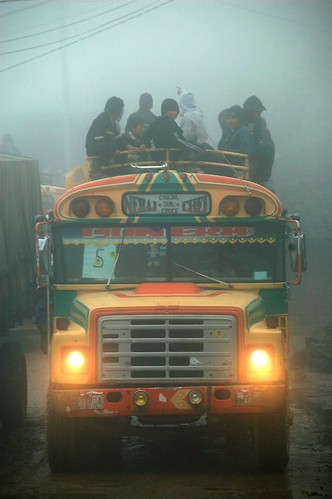
Prior to settling in to wallow in the cold, we took a trip from our base camp in Nebaj, largest town of the Triangle, to San Juan Cotzal and Chajul, the Triangle's other two points. The pom-poms in the women's hair were slightly different, and it was pleasant to see the charming towns and to imagine what the views might have been like on a different day. But there was still the fog. And the cold. And after driving for 45 minutes and rarely seeing another car on the road, we managed to get stuck in the closest there may ever have been to a traffic jam in Chajul, as one of the political parties brought in a dozen trucks and buses loaded with "supporters" for a rally in town. It is possible that these were all true devotees of the Partido de Acción Nacional. But it would not be unheard of in Guatemala if they had all been given the equivalent of two or three dollars to spend their Sunday visiting a couple small towns and cheering for the PAN on command.

The final day of our trip was sunny again. We wished for more time to go for another hike, but the long road back called our names anyway. The staff photographer spent the morning trying to catch pictures of Ixil life at the market from a respectful and unobtrusive distance, with middling success on the unobtrusiveness. While standing around snapping photos, a young guy with a handtruck stopped by to chat with the staff photographer. After a friendly talk about, among other things, how much a plane ticket to the US costs, and how long it would take to get there, they parted ways, only to meet again a couple blocks away. At this point, the Ixil interlocutor (named Geronimo) asked if the staff photographer (henceforth "SP") would take his picture. The SP explained that he would be delighted to take Geronimo's photo, but that he could not possibly print a copy until he returned to Guatemala City, and that the odds of his return to Nebaj were very small. Geronimo was undeterred, as any number of his church friends would be coming to Guatemala City over the next few weeks. The SP said he wasn't sure that would work, but agreed to take Geronimo's picture and trust the Guatemalan mail system to deliver it appropriately -- a fair but still shaky proposition. Geronimo found it satisfactory, and asked the SP to follow him to his preferred portrait location, which turned out to be the evangelical church where he works and lives. (One of many, many, evangelical churches in Nebaj, by the way, from which issue all manner of hymns and generally unpleasant music at all hours of the day.)

Geronimo lives in a small cinder block room, sleeps on a wooden pallet, and had, as decoration, only a single 8"x11" frame, bearing four items: A postcard with a picture of Jesus; a scrap of paper with some names on it; a commercial photo of three cute babies (unclear why this was selected for inclusion); and a picture of Geronimo himself, withe his handtruck, wearing a giant blue sequined sombrero, as one might wear when being photographed after too many margaritas in Tijuana. Geronimo went on to explain his vision, to one day acquire enough photos (apparently of himself) to cover all the walls of his room. This story was far too sympathetic to deny.

Your correspondent realizes now that it may appear that he is making sport of Geronimo, but please accept assurances that I only do so in order to maximize reader interest. Well, and also the whole room-full-of-self-portraits thing was weird. But Geronimo was embarrasingly kind, painfully sincere, and while his vision struck me as odd, who am I to tell a guy who clearly works hard and yet still sleeps on bare wooden pallet what kind of simple dreams he should be reaching for? So Geronimo took off his work shirt, put on his best coat, grabbed his framed pictures, and stepped into the sunny courtyard. Here is the result. I can only assume that he wanted to be pictured with his own framed picture, not out of some post-modern vision of one day having a picture of himself holding a picture of himself holding a picture of himself (etc), but because it was perhaps his proudest possession. Or maybe there wasn't a giant blue sombrero available. In any case, your correspondent is ordering a print of the picture for Geronimo, and hoping the Guatemalan mail system can get speed it to its destination. But if any reader is planning a trip to Nebaj anytime soon, please speak up and I'll get you a copy and directions to the church where he lives.

Tuesday, February 20, 2007

Nooks and Crannies


We kicked a month-long spell of Guatemala City-based languor and headed for the hills in the Quiché department. Our destination was the remote Ixil Triangle, one of the places that remained on our must-see list with only three or four long weekends left in our time in Guatemala. It's not easy to get to, but we've already done easy to get to -- and often twice. Well worth the trip, where we saw dapper hats which are de riguer for the gents, and colorful hair-weaving pom-pom things -- the seasonal must-have for the ladies -- as pictured above. But even better was the warmth and friendliness of the people who have every reason to not think much of strangers after being abused by various out-of-towners for most of the last few centuries. Details to follow...

Saturday, February 10, 2007

Work


Once again, it's been a while since I rapped at ya. Since that has become more the rule than the exception, I guess I should stop commenting about it. But I do appreciate those of you who keep checking in every once in a while even when the site goes for a couple weeks without updates.

Outside of work, there hasn't been too much Guatemala-centric excitement of late. Your correspondent has been filling his weekends with movies that people in America saw five months ago and occasional dinner parties with fellow gringos. But that's the same stuff he'd do in the US, so it doesn't seem worth reporting on.

Work has been a different story, though for reasons of the potential for reader interest and reasons of not wanting to get fired for blabbing about work on the internet, I generally can't go into too much detail here.

The big exciting news, which was on the front page of the paper here Thursday, and thus has a pretty firm foothold on "unclassified" at this point, is that my boss's boss is coming to town. For some reason, he feels it necessary to visit Brazil, Uruguay, Colombia, and Mexico, as well, although we all suspect that Guate is the driving force behind the trip. I'm not to tell you much more beyond what's in the press release, but I will divulge that a visit from the Big Cheese tends to send an Embassy from "busy" into "bonkers" mode.

Prior to the arrival of full-scale bonkers mode, I had been working on some other projects for the economic section of the Embassy, which gave me a couple chances to get out and about. There was a weekend trip to the south side of Lake Atitlán, which is one of the loveliest spots in Guatemala, but has already been thouroughly described in these pages. On previous tourist trips, your correspondent did not visit any of the temporary shelters built to house the residents of entire towns that were destroyed by mudslides in Hurricane Stan. That has now been rectified.

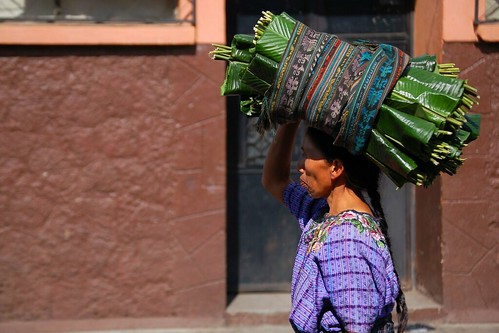
The other, shorter trip I went on was to the small town of Pachalum. This is a town of only about 10,000 people -- except about half of the male population now lives in the greater Newark, NJ region. An interesting place, and one day perhaps the double-top-secret report of the visit there will be declassified, or obtained by the New York Times in a Freedom of Information Act request. I'm sure the loyal readership will manage to wait. In the meantime, enjoy the above picture, taken on a previous trip to Santiago Atitlán, demonstrative of the fact that no matter how long one lives in Guatemala, he may never tire of seeing people carry crazy stuff on their heads.

Sunday, January 28, 2007

Staff Photographer's Wife Actually Better Photographer than Staff Photographer


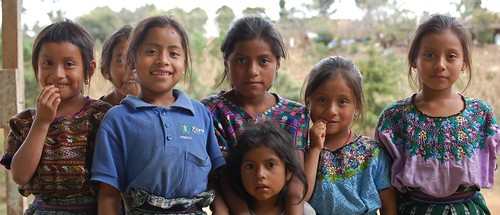
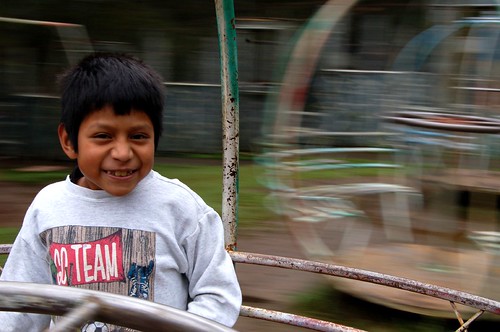
The internationally recruited staff of the Holla is generally proud of the work we produce for the eight or nine people who read our fine publication. But every now and again, we have to give credit where it is due. Such is the case with the above photo, taken not by our snobby staff photographer, but by his wife. The photo editor's wife thought the photo department as a whole was selling itself short, but one can't really argue with results. The Holla staff photographer's wife serves on the board of a non-profit group that built a school (along with a number of other community services) for the girls pictured above. She took this photo during a recent site visit. The Holla thinks it is great, and would encourage readers to click on the picture to see a larger version.

Saturday, January 20, 2007

Big Changes at the Holla


Among other cosmetic changes here at the Holla, we are proud to announce that we actually found the spot where (we think) we can allow comments from readers who do not have a special Blogger log-in. So if any of the two or three readers out there who don't comment already have been aching to "Holla Back," but have been stymied, you might give it another try.

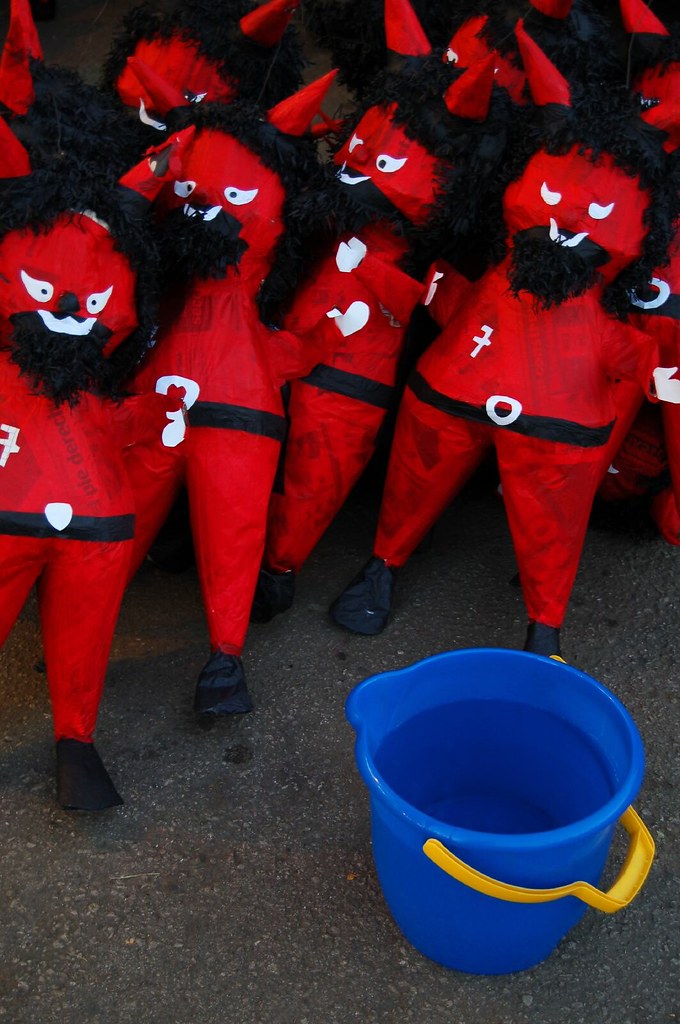
And as a bonus for our readers, here's a photo of the fireworks from the Quema del Diablo. Fireworks season has pretty much come to an end. Christmas eve is the huge fireworks day, way more than Quema del Diablo or New Year's Eve, but we missed our second consecutive Christmas here. The New Year's Eve fireworks were just as raucous as the Quema del Diablo event, if not more so. Supposedly the celebration of the Feast of the Christo Negro (a famous (in Guatemala) image of Christ and supposed site of miracles) in mid-January is the end of fireworks season, but apparently some of our neighbors have a found a few extras lying aroundt the garage.

Friday, January 19, 2007

North of the Border


Originally, we had planned our vacation to be a whirlwind trip to Colorado and Boston for family time, and then just under a week in Panama. As silly as it sounds, we are allowed one trip for "R and R," which involves normal use of vacation time, but the State Department pays for one full-fare ticket for each of us to the nearest point of relief -- i.e. the nearest spot where we could enjoy an American-style standard of living for a little while. So if you're in Cambodia, they'll fly you to Australia. If you're in Africa, it's usually Europe. And for those of us in the less-developed spots of Latin America, we get a free ticket to Miami. Luckily, the key phrase is "full-fare," which means we can get a $900 ticket for the two hour flight to Miami, or use that much money for a flight elsewhere. Thus, we were going to do Guate-Denver-Boston-Panama-Guate and only pay a hundred bucks or so out of pocket.

And then Congress didn't pass the budget on time, which they never have since the days of Martin Van Buren. So, the arcane rules say we had to wait for them to release the December pile of money before we could buy our tickets home. Which meant we had to wait until three weeks before Christmas. The reader will not be shocked to hear that the prices get just a little higher when you wait that late. So we wound up paying just a hundred bucks or so out of pocket just to do the Colorado and Massachusetts legs of the trip, and then went under our own steam to Mexico.

The sliver of Mexico avaliable to us on a seven-day road trip from Guatemala City is not the most developed part of the country. We had ideas in our heads that we might get up early and with a couple long days of driving, go to the Yucatan or Oaxaca, or to see the Olmec remains in Tabasco. But a more realistic schedule limited us to Chiapas. We kept our expectations low -- surely Chiapas would be just like Guatemala, in geography, culture, and amenities.

How wrong we were! Upon crossing the border, the highway was in noticably better shape, cleaner, and (through no fault of the Guatemalans) straighter and flatter, as the sharpest (and prettiest) of the mountain ranges are on the Guatemalan side of the border. On the other hand, the Mexicans realize that you can drive fast on their roads, and have responded in kind with an extremely agressive speed bump program. Any populated stretch of the road -- which can apparently include a random shack five hundred yards off the shoulder -- merits at least two speed bumps, usually so big that even when driving as slow as humanly possible our poor little Nissan was guaranteed to scrape bottom. I'm mostly sure we didn't lose any parts that were actually critical to the operation of the car.

We decided that we couldn't risk hitting an unmarked speed bump at night, so before darkness fell we stopped in Comitán, a surprisingly quaint city celebrating its 500th anniversary. We checked into a charming hotel room, and had a delicious meal of flavorful beer and even more flavorful food. It is an inexplicable tragedy for the people of Guatemala that the cultural meme responsible for mole sauce never managed to permeate the border.

The next day, we decided to take what our bare-bones guidebook (purporting to cover all of Mexico and Central America) promised was a scenic route. The road surely would be lovely when not enveloped in fog. We made it through the sugar-cane fields to Venustiano Carranza, a town claiming to be home of the marimba -- we decided not to mention this boast to anyone in Guatemala lest things get ugly. There were, in fact, quite nice views from the hilltop town. Maybe not really worth going a couple hours out of the way for, but such are the risks the road-tripper takes when allowing the wind to decide his direction. We passed through a couple other modestly interesting towns on the way, including one famous for their handmade giant ceramic chickens. So.

That afternoon, we reached San Cristóbal de las Casas, at the heart of Chiapas. For those who have visited and are familiar with Antigua Guatemala (or just those who have seen pictures of it), San Cristobal (accent to be dispensed with in all further references) is like Antigua if it was still a real operating city rather than a carefully preserved colonial museum. I love Antigua, but it was fantastic to see actual Mexicans walking around the town (even if many of them were also tourists), and to have a selection of interesting bars, many of which happened to have live music on any given evening. In the end The Lovely Katherine and I decided that a large part of this was probably related to the average age of tourists in San Cristobal being about 15 years less than that of the average tourist in Guatemala. And although a distressing number of these young tourists were of the dreadlocks-and-tie-dye variety, we didn't hear any Grateful Dead cover bands, and avoided having any discussions with starry-eyed fellow travelers about the righteous struggle of the Zapatistas against The Man.

As we headed on to Palenque the next day, the full Zapatista scene came into sharper focus. Many towns or even cornfields would be marked with billboards declaring that locale "Zapatista Country." If we weren't more than a little scared of what kind of reaction a couple gringo tourists stopping to snap pictures would elicit, the staff photographer would have loved to snap some pictures of one local schoolhouse that was painted in a vibrant mural showing Subcomandante Marcos carrying AK-47s under rainbows and smiley-face suns. (There is a photo of one of the signs, but alas not the mural, on the Wikipedia page on the Zapatistas - scroll down a bit.)

Along the way, we stopped at the Mayan ruin of Toniná, which is not one of the more famous ruins, but was actually lovely. It is built on a hill, so from the temples at the top, the views are fantastic. And there was very little tourist hub-bub about, as it's a little off the beaten path. We arrived after dark in the town of Palenque, which basically came into being to cater to the tourist needs of visitors to the more famous Mayan ruins of the same name, and it looks the part. It did have plenty of opportunities to buy bootleg movies, or t-shirts with pictures of Mayan temples on them. But it's not all bad, as they did have Mexican beer, good Tequila, and spicy food, so we couldn't complain too much.

The ruins at Palenque are a fairly compact site, at least when compared with Tikal. The big attraction is some of the relatively well-preserved murals, showing various Mayans alternately worshipping or beheading other Mayans. We have no photographic evidence of this, as the staff photographer found the colorful lichens to be more photogenic. Many tourists did seem to want to take videos of the temple carvings, which your correspondent found a little odd, but probably not as odd as they thought him for taking pictures of mold (which didn't turn out that well in the end, anyway). More annoying however, and in sharp contrast with policies at Tikal and Copán, was the ubiquity of tchotchke vendors within the borders of the park. Every pathway up to a temple was lined with blankets on each side selling replica masks or cheap paintings approximating Mayan calendars. It made it significantly harder to get any feeling of the history of the place when you were mostly trying to get away from the mob long enough to breathe. Eventually we got away from the worst of the crowd, enjoyed the historic site, and then started heading back to San Cristobal, which is when your correspondent fell victim to his morning's breakfast.

Your faithful reporter has been in Guatemala for a year and a half now, and has never felt more than mild discomfort as a result of the local cuisine, even when buying food off the street or eating in the dirt-floored homes of the local population. And yet something in the cleaner, more developed environs of Mexico didn't agree with me, and after four hours of valiant struggle on windy roads, I lost it at the roadside with San Cristobal in sight. Montezuma, on the behalf of all people of European stock, I apologize!

Given my delicate state, we decided to check into a slightly swankier hotel for our second engagement in San Cristobal, in case we wound up spending more time in the room than we had hoped. We stayed in a historic building on the main square. The quite ridiculous amount of noise that came with a room facing the main square was surprisingly not much of an obstacle in getting to sleep. Feeling mostly better the next day, we took a boat trip on the river through the Sumidero Canyon, got up close and personal with some crocodiles, and then spent an hour driving around Tuxla-Gutierrez trying to find the road to see it from the top of the canyon without success.

For our last day in the area, we did a quick spin through one of the many small villages outside San Cristobal that are still populated by indigenous groups that maintain many of the traditions of their ancestors from the era when the Spanish arrived. We were there for the annual festival in Zincantán, which was not a ferris wheels-and-midway games kind of festival, but a more traditional gathering on the square in front of the church. Many of the men were dressed in elaborate costumes, with straw hats flowing with colored ribbons and brightly colored robes covering the embroidered tunics that all the men wore. They looked on at some sort of play: Two men, wearing bright red masks and carrying/riding what one could only call ceremonial hobby horses had an elaborate and muffled conversation (in between pulls off the bottle) with two men dressed in white sheets that I took to approximate womens' garb. Another man had a large wicker tent with a (also wicker) cow's head on one end, playing the part of the livestock. They brought a series of carved idols of San Lorenzo of Zincantán out of the church and from across the square, took turns being blessed, and then the whole group decamped to a nearby streetcorner where the next act of the play took place, involving a very acrobatic dance by the gentleman playing the cow. It was fascinating, and the costumes were gorgeous. The staff photographer had sadly (or nobly) made a pledge to his traveling companion not to even get out his camera out of respect for the Zincantans, who aren't much for photography. It was with a mixture of pride and deep regret that he mustered the will to honor this pledge during the colorful and picturesque ceremony.

All that remained after that day were final efforts to cram as many delicious tacos, Bohemia beers, and shots of Don Julio down our mouths as we could before returning to the culinary boredom and work-related travails of Guatemala. I can only assure you we did our able best.

Thursday, January 18, 2007

Eatin' Good

I broke a personal pledge to myself yesterday. For 18 months, I have carefully avoided going to American chain restaurants, because I figure that as long as I'm here, I might as well eat at the Guatemalan and/or Mexican chain restaurants. So after some time of avoiding Chili's and TGI Friday's, I had a business lunch the other day where the Guatemalans we were meeting wanted to eat at Applebee's. Applebee's opened here sometime last year, and the bankers we were meeting with seem to love it: "It's just like Friday's, but a lot less crowded!" I don't think I ever ate at an Applebee's in the U.S., so I don't know what their design scheme is, but in the one in Guatemala, all the walls are lined with celebrity head shots. Not that they're trying to fool anyone into thinking that Leonardo DiCaprio and Madonna have stopped by for cheese sticks at the Guate Applebee's, I think they just decided it made the place feel more "American." Or something. I was almost convinced I was back home until the chicken-sandwich-and-fries lunch was followed with complimentary coffee and flan.

Sunday, January 14, 2007

Investigative Journalism


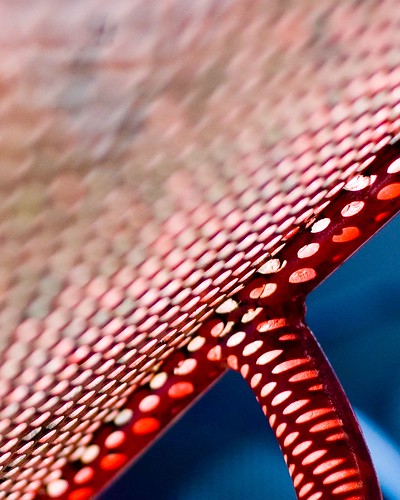
The reputation of the Holla is quickly spreading. While on my way to buy milk this morning, the staff photographer made a quick detour to snap some shots of the red, yellow, and blue seating area at the nearest American Doughnuts location. The results were fair at best. The staff photog is now well accustomed to getting odd looks when he takes pictures, as the idea that you might use a camera for more than family snapshots is a bit foreign to many Guatemalans. On this particular morning, the sole employee of the doughnut shop stared curiously for some time, as she set up the morning's doughnuts. Just as the photographer was packing the camera up again, the employee recognized her responsibility to the store, and confronted him. "Are you with the press?" she demanded. He contemplated for a moment, but in the end admitted to himself that the Holla is more of a literary journal than a bona fide organ of investigative inquiry, and attempted to explain to her that he just thought the light on the colorfully painted metal tables might make nice artistic pictures. She looked confused, and repeated everything back -- "Not with the press, huh?" "Artistic pictures, huh?" She seemed genuinely concerned that there was going to be a damaging exposé in the paper on how badly the chairs at American Doughnuts in Zone 13 need to be repainted. Fortunately, the staff photographer convinced her that these pictures were not for publication. So, if you happen to run into her, please don't mention that you saw the above photo in this internationally recognized journal.

Monday, January 08, 2007

Pure Cream

As Americans go, I'm not entirely hopeless with respect to soccer. As a participant, I enjoyed years of childhood rec leagues and college intra-murals, and have made the occasional effort in Guatemala to particiapate in the local sport. As a spectator, I love the World Cup, and am generally conversant in the more important teams that are always playing for whatevery Lesser Cup they're contesting this week. I know the names of a handful of the world's most famous players, as well as most of the guys on US National Team. At the very least, I'm not one of those people who thinks soccer is a terrible bore because they don't keep changing the rules to make sure they score ten goals a game.

That said, I can't figure Latin American soccer at all. First of all, in Guatemala, they play two seasons a year -- the "apertura" and the "clausura." So each year, two different teams are the "champions." They never play each other to see who's the real champion of the year, theyjust settle for two "champions" each year. And they're ok with this. They just act like both of the teams that win are actually champions, like there was nothing cheap about it all. Having one champion each year is, I suppose, arbitrary, but humankind has divided time by years since some time before the invention of soccer. If you're going with two "champions" a year, why not five? Why not have a different "champion" based on who was ahead at halftime and who won the second half of each game? And on top of having two champions a year, there are a mystifying array of other cups and international club tournaments in addition that I haven't even begun to sort out.

Anyway, not to make it seem less important than it was, but I went to the second leg of the home-and-away Guatemalan National League "Championship" just before departing for Christmas. In Guatemala, there are two teams from Guatemala City -- Municipal and Comunicaciones -- and then ten other teams that rarely, if ever, muster the resources to compete with the big guys. Perhaps because "Municipal" and "Comunicaciones" are a bit unweildy to work into a cheer, the teams are mostly known by their colors; Municipal are the Rojos and Comunicaciones are the Cremas. (The Rojos' mascot is a little devil, while the Cremas' is - no joke - Casper the Friendly Ghost.) When these two play, it is officially called a clasico, even if the game sucks, and when the championship is between the two -- a Classic Championship -- the passion of the city's fans hits a fever pitch.

While each team has their own stadium, when they play in a title game, they play both the home and away games in the larger national stadium. For some reason, it was literally impossible to buy tickets in advance, and we figured that for such a monumental event, we would need to get there early to get a spot in the ticket queue. We arrived at 8:30 for a 12:00 game, walked up, bought tickets, and entered the nearly empty stadium. Apparently the Guatemalan passion for soccer was overmatched by the Guatemalan desire to sleep in on a Sunday. And, much to our dismay, we were informed that nobody would be selling anything to drink in the stadium, and that we couldn't re-enter if we left. With a little sweet-talking, we convinced one guard that this policy was absurd (when applied to us), and he took our names and agreed to let us back in later. We found, among many, the sincerest taco stand outside the stadium, ordered too many tacos, and in a internationally understood pre-game tradition I haven't participated in for years, started drinking beer at 8:30 in the morning.

At the designated hour we re-entered the stadium, prepared with sufficient reinforcements to make sure we stayed in 'game shape' for the duration. The rojo and crema fans were spearated from the field and from each other by twenty feet of cyclone fence and barbed wire. The Cremas had the best regular season record, so they were nominally the home team for the second game, which meant their fans also got the center-field seats. The fans from each side chanted and sang and generally made American sports crowds look a bit reserved. Most charming were the family cheers, such as the entire crowd of one team's fans, when the other team took the field, chanting in unison a swear word whose translation in English is probably the foulest word you care to think of. During the game itself, when someone would commit a hard foul, the crowd would chant a particularly foul Spanish phrase, that in English translates as the comparatively benign "Son of a whore! Son of a whore!"

The game was fair. Not particularly well-played, but close throughout. The home team led after a first-half goal, and after a scoreless tie in the first leg, would win the championship if they held on. Of course, they gave up a soft second-half goal and regulation time ended in a tie. Tied! After two games of championship soccer between the two most storied franchises in Guatemalan soccer! What drama would await in extra time? A sudden-death winner? Penalty kicks? A punishing full-time extra period?

Actually, none of the above. Guatemala is surely -- one hopes -- the only league in the world that decides the grand final league championship on the basis of away goals. (Meaning if the total score added up between the home and away games was a tie, whichever team scored more goals on the opposing team's field wins. So after a 0-0 tie and a 1-1 tie, both on the same field, they awarded the team that happened to tie 1-1 in their "away" game the championship.) The rojo fans went crazy, and there was a trophy ceremony immediately. The crema fans stared in disbelief. We were annoyed, we commiserated with nearby crema fans, and then realized that exactly at the moment of the ending gun of the game, they were allowed to sell beer in the stadium, an opportunity many enterprising vendors helped us enjoy.

We sat around and drank beer until we were the last fans in the stadium, at which point your ever-probing correspondent decided to check out if the "emergency exit" through the fence was actually padlocked, or if one could get through in the case of a fire. In a surprise, you actually could unlatch and open the gate, and with no more security around, we let ourselves onto the field while clean-up crews took down the loudspeakers and advertising banners and such. We asked permission from everyone we could, and nobody seemed to have a problem with us going on the pitch of the National Stadium of Guatemala. Not exactly Old Trafford, but still pretty cool. We went into the administration office and asked to borrow a soccer ball, but they didn't have one. We asked all the cleaning crews and trainers and such. No luck. The National Soccer Stadium of Guatemala! And nary a soccer ball to be had! Tragedy! We settled for taking some shots on goal with an empty water bottle. After a morning of drinking and sitting in the sun, it seemed amusing enough at the time. We surely looked like full-on retards to the straggling clean-up crew, but it was worth it.

And after all this, we had no choice but to go to the home of our friend with the biggest TV and continue the day watching American football, until I fell asleep, lobster-red from the sun and completely hung over at 8:00 in the evening. It was a hard day, but one I was willing to put in for the sake of the international unifying power of sport.

Sunday, January 07, 2007

Keeping the Home Fires Burning


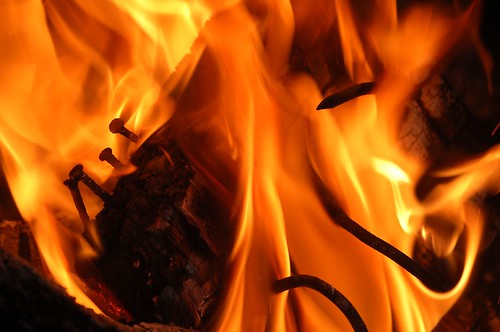
Hello, faithful readers. The Holla offices are ready to start humming again after the staff spent the holidays in various ports of call such as Colorado, Boston, and Chiapas. We'll be back soon with stories sure to thrill and amaze on topics ranging from championship soccer to Subcomandante Marcos. For now, enjoy this picture from the trip described in the previous post.

Saturday, December 16, 2006

Tactics for Tactic


Joe, one of my esteemed predecessors in the Consular Section, sent a seemingly cryptic e-mail a month or so ago. He had served in the Peace Corps in Guatemala many years prior to joining the Foreign Service and returning here as a Vice Consul and Third Secretary. He is now on his second tour, in Lithuania. He sent an e-mail to my boss in Guatemala, which she forwarded to the entire section, seeking a volunteer to go to the small town where he had lived in his Peace Corps days to drop off a Christmas present for the family he had stayed with. And he noted that if the volunteer should go on the right weekend, they might witness the "Bolas de Fuego, a celebration that involves the locals throwing fireballs at one another. " Many of my colleagues inexplicably shied away from this opportunity for cultural exploration, but your intrepid correspondent stepped up.

Tactic (pronounced "Tahk-teek," not "Tack-tick") is actually a decent-sized town as these things go in Guatemala. Nobody seems to know with any certainty how many people live there, but I would guess something like 12,000 or 15,000 (the only estimate I found on the web says 27,000, but that's got to include a healthy slice of the outlying area). We arrived on Friday afternoon and met our host, Naldo (short for Reginaldo), on the main square, and he directed us a few blocks to the family home. We were welcomed by Doña Rosa, the matriarch of the family who could understand spoken Spanish but could only speak Pokomchí herself (see #49 on this map). We sat in her kitchen, and she served us each a mug of coffee from the pot that seemed to have its own dedicated 50-gallon-drum-cum-cookstove, one of two in the kitchen. A variety of Naldo's brothers and sisters and children came and went, stopping by to chat and breath in the wood smoke and then filter back to the room with the TV (which we were never invited to watch).

The hospitality that the family showed us was literally embarrassing. Most readers are probably familiar with circumstances where one puts forth obligatory protestations over a host's generosity. But this was a case where we actually felt bad about the kindness of this family that probably earns in a month, with four brothers working, what I earn in a week. They emptied out a room with three beds in it so that we could have a room to ourselves -- we protested, but never found out for sure where all those displaced people slept. They served us a delicious chicken dinner, although I would guess that serving meat was a fairly expensive proposition for them. They served us spaghetti and tomato sauce for breakfast the next morning, which was an unusual but tasty. They tricked us into staying for lunch even though we said we were going to leave, serving soup with potatoes, veggies, and a big chunk o' meat. (As an aside, this was the only meal that involved us having to force ourselves to eat really undesirable food in order to avoid causing offense, as the meat was shoe-leather tough and generally not very appetizing. I ate one-and-a-half servings. It could have been a lot worse.) They helped us feel at home by digging out the CD of "English music" that Joe had left them, full of sixties girl-group classics, even though we said we were fine with marimba.

Sitting in the kitchen and chatting was a little odd, because what did we really have to talk about? But we muddled through. The kitchen was constantly filled with fumes from the two oil-drum cookstoves. There wasn't really a door on it -- just a hand-made wooden gate opening onto an open-air entryway where the two dogs ("Escooby" and "Seca" (also known as "Joe's daughter-in-law")), two cats (both apparently named "Negro" by default), chickens and ducks made their homes. The primary entertainment was the constant efforts of the ducklings to sneak through the gate into the kitchen to look for crumbs and enjoy the warmth for some indeterminate amount of time before Doña Rosa would decide "enough" and pick up her duck-chasing stick, shooing them out of the kitchen again while saying "Psssshhhhhhhhhhhhh!" Coffee was served at every moment anyone was sitting in the kitchen -- even the three-year-old girl had a breakfast of white bread dipped in hot coffee -- in part because it is quite often very chilly in Tactic, and also because you have to boil the water anyway so why not throw in some flavor?

We discussed the main event of the evening a bit, and many of our hosts were not really thrilled about going. "I don't usually go -- it scares me," said Naldo. But duty called and we went to see it, and he and young Eber felt equally duty-bound to accompany us. We stood on the main square in the drizzle for a bit. A small crowd was hanging around in little pockets on the square and around its periphery. Peppy live music blasted out of the evangelical church on one side of the square. We admired the mini-version of the Gallo Beer Christmas Tree in the square, and the Lovely Katherine chatted with Eber about school while I chatted with Naldo about his work repairing shoes. Eventually, a fiery glow emerged from one of the side streets, and a bunch of youngsters showed up with a coffee can full of flames. Other youngsters ran to the non-operational fountain in the square and soaked their jeans and gloves in the stagnant water to prepare for battle. One of the kids lit up a canteloupe-sized ball, made of rags wrapped in twine or wire or some such, and soaked in kerosene or similar. He threw it at another of the kids; it hit him and bounced to the ground, at which point a scrum developed around the ball and they all tried to kick it, but it soon flickered and went out in the damp conditions.

At that point I realized that I had somehow projected onto Joe's invitation the assumption that this annual tradition must entail some community pride, some pomp and circumstance, some official speech by the chairman of the planning committee that it was great to be able to celebrate the Bolas de Fuego for another year. Instead, it was more like the American "tradition" of young hooligans throwing eggs at cars on Halloween than it was like a sanctioned town fair. The entire event consisted of teenage boys throwing flaming rags at one another, and at bystanders who for some reason gathered nearby to make targets of themselves. In fact, it was exactly as Joe had described it, nothing more, nothing less.

I quit thinking about that when the young toughs decided that Mr. Gringo-with-an-expensive-camera looked like a particulary good target. We had a couple fireballs tossed in our direction, but then again, so did a lot of people, so maybe we were just paranoid. Whatever the reality of the situation, which the Lovely Katherine described to our other friends as "maybe the first time I have ever been literally weak-kneed with fear," we decided to decamp to Foto Lydia, the portrait studio near the square where one of Naldo's brothers works. This didn't remove us entirely from danger, as the young flamethrowers kept throwing fireballs wherever they saw people, to the point where they even threw a fireball into the door Foto Lydia, but the ubiquitous cinder-block construction provided fireproof cover. The drizzly conditions helped snuff out most of the fireballs before they could do to much damage, and somehow we didn't see anyone sustain any injuries -- which apparently is not the case every year.

The next morning we walked with Naldo and three-year-old (or so) Rubi up to the church on top of one of the hills in town, which afforded nice views for what one could see under the clouds; and then went with Naldo, Eber, and Rubi to the local park and zoo. It's sort of weird that such a small town has a zoo, but it did, with one row of various pheasants and peacocks and such, plus some spider monkeys, crocodiles, and rabbits. We rode the merry-go-round with Eber until we were sick. It was both a shame and a relief to bid an mid-day farewell to the family on Saturday and head on to see the orchid nursery in Cobáan. It was really exhausting making friends with people from a background so different from ours, but a fascinating and much appeciated weekend none-the-less.

Photos coming soon, but maybe not until after we get back from Xmas. And the photo department doesn't think any of the pictures of the bolas de fuego are worthy of publication, but we'll see

Friday, December 15, 2006

Beat the Devil


Being American or from Protestant stock or generally unbothered by religion, I had no idea that there actually is an official start of the Christmas Season. Apparently December 8 is the day of the Immaculate Conception, which leaves only 17 days until Christmas Day. I'm not sure if that's in the Bible or if it was just established by some papal bull or the Knights Templar or whoever makes such decisions, but it seems to imply less of an Immaculate Conception and more of an Immaculate Nearly-Full-Term-Baby-Jesus-Insertion. In any case, as in America, the Christmas trees and the carols playing in the grocery store and such have been going on for a while, but the religious celebrations just started last week. Apparently there are ceremonies of some sort where they cart around Joseph and Mary sculptures in a symbolic search for an inn every night for the next week.

Before all the Christmassing gets started, there's a final blowout, not unlike Mardi Gras, except that after the blowout, no fasting is required. In Guatemala, December 7th is the Quema del Diablo, or Burning of the Devil. The idea is sort of that one removes all the malign spirits from one's house through the symbolic ritual of dumping any trash or other unwanted possessions on the street and setting them ablaze. In many neighborhoods and towns, this tradition is pretty much unchanged, and the local news (immediately preceding my interview, in fact) had a lengthy story about how it really isn't good for anyone's lungs to burn unwanted tires, even if they do provide hours worth of incendiary entertainment.

In the posh neighborhood full of doctors and construction magnates and foreign diplomats, there aren't many tires being burned anymore. Making the holiday somewhat more literal and yet less practical, many now celebrate by purchasing a papier-mâché devil and burning that instead of a pile of garbage. The child labor force of Guatemala must be working serious overtime in November, because on December 7th, all variety of fireworks stands and mock devil outlets suddenly appear, offering diablos from the small and economical to larger-than-life-size. Ideally, the devil is stuffed with firecrackers, piñata-style. At dusk, the devils are burned, and fireworks are set off all over town. We could see fireworks in every direction, going up right behind our building, in the yards our balcony overlooks, and dangerously close to a building up the block. Any José with a few bucks in his pocket can buy the kind of fireworks in Guatemala City that Americans can only get in Wyoming. I'm not sure if the Fourth of July used to have the thrilling 360-degree spectacles of neighbors in every direction shooting off huge fireballs. But I assume we banned these things for a reason, and I hesitate to guess how many Guatemalans lost fingers last Thursday. Our whole neighborhood smelled of burnt gunpowder and whatever other toxic substance they use to make sparks green or orange.

If you've ever wondered what you're missing by not living in Guatemala, you should know that The Lovely Katherine declared Quema del Diablo the best holiday in the world. That might be putting it a little strongly, but it does have a freewheeling spirit that American holidays maybe once had, but no longer do.

Tuesday, December 12, 2006

Watch This Space


We were on a bit of a dry spell there in terms of events with any reader appeal in Guatemala. But the last week was full to bursting with newsworthy tidbits, often involving pyrotechnic derring-do and ridiculous risks to life and limb. So clear your calendar for some exciting posts to come as soon as the editorial staff gets time to get this edge-of-your-seat stuff ready for publication. Or, at least, as ready for publication as we bother to get anything.

In the meantime, trip out to this picture the staff photographer took of the lights on the balcony above ours.

Thursday, December 07, 2006

King of All Media


It was a little while in coming, but the media titans of Guatemala finally realized that my dashing good looks were being wasted on radio interviews. So I finally got my big break, interviewed for a television piece about how if you want a visa to go see Tia Marta in California for Christmas, you need to schedule an appointment now. (Or more accurately, two weeks ago.) It was short and to the point, and I managed to not sound like any more of an idiot in Spanish than I probably would have in English. I don't know what happened to my collar, it was straight when I looked in the mirror and checked my teeth for spinach just before the interview.

The night they said they were going to air the interview, they didn't, and I was a bit worried that they realized how boring talking about visas is. But they claimed that they wanted to maximize the audience for it so they showed it morning, noon and evening newscasts over the last day. Somehow, they managed to squeeze in three minutes of me into the other 57 minutes where they exclusively discuss murders, disappearances, grisly fires at illegal child-labor fireworks factories, and sports.