
If you thought that we could sink no lower after joining the ranks of SUV owners, think again.
There are certain hardships involved with living far away from one's family, in a strange culture, in a city with a crime rate so high that it makes Detroit look like Dekatur. But when one's cheif complaint about his living situation is that the apartment is so big he can't keep up with sweeping the floors, one can't help but start counting the days until he fully embodies the charicature of the pampered ex-patriate sipping cocktails and complaining about how hard it is to find good help.
To ease the terrible burden of sweeping our own gargantuan apartment (or more accurately, the burden of walking around with blackened feet because we haven't bothered to sweep the layer of settled diesel particulate and volcanic ash off our floor in a week (and further to avoid looking at the grime on our feet and thinking about how that stuff winds up on our floor because it's so prevalent in the air we breathe every day)), we hired a maid. Sylvia comes by once a week, and we pay her a ridiculously small amount to spend a whole day cleaning our kitchens and watering our plants, doing laundry and breathing the toxic fumes of the solvents used to clean a whole bottle of purple nail polish (not mine) off the bathroom floor. And yet if you told the Guatemalan families who live above and below us what we pay Sylvia, they would either pity us for getting suckered into such a terrible deal, or scorn us for driving up wages for the whole neighborhood. Or both. Not unlike the SUV, we wound up hiring Sylvia because one of our colleagues who had formerly employed her was departing. He recommended her highly and we almost felt responsible for what would happen to her without income every Tuesday, and there was that quarter inch of soot lining every flat surface in our apartment, so you can see we really had no choice.
I think we were the only couple in the entire Embassy that didn't have a maid yet. Some families with small children have a full-time nanny plus a maid and maybe a gardener, as well. In fact, fairly often someone either from the embassy or the outside world would want to come by to do some maintenance on the apartment, and ask when someone would be around to let them in. We would reply that we both work, and can't take time off to come hang out and wait for the cable guy, to which they would explain, "You don't have to be there, the maid can let us in." When we revealed that we didn't have a maid, we would get a look of confusion, and then the service provider would just give up, which is why we've been "borrowing" wireless internet from the neighbors for longer than I should probably admit in this public forum.
Now we've had a one-day-a-week maid for several weeks. It does feel like we're living someone else's life. At first, it grated on our American sense of rugged individualism and our distrust of snobbery and noblesse oblige and the Coastal Liberal Elites Who Are Tearing Our Country Away from the Heartland Values that Made Us Great. But it is effing awesome to come home on Tuesdays and have the house spotless and the laundry folded and the dishes done. And to spend all those hours that could have been wasted on sweeping instead on composing a thousand-word blog entry about not sweeping, or other such productive pursuits.
It is, at times, a little weird to find all of the pants, both male and female, mixed in one stack on the Lovely Katherine's side of the closet; or that rather than our fluffy neutral-colored bath towels, the bathroom has been restocked with ratty rainbow-colored beach towels and a golf towel that says "Fox Hill Country Club;" or that we're still not sure where she decided the measuring cups are stored, so your correspondent just figures a coffee mug must be about one cup and wings it at least until we hire a cook. But do not misconstrue such notes as greivances. At least in your correspondent's mind, he has not yet crossed the at-least-internally-important line between hiring help and complaining about it -- I figure we have to maintain some milestones for the second year of our descent.
Saturday, July 29, 2006


Wednesday, July 12, 2006
Another boring church

The facade of the church in San Andres Xecul, a small town outside of Quetzaltenango. Fortunately there wasn't direct sunlight on it or our eyes might have been permanently damaged.
Tuesday, July 11, 2006
A Superhero for Our Times

Enemies of fried food beware -- Super Pollo is packing a machete! Once he works out the opposable thumb, you're in real trouble!
Thursday, July 06, 2006
On the Road Again
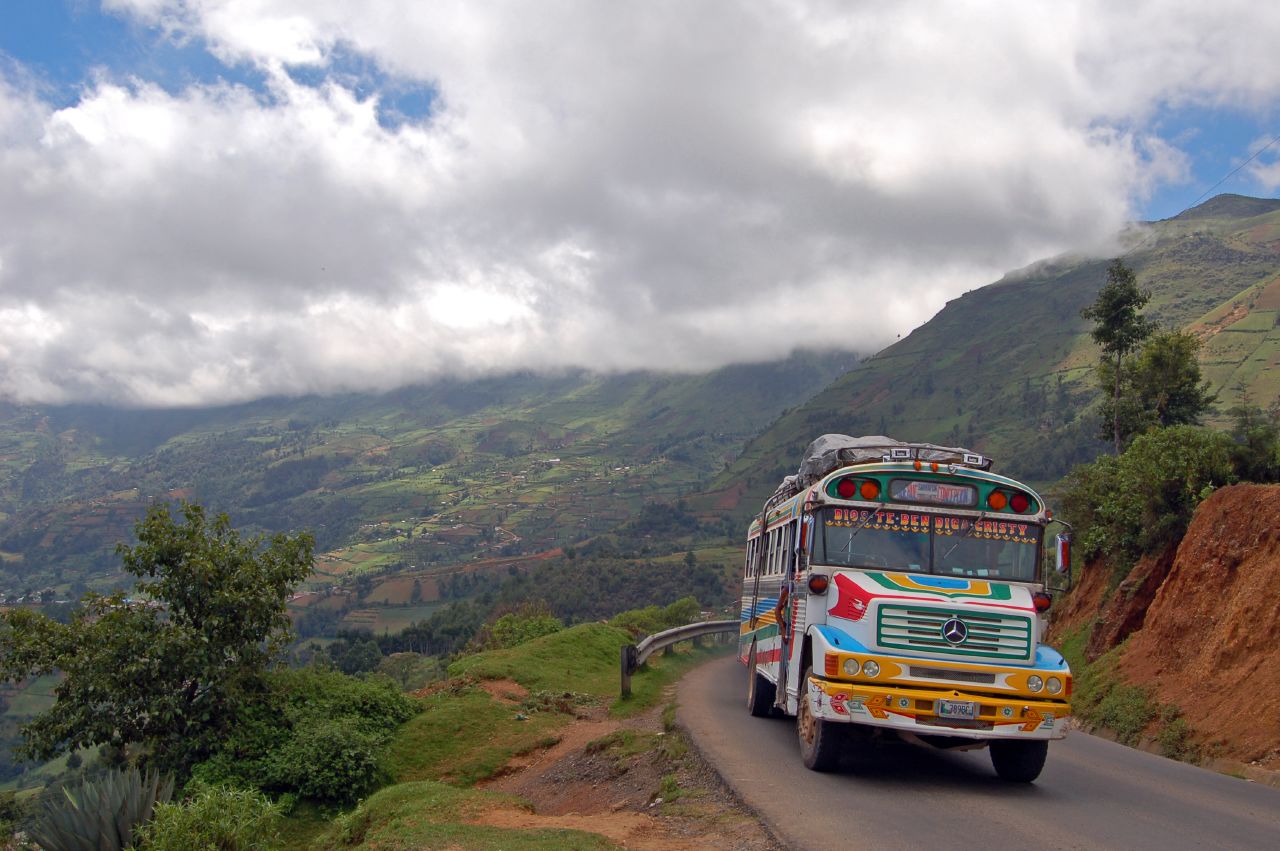
We enjoyed a cleverly constructed almost-four-day weekend a few days ago. Friday, June 30 was Army Day or War Day or Tank Day or something. On Thursday, the American People needed me in Sololá, near Lake Atitlán, a couple hours away from Guatemala City. So, I went and conducted the business I had at the Sololá jail (which, like most modern prisons, is practically indistinguishable from a country club) on Thursday morning and then took the afternoon off.
Equipped, as we were, with our new and insufficiently tested mini-SUV, we declared, "Screw the rain and the mudslides." The Highlands were calling our names. We checked to make sure none of the roads we were planning to travel were closed at the particular moment, and after a stroll through Sololá, continued West to Quetzaltenango.
Quetzaltenango, also known as Xela, is Guatemala's second city. It's a fair sight nicer than Guatemala City, with an actual Indian restaurant and an attractive downtown. We enjoyed a quick meal and then headed for Zunil, a small town that's supposed to have a pretty church and their own version of the local idol Maximón. As we passed through Almolonga, another tiny town on the way, we spied ferris wheels over the rooftops, and screeched to a halt to check it out. It must have been the town's annual fair, as the streets were packed with midway games and amusement park rides. We saw a dance performance featuring costumed characters, a performance by Guatemala's most famous modern marimba band, and the candle- and neon-lit church. We also played a quick couple games of Lotería, a bingo game for players of all education levels that uses pictures instead of letters and numbers on the grid. The Lovely Katherine, being a master of all bingo-related games, promptly won the second game. She was awarded a prize of five drinking glasses decorated with a daffodil pattern. She denied that she had attempted to throw the game, and passed on her prize to a young volunteer who had aided her in avoiding some obvious strategic blunders when her victory drew near.
The next day we enjoyed a luxurious breakfast in an almost American-quality coffee shop, and then plotted a course through Huehuetenango for Todos Santos Cuchumatan. Todos Santos is on the far side of a precipitous climb up the mountainside from Huehue, and then a dirt road back down the other side. It is a tiny town in a gorgeous valley, and draws a modest but disproportionate number of tourists because the men as well as the women still dress in their traditional colorful garb. The place couldn't have been more picturesque, nor the residents more tired of having their picture taken. One highlight was a dinner in a tiny comedor, where we ate fried chicken and were joined at the dinner table by one of the main course's survivors.
The weekend had been a smashing success, and wasn't over yet. We went back south along the highway and then turned east to climb another pretty mountain ridge and arrive in Momostenango, which we selected because they supposedly make the finest blankets in Guatemala, and it's a funny place name, to boot. We pulled into Momostenango at about 3:00 on Saturday. At about 3:15, we decided to spend another evening in Xela, and then back to Guatemala the next day, figuring that having a fantastic time at two of our three intended destinations would have to be enough for one trip.
[Photo department note: Due to the new camera, the photo department is taking more pictures than ever, and spending more time than ever trying to edit them. These photos were grabbed for the purpose of illustration, actually carefully selected photos coming soon.]
Tuesday, July 04, 2006
In which we surrender
The Lovely Katherine and your correspondent have a long-running disagreement as to whether we live in "the suburbs" or not. In a political sense, we live well within the boundaries of Guatemala City. In an aesthetic sense, there's not much in terms of street-level retail, pedestrian infrastructure, or other markers of true urban living in our neighborhood. In a criminal sense, some not-too-distant neighbors were recently followed into their garage by armed goons and tied up while their jewelry and electronics were stolen, which seems pretty urban to me. (Note to worried relatives: we live in an apartment building with security features that would make such a robbery attempt much more difficult, and thus extraordinarily rare.) In the end, it doesn't matter whether we classify as "suburban" or not, and I keep up the semantic fight just because my inner urban hipster is screaming about the implications of living in the suburbs: that we're old and have had all our rough edges sanded off.
But it's impossible to fight the facts any more. Katherine works at a school a few miles north of the city proper (but decidedly not suburban), and the last bit of her daily commute is on a dirt road that gets pretty treacherous during the rainy season. We also do a fair amount of bumping around the precipitous, unmarked speed bumps and domestic-appliance-sized potholes of Guatemala's highways and small towns. Which is all rationalization, powerless to stop the pure cold facts of our yuppie-dom:
We bought an SUV.
It's a small SUV, but an SUV nonetheless. A departing embassy employee was trying to unload his Kia Sportage before moving back to DC. The car does not meet US emissions standards (and also has windows tinted well past what seems reasonable, but I'm not sure if they would be technically street-legal in the US or not), so keeping it wasn't an option for him, and he was in a mood to sell. I don't suffer any illusions that a Kia Sportage is a particularly manly SUV (especially if you pronounce it in the French manner - "sport-AAAHJ"), it just seemed like a smart purchase in terms of safety. Of course, I'm sure that's just what you would hear from my SUV owning brethren, cruising the highways of America in their Expeditions and Yukons and Hummers.
But it's impossible to fight the facts any more. Katherine works at a school a few miles north of the city proper (but decidedly not suburban), and the last bit of her daily commute is on a dirt road that gets pretty treacherous during the rainy season. We also do a fair amount of bumping around the precipitous, unmarked speed bumps and domestic-appliance-sized potholes of Guatemala's highways and small towns. Which is all rationalization, powerless to stop the pure cold facts of our yuppie-dom:
We bought an SUV.
It's a small SUV, but an SUV nonetheless. A departing embassy employee was trying to unload his Kia Sportage before moving back to DC. The car does not meet US emissions standards (and also has windows tinted well past what seems reasonable, but I'm not sure if they would be technically street-legal in the US or not), so keeping it wasn't an option for him, and he was in a mood to sell. I don't suffer any illusions that a Kia Sportage is a particularly manly SUV (especially if you pronounce it in the French manner - "sport-AAAHJ"), it just seemed like a smart purchase in terms of safety. Of course, I'm sure that's just what you would hear from my SUV owning brethren, cruising the highways of America in their Expeditions and Yukons and Hummers.
Saturday, June 17, 2006
Trapped in Guate
Our normally frenetic pace of Central American exploration has ground to a halt of late. In part, we've seen everything that's easy to see on a two-day weekend trip. But return visits or slightly more ambitious expeditions have been stymied by harsh reminders that we are in the developing world. Most of the major roads out of town have suffered either derrumbes (landslides onto and blocking the road) or hundimientos (landslides out from under the road, often taking a good chunk of the road with it).
Tropical Storm Stan (also alternately known as Hurricane Stan, because it sounds better though it may or may not be technically accurate) caused many of these roads to wash out, and the Guatemalans responded with an aggressive chewing-gum-and-duct-tape campaign to patch the roads up. Being fair, there's just no money in the coffer to do much else. Be that as it may, it's not surprising that one month of the six-month-long rainy season has already washed away most of their jury-rigged repairs so much as it's surprising that the repairs lasted this long to begin with.
In any case, there is still plenty to be seen, we'll just have to refocus our efforts on the pleasures of the more immediate region.
Tropical Storm Stan (also alternately known as Hurricane Stan, because it sounds better though it may or may not be technically accurate) caused many of these roads to wash out, and the Guatemalans responded with an aggressive chewing-gum-and-duct-tape campaign to patch the roads up. Being fair, there's just no money in the coffer to do much else. Be that as it may, it's not surprising that one month of the six-month-long rainy season has already washed away most of their jury-rigged repairs so much as it's surprising that the repairs lasted this long to begin with.
In any case, there is still plenty to be seen, we'll just have to refocus our efforts on the pleasures of the more immediate region.
Wednesday, June 14, 2006
Big ups to the family
About six weeks ago, I gave up on the visa interviewing bit. Or rather, I rotated into the American Citizen Services section. "What the hell does that mean?" I can hear you asking. Mostly it means that instead of doing interviews to see if Guatemalans qualify for visas, I do interviews to see if purported Americans qualify for passports. This breaks into three types of interviews:
1. Obvious gringos who got pickpocketed or robbed while on vacation, and need a new passport to get home. These interviews are easy and boring.
2. Ex-pats who may look like gringos or may be of mostly Guatemalan blood in for routine renewals. These interviews are easy and boring.
3. Kids ranging from age two to age eighteen claiming that they were born in the US when their parents were there illegally, and then they were sent off to live with Grandma in Guatemala when they were a few months old and now they want a US passport for the first time. These interviews are nearly impossible.
The other part of the job is being on call at all hours in case any American is arrested, hospitalized, victimized, or killed. The two big cases I've had to work on so far have been gentlemen with various forms of mental illness who have been living on the streets of Guatemala for an unknown period of time, and now need help getting back to the US.
(Little known fact for US Citizen readers: if you are destitute in a foreign country, your government will pay to send you home. Until doing the training for consular work, it never would have occurred to me if I completely ran out of money to go to the Embassy and ask for a ticket home. A lot of folks apparently have no such mental barriers, and come in asking for money until they realize that we're going to call their mommy first, then loan them money and cancel their passport for further adventures.)
These gentlemen were true hard-luck cases, and the worst part was that they had nobody in the world who would help them. We contacted each of their parents, none of whom were willing to provide any assistance in bringing their kids home. I guess I was hoping for a somewhat higher level of diplomacy then trying to get mom and son to patch things up when I signed up for this gig. Anyway, a big thanks to all the folks back home who would spot me airfare to get home if I fell and hit my head on the sidewalk in Guatemala, which is sadly not something everyone can count on.
1. Obvious gringos who got pickpocketed or robbed while on vacation, and need a new passport to get home. These interviews are easy and boring.
2. Ex-pats who may look like gringos or may be of mostly Guatemalan blood in for routine renewals. These interviews are easy and boring.
3. Kids ranging from age two to age eighteen claiming that they were born in the US when their parents were there illegally, and then they were sent off to live with Grandma in Guatemala when they were a few months old and now they want a US passport for the first time. These interviews are nearly impossible.
The other part of the job is being on call at all hours in case any American is arrested, hospitalized, victimized, or killed. The two big cases I've had to work on so far have been gentlemen with various forms of mental illness who have been living on the streets of Guatemala for an unknown period of time, and now need help getting back to the US.
(Little known fact for US Citizen readers: if you are destitute in a foreign country, your government will pay to send you home. Until doing the training for consular work, it never would have occurred to me if I completely ran out of money to go to the Embassy and ask for a ticket home. A lot of folks apparently have no such mental barriers, and come in asking for money until they realize that we're going to call their mommy first, then loan them money and cancel their passport for further adventures.)
These gentlemen were true hard-luck cases, and the worst part was that they had nobody in the world who would help them. We contacted each of their parents, none of whom were willing to provide any assistance in bringing their kids home. I guess I was hoping for a somewhat higher level of diplomacy then trying to get mom and son to patch things up when I signed up for this gig. Anyway, a big thanks to all the folks back home who would spot me airfare to get home if I fell and hit my head on the sidewalk in Guatemala, which is sadly not something everyone can count on.
Tuesday, June 06, 2006
Appropriate Force
Today I felt like a true diplomat. Or was it a cop? I represented our country in formally signing the papers to accept custody of a guy who was being extradited from Guatemala to the United States. The handover happened in a room probably no bigger than 12 feet on a side, which turned out to hold at least nine Guatemalan National Police carrying automatic weapons, wearing helmets, with faces covered, as if there might be a riot in the airport. These nine heavily armed guys, plus a couple of my fellow bureacrats, handed over the prisoner to the US, represented by me and two Deputy US Marshals who were dressed like they were going to the beach. I guess the beach attire made them inconspicuous on the airplane, to whatever extent you can blend in when you're leading around a guy in handcuffs.
Wednesday, May 31, 2006
In Which We Are Stung by Plants, Accosted by Spiders, and Peed on by Monkeys
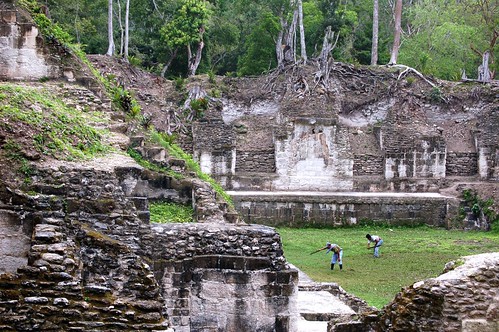
Your correspondent has, at various times, described visits to ancient ruins as having a certain "Indiana Jones" flair, whether because of daunting travels to get there or the overgrown remnants of long-lost cultures discovered in the jungle. Over the Memorial Day weekend, your correspodent and three trusted companions undertook an adventure, more Indiana-Jones-y than any previous: A three-day trek through the jungle from two less-known ruin sites to Tikal. Or, at least, the Yaxha and Nakum ruins were formerly in a logjam tie for last among the non-Tikal ruins of Guatemala's northern jungle. Then they were the setting for the Guatemala installment of the runaway CBS hit and bug-eating-for-fun-and-profit extravaganza that is "Survivor." The jungle trek was fantastic, but we did discover almost instantly that if you are scouting locations for appropriately large and disgusting bugs to make people eat, Guatemala's Peten region is not a bad spot.
On Friday evening we flew from Guatemala City to Flores, a charming town on an island in a lake and the base camp for many trips to Tikal, where we stayed the night. The next morning, as we searched for breakfast, we discovered many of the sidewalks to be covered with inch-and-a-half-long beetles that looked to have been washed off the rooves above by the night's rain, although the locals had not acheived concensus on where they had actually come from. Having already seen the required exotic creepy-crawlies and had not set out from civilization yet, but decided to soldier on anyway.
The guide service we had hired picked us up at 8:00, looked at our packs, and gently reminded us that we would have to carry our own packs on the third day because the packhorses could not take that part of the trail. Again we soldiered on, taking a mini-bus to the Yaxha ruins, an hour or so outside of Flores on the road to Belize. We were met by Joel (in Spanish, "HO-el") who would be leading us through the jungle for the next few days. Joel was about 5'6", totally ripped, with veins bulging out of his neck, home-made tattoos on his arms, and sporting a bandanna and a handlebar mustache. He looked more than a little like a pirate. Joel had previously been a xatero, i.e. he made a living hacking his way through the jungle collecting xate leaves, which are used in flower arranging. Currently, xateros make about $5 for a 12-hour day of work.
We took a brief tour of the Yaxha ruins, and took in the view of the lake from the restored temple. I really felt the spirit of "Survivor" in me at that moment. Like much of the Peten, Yaxha is home to howler monkeys (which don't howl so much as the growl like angry pack of dogs) and leaf-cutter ants (which cut huge (well, huge for ants) trails from their anthills to their latest victim).
That afternoon we hiked 10 miles or so -- mostly through thick jungle. Joel carried a machete, which people do here just as a matter of course, but Joel actually used his on many occasions to hack open the path through the jungle. He said the last time anyone used this trail was about two months ago, allowing plenty of time for re-growth and for trees to fall onto the path.
We slept at the ruins of Nakum, which was a more compact site than Yaxha, with lots of trees growing on the old temples, but enough restored or still-exposed sections to make it feel like ruins and not just funny-shaped hills. One of the highest buildings had a tall tree growing off the top with rickety ladders leading up to jury-rigged observation platforms that allowed great views of the jungle and a bunch of wild parrots. (We also saw a couple wild toucans later in the trip, but the staff photographer was a little slow with the camera.)
Hacking through the jungle that day, we were attacked by at least two families of spider monkeys. Upon hearing people approaching, the spider monkeys start jumping up and down and shaking tree limbs to try to scare away potential attackers. They pursue this tactic for about a minute before they mix in throwing sticks and branches and urinating on anyone in range. They are well known to throw their poo, as well, but nobody in the party could confirm any poo-related injuries. On that day's hike, we brushed by some plants that instantly started burning and left huge welts on our arms, and a bug that our guide said had urine that burned as well. Apparently burning and peeing are the jungle's two defense mechanisms, and this bug had combined them into a kind of super-jungle-attack. We were careful to provide him no reason to use it.
Speaking of burning, there was no organized campsite the second night, so Joel cleared out a spot that someone had used before and "sanitized" it by setting palm fronds on fire and then sweeping them over the dirt. We slept in hammocks with a thankfully unnecessary tarp slung over us.
The last day quickly changed from the first two when we ran into a flooded spot in the trail, requiring hiking for a while though standing, and quite smelly, water. The muddy conditions continued, which allowed for spotting a number of turtles and tons of jaguar tracks, but also allowed us to spend hours of the trip clinging to the less-flooded high ground along the sides where the trail met the jungle, or hopping from foot-sized island to island along the trail in a kind of long, tiring version of Frogger. It was all worth it though when we saw the coolest piece of wildlife of the trip (well maybe second to the acid-peeing bug), a huge tarantula. It's body was even bigger than the three-inch cockroach we had seen a day before. Actually, we saw two tarantulas, the larger of which was hanging out on the only passable piece of the flooded trail, a slippery log. Your correspondent's arachnophobic companion impressed all parties by calmly stepping over the tarantula, which our guide unconvincingly promised was "more scared of us than we were of it."
After a hike that took a couple hours longer than promised due to the slogging and the island-hopping and such, we finally made it to Tikal. We were almost too tired to actually go see any of it, but as we always do, we soldiered on. It was a gorgeous day, much sunnier than the previous trip, with great views of and from the temples.
Thoroughly exhausted, we took the shuttle back to the Flores airport, ready to leave the giant cockroaches and giant spiders and giant beetles and mushrooms and such behind us. In their wake, we managed to keep a piece of the Peten with us: your correspondent was still finding ticks on his person two days after our return. (If anyone knows more than Google about whether there's Lyme Disease in Guatemala, feel free to Holla Back.)
Wednesday, May 24, 2006
Genuine draft flavor

Those of you still looking for a reason to come to Guatemala can stop your search. Our most recent visitor and jumped right in to the local culture by having a delicious Gallo beer -- "the pride and tradition of Guatemala," it says right there on the bottle. We recently learned about one link in the chain that the Gallo brand uses to maintain its stranglehold on the Guatemalan market. They hold the Guatemalan copyright the names of virtually every other beer. So if Guinness or Bud wants import their products while maintaining their quite substantial brand, they have to give the Gallo company an apparently prohibitive cut of the profits. So, by and large, Gallo it is here, but fret not: Rob Onorato, who has had a beer or two, declared that Gallo tastes like "Nat(ural) Light -- but Natty Light from a keg, not from a can." Get the ad wizards working on that one!
Sadly for those of you in America who are don't get to enjoy the taste of Natty Light on tap as often as you would like, don't be fooled. Another Gallo company -- the one run by brothers Ernest and Julio -- holds the copyright for "Gallo" brand alcoholic beverages in the US, and prevents you from getting a bottle of Gallo properly labeled in the States. Rather, it is sold under the name "Famoso," so keep your eyes peeled. I've actually seen it at one of the liquor stores on 14th St NW in DC, although the sign next door promising fast wire transfers to Guatemala may have had something to do with that. It's not clear whether the Gallo company here learned this copyright skulduggery from the Gallos in the US, or if it was what the Guatemalans call "karmic payback."
Sunday, May 21, 2006
In non-Guatemalan news
The editorial staff tries to keep this journal focused on items that have some Guatemalan angle, in an effort to keep the content interesting for US audiences and distinguish the publication from the millions of "what I did today" blogs out there. Thus, the occasional large gaps in the publication schedule when nothing of uniquely Guatemalan import happens. This entry is an exception.
I scored 131 points on a single word in Scrabble last night, crushing my opponent's will to continue playing. Now I know how the Redskins felt in Super Bowl XXII. Feel free to "Holla Back" if you can top that -- I know it's possible, as there were no Q's or Z's in my word.
I scored 131 points on a single word in Scrabble last night, crushing my opponent's will to continue playing. Now I know how the Redskins felt in Super Bowl XXII. Feel free to "Holla Back" if you can top that -- I know it's possible, as there were no Q's or Z's in my word.
Friday, May 19, 2006
In which I impart my knowledge of the lively arts to the benighted locals
The Guatemalan print media offer a broad array of journalistic styles, appealing to various segments of the reading public. Just like Americans can choose between the lunchpail directness of the New York Post or the bourgie semi-sophistication of the New York Times, Guatemalans can choose between the near-New York Post-level sophistication of the Prensa Libre, or the sub-literate-level sophistication of Nuestro Diario and many options in between. It is left as an exercise for the reader to decide where the Holla falls on this scale. While the Prensa Libre tends to feature pictures of congressmen staring off camera in important hearings, the Diario tends to feature young women staring directly at camera in as little as possible. The common ground that unites them all is the evergreen of Guatemalan photojournalism, the picture of someone recently murdered in the street with a family member kneeling nearby, their grief made public for the country by the valiant free press.
In an effort to inspire the Guatemalan photo corps to stretch a little, the Embassy has started an annual contest for the local photogs, awarding prizes in a variety of categories. As an American who the Press Officer has spotted holding a camera before, your correspondent was invited to serve as a judge. After wading through and eliminating all the pictures of murder victims on the street, there were some excellent, striking pictures (and a few not-so-striking pictures) left. Considering that the camera used by a staff photographer at the Greeley Tribune is probably worth what the Pensa Libre photographers make in a year, plenty of slack was allowed on certain technical dimensions. But even in categories with titles like "Extraordinary Citizens," "This is My Country," or, "Teamwork," half the pictures were of dead people and mourning relatives, some more artfully shot than the others. Despite the subject matter, it was a bit odd to think that your correspondent, who routinely takes pictures like this, was judging the work of these dedicated professionals.
At the end of the evening, they announced winners by name and sometimes by title of the picture. Unfortunately, they didn't announce them by descriptive phrases like "The picture of the helicopter dropping aid to disaster victims," or "The one with the sunset and the fluffy clouds over the volcano," or "The portrait of the President of Guatemala and Ronald McDonald" (all actual pictures -- the last of which was a finalist in the "Extraordinary Citizens" category, by default), so this judge left the competition having no idea whether his opinions corresponded with those of the expert celebrity judge (a University of Texas journalism professor). The winners and their friends all seemed delighted with their prizes, and thus the event seemed to be having its desired effect for both the Embassy and the invitees, so it seemed for the best that I not shatter their illusions of competence in the majority of the judging pool.
In an effort to inspire the Guatemalan photo corps to stretch a little, the Embassy has started an annual contest for the local photogs, awarding prizes in a variety of categories. As an American who the Press Officer has spotted holding a camera before, your correspondent was invited to serve as a judge. After wading through and eliminating all the pictures of murder victims on the street, there were some excellent, striking pictures (and a few not-so-striking pictures) left. Considering that the camera used by a staff photographer at the Greeley Tribune is probably worth what the Pensa Libre photographers make in a year, plenty of slack was allowed on certain technical dimensions. But even in categories with titles like "Extraordinary Citizens," "This is My Country," or, "Teamwork," half the pictures were of dead people and mourning relatives, some more artfully shot than the others. Despite the subject matter, it was a bit odd to think that your correspondent, who routinely takes pictures like this, was judging the work of these dedicated professionals.
At the end of the evening, they announced winners by name and sometimes by title of the picture. Unfortunately, they didn't announce them by descriptive phrases like "The picture of the helicopter dropping aid to disaster victims," or "The one with the sunset and the fluffy clouds over the volcano," or "The portrait of the President of Guatemala and Ronald McDonald" (all actual pictures -- the last of which was a finalist in the "Extraordinary Citizens" category, by default), so this judge left the competition having no idea whether his opinions corresponded with those of the expert celebrity judge (a University of Texas journalism professor). The winners and their friends all seemed delighted with their prizes, and thus the event seemed to be having its desired effect for both the Embassy and the invitees, so it seemed for the best that I not shatter their illusions of competence in the majority of the judging pool.
Wednesday, May 10, 2006
Meritorious!
Today was the Annual Embassy Awards Ceremony. It was long, and lacked any edge-of-the-seat suspense, but it was a nice day to be outside and it was unanimously declared to be better than working. Because we're the government, and because Congress keeps telling us to do more stuff while tightening the pursestrings, none of the Guatemalan employees got a raise this year. So, in a backdoor effort to keep morale high, they give just about everybody some sort of award, ranging from recognition for 25 years of service to one full year of driving embassy vehicles without an accident (actually the latter is probably more impressive, given Guatemala traffic and the levels of incompetence required to be fired by the government). It seemed that everyone in the embassy shook the Ambassador's hand at some point today. You might think that the Special Olympics everyone-gets-an-award approach might limit their value in the eyes of the recipients, but it seems like mostly everyone likes to be told they're great and they can quickly forget that everyone else was great, too. Of course, my award was different, as I fully deserved a little recognition for all my hard work saving lives back when Hurricane Stan breezed through the country.
Saturday, May 06, 2006
Of Our Attractive Balcony
Today at 9:00 in the morning, the young gent who works the front desk at our apartement building called to see if the guys who are painting our balcony could come up. Seeing as it was the first we'd ever heard of it, we had some further questions about what exactly they would be painting (the exterior wall) and whether they needed to come through our apartment (yes) and whether they were sure they needed to come through our apartment (still yes).
Yesterday, while sitting on our couch, I had seen the bottom half of a ladder dangling from above. Maybe I've lost my sense of childlike wonder for ridiculous workplace risks; I didn't even get up to investigate. Just as well: Today we witnessed their strategy firsthand. Two workers arrived, one tied himself into a harness, then tied himself to the ladder. The other guy secured a second rope to the ladder, which they then swung over the side of the balcony. The ladder -- not the rope. Non-harness guy wrapped the rope attached to the ladder around his foot a couple times and then stood on it to keep the ladder from falling any further. Then the other guy climbed down the suspended ladder and painted the outside of the balcony. I'm sure they were making about 15 bucks a day to take these kind of risks in service of a building that didn't seem to really be in that desparate need of painting. We drank our french-press coffee and ate garlic-and-tomato omelettes and watched.
Yesterday, while sitting on our couch, I had seen the bottom half of a ladder dangling from above. Maybe I've lost my sense of childlike wonder for ridiculous workplace risks; I didn't even get up to investigate. Just as well: Today we witnessed their strategy firsthand. Two workers arrived, one tied himself into a harness, then tied himself to the ladder. The other guy secured a second rope to the ladder, which they then swung over the side of the balcony. The ladder -- not the rope. Non-harness guy wrapped the rope attached to the ladder around his foot a couple times and then stood on it to keep the ladder from falling any further. Then the other guy climbed down the suspended ladder and painted the outside of the balcony. I'm sure they were making about 15 bucks a day to take these kind of risks in service of a building that didn't seem to really be in that desparate need of painting. We drank our french-press coffee and ate garlic-and-tomato omelettes and watched.
Wednesday, May 03, 2006
Of Rotten Mango and Soaring Concrete
While multitudes of Guatemalans (et al) took the day off in protest in the US on Monday, that was standard practice here. Guatemala, like most countries, observes Commie Labor Day on May 1 with a national holiday. It was a perfect opportunity for your correspondent to tag along with some long-term visitors one last time. In this case, we all headed to lovely El Salvador.
Said long-term visitor spent a significant portion of her time working in a medical clinic near Lake Atitlan. She is just finishing up Med School, and is suffering the attendant crippling debt. In keeping with the budget of this financially insolvent do-gooder and her beau, your correspondent was forced to abandon the swim-up bars and turndown service to which he has grown accustomed on his seaside retreats. Instead, we crashed with a guy named “Chito.” The young doctor’s surfer beau had shared some gnarly waves with a dude up in California who owns some vaguely sea-side property near Sunzal beach, perhaps the finest beach in El Salvador. His caretaker: Chito; which is really not that odd a Spanish name, other than that it is homonymous with a famous American snack treat, for which we cannot find it in our hearts to blame Chito himself.
In any case, the place, it turns out, was not a private residence, but open for public rental of rooms. The grounds were filled with piles of rotting mangos (at one point, one of our party asked at a little store to purchase mangos, which are actually not for sale because everyone has a mango tree in their yard that drops more mangos than any family could eat, so there’s no market for them. This was expressed by the shopkeeper casting a bewildered gaze up at the trees and making a motion that seemed to express “mangos everywhere!”) In any case, the mix of free-range chickens, rotting fruit, and less-than-enthusiastically cleaned/maintained bathroom facilities gave the place a distinctive aroma. The rooms were concrete cells with two single beds, a rotting wooden table, and a circa-1958 fan. Both Chito and his lovely companion Marta had promised a “four-minute” walk to the beach, while neglecting to mention the trash-strewn path one followed to get there. While the price for these accommodations was reasonable, it was not quite equal enough to zero to make your correspondent anticipate a return trip; once was enough to relive the kind of bargain-basement suffering that 19-year-old backpackers would honor as a badge of authenticity of experience.
This could not detract from the fact that Sunzal is a fine beach, with water of ideal temperature and waves that are big enough to be fun but not so big as to make you seriously think you’re going to die as the toss you about and then pull you under.
In a more exploratory vein on Sunday, your correspondent and his team ventured to the fish market in La Libertad, then on to San Salvador, the capitol of our neighbor to the south, which is generally, and accurately described as “like Guatemala City, but smaller.” They have a nice Cathedral, which the prior archbishop suspended construction of in order to spend the money on poverty alleviation; when he was assassinated, they honored his memory by resuming construction of the Cathedral. It’s nice enough, but the crowning irony is that it is far outdone by the 1964 concrete architecture of El Rosario, a church a mere two blocks away, built of two giant concrete arches with the space between filled almost entirely with stained glass. It is certainly the most interesting and perhaps the most beautiful church your correspondent is familiar with, in no small part because of it’s non-traditional construction.
Also in San Salvador, we cruised by the Official Statue of El Salvador: "El Salvador del Mundo", ate delicious pupusas and beer in the downtown market, bargained for hammocks, and bought a produce section worth of veggies including the mysterious mami (which is like a mix between an avocado and a sweet potato).
The remainder of the day was spent in power-failure darkness in a serious thunderstorm in a beachfront restaurant. The following day was spent in vain search of sea caves, which even if we found would have surely been occupied by young lovers seeking a little solitude from the labor day beach scene in Majahual, El Salvador.
In all, the weekend was a grand success, and has precluded the necessity of any further trips to San Salvador or further evenings in sub-backpacker-hostel level accomodations, at least until we meet a guy named "Dorito."
Thursday, April 27, 2006
All Hell Scheduled to Break Loose: Monday, 7:00 AM
Energy prices are high everywhere. While President Bush presents his own modest proposals for dealing with gas prices in America, Guatemala is taking a more revolutionary approach: Daylight Savings Time. Apparently they tried it once before, five years ago or so, decided it wasn't for them, and haven't tried it since. But this year, they're trying again. The results for a country that is generally not familiar with daylight savings time as a concept, not really all that big on time as a concept to begin with, and not much on trusting the government or consuming any news media should be interesting. At The Lovely's school, they were trying to explain it by saying "You have to show up an hour earlier, but you get to leave an hour earlier," without really noting that the clocks would still say the same time when you showed up. There were newspaper ads explaining that you didn't actually have to get up at midnight to change your clock, you could do it before you went to sleep and it would work out fine. I concede that it is sort of a weird concept to grasp if you haven't grown up with it, while still hoping that they'll wind up screwing everything up and we'll wind up with sunset at 10:30 PM.
Tuesday, April 25, 2006
Baby-holding Record Set
As previously alluded to, we tried to take advantage of the last weeks of summer by heading to the beach this weekend. And none too soon. The rainy season officially started yesterday. It has rained here in the last month, but occasional sprinkles are not Official Guatemala Rainy Season Cloudbursts, which is what we got yesterday afternoon, and again this evening.
The staff photographer was punished for his profligacy with the Holla budget the week prior and not invited, so the event has not been recorded. But the ratio of grown-ups to pipsqueaks on the trip was 8:7, a hairs-breadth victory for maturity in terms of numbers, if not in terms of weight. The other three couples we went with are all of the Foreign-Service-as-child-care-opportunity school of thought. One couple brought their six-month-old girl, who is thankfully one of the more chill babies I've had the pleasure to meet. Which led not only to me besting my personal baby-holding record, but shattering it, the result of an surprise pass by the doting father, mostly so he could reach the chips and guac we were enjoying at poolside. Anyway, in case my mother was wondering why her psychic state inexplicably improved drastically from 6:36 to 6:42 on Saturday night, it is because I was holding a baby and not trying to get rid of it for a whole (estimated) six minutes. Previous record had been however long it takes to hold a baby and say "she's cute" and then pass it on to the next cubicle-dweller.
Just so nobody's hopes swell too much, it's a record I'm certain will stand for many years.
The staff photographer was punished for his profligacy with the Holla budget the week prior and not invited, so the event has not been recorded. But the ratio of grown-ups to pipsqueaks on the trip was 8:7, a hairs-breadth victory for maturity in terms of numbers, if not in terms of weight. The other three couples we went with are all of the Foreign-Service-as-child-care-opportunity school of thought. One couple brought their six-month-old girl, who is thankfully one of the more chill babies I've had the pleasure to meet. Which led not only to me besting my personal baby-holding record, but shattering it, the result of an surprise pass by the doting father, mostly so he could reach the chips and guac we were enjoying at poolside. Anyway, in case my mother was wondering why her psychic state inexplicably improved drastically from 6:36 to 6:42 on Saturday night, it is because I was holding a baby and not trying to get rid of it for a whole (estimated) six minutes. Previous record had been however long it takes to hold a baby and say "she's cute" and then pass it on to the next cubicle-dweller.
Just so nobody's hopes swell too much, it's a record I'm certain will stand for many years.
Monday, April 24, 2006
Much Delayed Semana Santa Report
 The photo department finally got through editing all 500 pictures down to a brisk 85 or so and getting them on-line, just in time for the editorial staff to make a hasty end-of-"summer" trip to the beach. We know that our loyal readers are sitting at home on Saturday nights hitting "refresh" on the Holla website every five minutes waiting for news. So, we apologize, and will forgo our usual lengthy introduction and cut to the equally lengthy chase.
We had heard that the crowds in Antigua were unbearable for the Semana Santa (Holy Week) processions, and were almost ready to skip the whole thing. But we figured it was worth a try, and if we couldn't find anywhere to park we would just turn around and head home. Lucky for us, the rumors of unbearable crowds were greatly exaggerated.
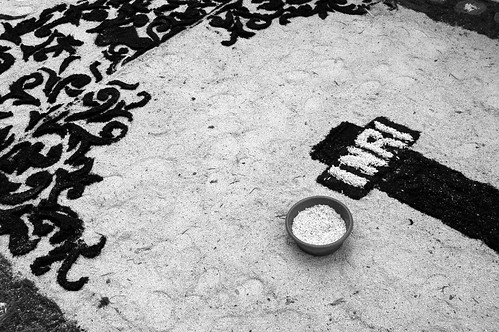
On Thursday afternoon and evening, and Good Friday morning, we wandered around the town, seeing how they make some of the less elaborate alfombras and seeing a few parades. "Alfombra" translates as "carpet," and refers to the elaborate decorations that the local residents build on the cobblestone streets in front of their homes and businesses. It is a painstaking process of collecting bushels of flower petals and seeds, arranging them in elaborate patterns, outdone only by the even more elaborate and intensely colored sawdust artworks. The ones we saw on Thursday were mostly pretty basic, but on Friday morning they were incredibly intricate, often the work of the entire night by a team of laborers. Each alfombra is then trampled by a parade. There must be some sort of symbolism there.
We managed to catch three parades, which ostensibly had scheduled stops around town, though they were best thought of as a rough suggestion of the route rather than a real timetable. Each parade follows a fairly standard pattern:
1. The Roman guards. Sometimes on horseback.
2. Guys in the purple robes start lining the street, then guys with censers of incense amble through, accompanied by guys in non-purple robes. For the Good Friday procession, the sea of purple robes was particularly thick. These guys mostly just stand around -- they may carry special poles that lift power lines out of the way of the very tall sculptures to follow, or may just be waiting their turn to carry the sculptures. In fact, you see people of all ages running around in purple robes all over the place, all day.
3. An anda featuring Jesus carrying the cross. An anda is like a giant sedan carried by sixty or seventy people, half on each side. Nobody I know has been able to come up with an equivalent word in English -- since "float" generally conjures images of the goofy Rose Parade floats with animatronic dinosaurs and whatnot.
4. A marching band
5. Anyone who feels like joining in the parade for a bit, mostly apparently very devout elderly folks.
6. Some other random folks on little four-person andas. Maybe if I'd been to a bit more church in my day, I could tell my Mary Magdalenes from my Josephs and John the Baptists.
7. Mary, carried by women, all in black veils, probably because the ladies wanted something that they would be able to wear again, unlike the purple robes.
8. Another marching band.
9. Cleaning trucks, backhoes, etc.
10. Everyone else in the world, selling all manner of food and toys.
The processions were as spectacular as billed (book now for Semana Santa 2007), even without the main event, which is the candlelight procession on Friday night. Instead, we shot up to Lake Atitlan, where a friend was working as a volunteer at a medical clinic in the small town of San Lucas Toliman. The big bonus of this was the extremely friendly family she was staying with that allowed us to -- or perhaps begged us to -- help build the alfombra on their street. The San Lucas processions were on a smaller scale, with far more indigenous flare and far fewer tourists, but the alfombras were still impressive and the joy of seeing our own work trampled brought us closer to to the event. We saw Jesus taken down from the cross in the local church, and had an amazing view from the bell tower as his body was led out for the final procession of the day.
One interesting note in Toliman was the local version of Maximon (whom faithful readers may remember) was hanged from the church, apparently because one of the many figures mixed into his composite character is Judas.
It turns out that nothing actually happens on Holy Saturday -- it's mostly just a day for fun with the family between the processions of Good Friday and the churching up of Easter Sunday. There were lots of families at the lakefront, and a mini-carnival with food stands and midway games in the main square. We spent the day wandering and allowing the staff photographer to play with his new toys.
Unsurprisingly, Sunday is all about church -- though there is one last procession (I hear it features the empty coffin coming back to the church, although your correspondent was unprepared for the early start required on Sunday morning to see it). But life also seemed to be back to normal, with things feeling a little sleepy. Maybe everyone was in church, or maybe your correspondent wasn't the only one with a hangover, or most likely, both.
Wednesday, April 19, 2006
Photo departement incapacitated by new photo technology
When first we began this adventure in Guatemala, an anonymous donor suggested that perhaps we would like a nice new digital camera to help the photo department appropriately document the strange and exotic culture. We demurred -- if you read the State Department warnings, it looks like the second you walk out the door with anything with more resale value than the day's newspaper some young ne'er-do-well will be robbing you at gunpoint and probably shooting you afterwards just for kicks. Your correspondent would like to state officially and for the record that anyone coming to Guatemala should seriously consider the risks and should take the State Department travel warnings seriously. That said, we relented in our objections to said anonymous donor providing the photo department with a snazzy new camera which has seriously hampered our reporting efforts.
The camera takes fantastic pictures, and has a ridiculous amount of storage capacity. As such, there was nothing to stop the photo department from taking nearly five hundred pictures over the four-day Easter weekend. The features editor is ready to go to press, but really the story of Semana Santa in Guatemala is all about the visuals, and editing five hundred pictures is taking longer than the photo department anticipated. We can only pledge to the reading public that the full story and photos will be published in the next couple days and will be worth the wait.
The camera takes fantastic pictures, and has a ridiculous amount of storage capacity. As such, there was nothing to stop the photo department from taking nearly five hundred pictures over the four-day Easter weekend. The features editor is ready to go to press, but really the story of Semana Santa in Guatemala is all about the visuals, and editing five hundred pictures is taking longer than the photo department anticipated. We can only pledge to the reading public that the full story and photos will be published in the next couple days and will be worth the wait.
Saturday, April 08, 2006
Passing the torch
As I advance in my Foreign Service career, there comes a time for reflection. It's been a long eight months, and I'm not sure I can keep up this pace. There are youngsters out there with more energy and more desire than I can muster anymore. The creeping onset of career senesence is upon me; time waits for no man; none of us is getting any younger.
So it was that I served as the administrator for the Foreign Service Written Examination here in Guatemala, where a crew of ex-pats (mostly Peace Corps) took the first step towards getting hired for my job. Not the best way to spend a Saturday, but it earned me a full day of comp time which I can use to turn some made-up-Guatemalan-holiday three-day weekend into a four-day weekend. Mostly it was a day of sitting and staring and occasionally checking the clock, as the proctor is not allowed to pass the time reading, which would just open the window for skulduggery among those hoping to usurp me. Weary is the head that wears the crown. Weary but watchful! The most unsettling part of the experience was when 15 of the 17 examinees had finished a given section of the test, and were not allowed to read, either, so we just sat there and stared at each other for ten minutes until the time expired on the two slowpokes. Perhaps we should have just gone ahead and had a staring contest -- winner gets to do 100 visa interviews on Monday.
So it was that I served as the administrator for the Foreign Service Written Examination here in Guatemala, where a crew of ex-pats (mostly Peace Corps) took the first step towards getting hired for my job. Not the best way to spend a Saturday, but it earned me a full day of comp time which I can use to turn some made-up-Guatemalan-holiday three-day weekend into a four-day weekend. Mostly it was a day of sitting and staring and occasionally checking the clock, as the proctor is not allowed to pass the time reading, which would just open the window for skulduggery among those hoping to usurp me. Weary is the head that wears the crown. Weary but watchful! The most unsettling part of the experience was when 15 of the 17 examinees had finished a given section of the test, and were not allowed to read, either, so we just sat there and stared at each other for ten minutes until the time expired on the two slowpokes. Perhaps we should have just gone ahead and had a staring contest -- winner gets to do 100 visa interviews on Monday.
Subscribe to:
Posts (Atom)

 Posts
Posts


