Maybe more words tomorrow.
Tuesday, October 23, 2007
Monday, October 22, 2007
Of Windsor, Part the Second
We promised more about the Larimer County Fair. But we now realize that pretty much everything about county fairs has already been said. We saw vaguely creepy carnival workers; we saw a goat and a rabbit and a pig; we saw puke being cleaned off the Zipper via the sloshing of water from a five-gallon bucket on the seats.
Thursday, October 18, 2007
Of Windsor, Colorado
After Vaughn, New Mexico, we landed on the interstate and made good time up to Windsor. We already published some of the staff photographer's efforts in this area. We also went to the Larimer County Fair; a small slice of the drama that event offers is pictured above. (She didn't win.) Perhaps more on this controversial topic tomorrow.
Tuesday, October 16, 2007
Of Vaughn, New Mexico
We passed through Roswell, New Mexico. Even the local Arby's has a sign out front that says "Welcome Aliens." Which is a boon for Roswell, as genuine UFO nuts and kitsch-lovers alike seem to be keeping the city alive. Meanwhile, in beautiful Vaughn, New Mexico, the signs don't say "Welcome Aliens"; they say "Welcome Anyone, Please. Please."
Monday, October 15, 2007
Kansas is Empty, But...

Texas is really, really empty. And so is New Mexico. Your correspondent actually, in a way that he recognizes most people find crazy, really likes all that emptiness, and regarded the Rio Grande valley as quite pretty and New Mexico as downright beautiful. We drove along US Highway 285, eschewing the potential excitement of interstate rest stops and pushing straight into the very heart of empty. It was great.
All that empty doesn't always translate into awesome photography, of course: There's one or two nice photos to be had, and then you could re-take them with slightly different arrangements of sagebrush or windmills. The occasional ancient roadside billboard is about all you can ask for. Of course, the sad little towns punctuating the old highway seem even more fascinating when you get to them. E.g. Ma Wilson's in Pecos, Texas, as seen above. Or Wayne and Rosie. We wish them success with their donuts, cars and crafts, respectively.
Sunday, October 14, 2007
Good Morning America!
After an uninspiring final night in Mexico, we left early and crossed into the U.S.A. to start soaking in the United States-style American-ness for a month. I admit it, I was just about ready to start sending campaign donations to Hugo Chavez, so it's a good thing we arrived for home leave when we did.
We crossed at a border outside of Laredo, Texas, which was advertised on highway billboards as the fastest way for Monterrey residents to get to an American mall. It was, actually, remarkably painless, and before long, we were enjoying the landscape of the Rio Grande valley. Although driving a car with Guatemalan plates, we didn't seem to get any more attention than average from the Border Patrol checkpoints in the valley: the one guy who gave us a serious grilling seemed like he probably just enjoyed playing to type as a gruff South-Texan law enforcement officer.
Trying to make sure that we re-Americanized ourselves as quickly as possible, within hours of entering the country, we ate a super-sized fast-food meal and stopped at Wal-Mart. This was a cultural exploration of its own, your correspondent would argue, as there are some interesting characters at the Wal-Marts in the Rio Grande valley. Somehow the cultural exploration seems less worthy of report: as if noting the differences between myself and the average Guatemalan is standard travel writing, but pointing out the differences between myself and the average Sanderson, Texas Wal-Mart customer would be cruel. Maybe that's borne of some ingrained desire to pretend that America is free of class distinctions. Or maybe it's because one of the most obvious differences between me and many of the people we saw in Wal-Mart was about 100 pounds apiece. It's kind of cliche to point out that Americans are fat, but, uh, Americans are fat. I guess I will have to confess to the State Department that there are certain parts of re-Americanizing that I intend to avoid.
Thursday, October 11, 2007
Of Monterrey

The staff photographer found Monterrey uninspiring. The above picture is from south-central Mexico, but these bull billboards appear on highways throughout the country. It's a liquor ad, but it's a fun liquor ad.
Anyway, since your correspondent did not spend much time delving into the beating heart of Monterrey, there were only two things (barely) worth noting there: the lodging and the food.
The hotel where we had reservation told us at 3:00 or so, when we arrived, that they did have our reservation, but that our room would be ready at 7:00 that evening because at present someone else was still using it. Which would not at all be a surprise at any number of flea-trap hotels we've stayed at in Latin America. While this hotel wasn't "nice" by any American definition, it was a central hotel in one of the major business centers of Mexico. The guy at the desk seemed mostly uninterested in explanations of how "reservations" typically work. Anyway, for some reason we didn't want to just leave all our stuff in our car on the street until 7:00 that night, we wound up at a Holiday Inn.
We wandered a bit on Monterrey's downtown pedestrian mall, looked at their big central park, and then went to dinner at a hotel recommended for its local specialties by the Holiday Inn concierge (of sorts). The restaurant met our basic requirement for air conditioning, and added a tex-mex flair by providing a bowl of chips and salsa as soon as we sat down. It turns out that the local specialty is goat. Not a particularly flavorful goat, just goat, cooked over coals, in a kitchen that was not open to the restaurant but did have large windows on the street in case you wanted to step outside and see how your goat was coming along. Anyway, if you're in Mexico, it seems it wouldn't take much effort to find somewhere a lot more interesting than Monterrey, (for example, anywhere else) but if you're in Monterrey, don't bother with the goat.
Wednesday, October 10, 2007
Of Guanajuato, Part the Second
Guanajuato lies in the hills north of Mexico City. Like many cities built on steep hills, or built a long time ago, or, as in this case, both, it is largely a maze of small alleys winding around the contours of the hills, meeting at crazy angles, and far better suited for exploration on foot than any other conveyance. It oozes charm. But it is so close to Mexico City that it is packed with Mexican tourists. There was some sort of film festival or something on when we were there, and buskers packed the streets with the same kinds of juggling and whatnot that they do in every tourist town in the world. We settled for drinking Bohemia in outdoor cafes and watching people mill about.
The scene at the town square later that evening was a bit maddening with all the tourists, so we escaped to have a beer somewhere more "local." Which isn't always actually a great idea. We stopped into a bar where, after ordering from a friendly woman without very many teeth and with a tube-top exposing a gut that many NFL linemen would envy, we realized that we weren't totally sure if the other women in the establishment were seeking compensated for their company. I avoided eye contact with the various clients, and in an effort to seem inconspicuous, even consumed a few of the complimentary pork rinds in peculiar red sauce that we were served. It's not the first time your correspondent has sacrificed the ostensible primary purpose of going out for a beer - i.e. relaxing fun - in the name of research. A tough job, but someone has to do it.
Tuesday, October 09, 2007
Of Guanajuato, Part the First
Guanajuato was beautiful. Like many Mexican cities, they have honest-to-goodness mariachi bands who hang out on a public plaza, waiting for passers-by to hire them for a song or perhaps for a future engagement. Before our first visit to Mexico, your correspondent thought mariachis were only from movies or tv or whatnot. But they're real, and they work hard for the money. Unfortunately, the staff photographer was not at the top of his game that night. More on Guanajuato tomorrow.
Monday, October 08, 2007
Interlude in Delmarva
A quick sidebar on the slow tale of our journey from Guatemala to Washington:

We spent the long weekend (yes, government bureaucrats get Columbus Day off) on the Delmarva peninsula, on the other side of the Chesapeake from our nation's capitol. We spent a couple days kayaking around the wetlands and seeing blue herons and bald eagles (though they didn't stay still long enough for the staff photographer to get close. Or perhaps the staff photographer just needs a $1500 super telephoto lens).
Perhaps more importantly, we also were reminded that one can see weird stuff on weekend trips within one's own country. Ocean City is strange enough as it is: A city that's one block wide and 150 blocks long, with nothing on one side of the street but hotels and nothing on the other but "Sunsations" stores selling towels and flip-flops and swimsuits. As we drove through, the streets were lined with people in beach chairs just watching traffic go by. In their defense, there was some sort of hot-rod convention in town, with lots of goofy ZZ Top cars cruising the strip. Just up the coast in Delaware, there was some sort of greyhound owners' confab (as in the dog, not the bus). Exactly what one does at a greyhound convention remains unclear - admire one another's dogs, discuss dog food, share racing tips? (In practice, one popular activity seemed to be the purchase of bumper stickers reading "STOP Greyhound Racing.") In any case, it made for some interesting sights, and should you see a grizzled dude in a taxi-yellow roadster with a lovestruck lady in the passenger's seat and three greyhounds in the back, you'll know where they met.

We spent the long weekend (yes, government bureaucrats get Columbus Day off) on the Delmarva peninsula, on the other side of the Chesapeake from our nation's capitol. We spent a couple days kayaking around the wetlands and seeing blue herons and bald eagles (though they didn't stay still long enough for the staff photographer to get close. Or perhaps the staff photographer just needs a $1500 super telephoto lens).
Perhaps more importantly, we also were reminded that one can see weird stuff on weekend trips within one's own country. Ocean City is strange enough as it is: A city that's one block wide and 150 blocks long, with nothing on one side of the street but hotels and nothing on the other but "Sunsations" stores selling towels and flip-flops and swimsuits. As we drove through, the streets were lined with people in beach chairs just watching traffic go by. In their defense, there was some sort of hot-rod convention in town, with lots of goofy ZZ Top cars cruising the strip. Just up the coast in Delaware, there was some sort of greyhound owners' confab (as in the dog, not the bus). Exactly what one does at a greyhound convention remains unclear - admire one another's dogs, discuss dog food, share racing tips? (In practice, one popular activity seemed to be the purchase of bumper stickers reading "STOP Greyhound Racing.") In any case, it made for some interesting sights, and should you see a grizzled dude in a taxi-yellow roadster with a lovestruck lady in the passenger's seat and three greyhounds in the back, you'll know where they met.
Thursday, October 04, 2007
Puebla to Guanajuato

In an effort to post highlights from our whole trip to Washington before we actually leave for Latvia, we're forgoing further details on Puebla and moving right along. Driving through Mexico City is not recommended. We tried to go around it, but that's not recommended, either. But there was, again, some gorgeous country, and a herd of goats behaving in accordance with their ancient mountain-goat DNA by climbing steep hillsides, as available. Or just looking for shade.
Wednesday, October 03, 2007
Of Puebla, part the second
Monday, October 01, 2007
Of Puebla, part the first
Our next stop along the road was in Puebla, Mexico. Puebla is a big, industrial city, so we didn't focus on spending a lot of our precious tourist time there. That said, like any city of a certain age, it did have some cool old architecture downtown. And the center still seemed to have plenty of life to it, a city planner's dream of street-level retail and sidewalk cafes on the main square. The big attraction in Puebla is their "Talavera" pottery and tile. There are plenty of shops ready to sell tourists a gaudy serving platter. More impressive are the many churches and office buildings covered top to bottom in colorful tiles.
The other memorable feature of Puebla was the food. Of course, there is the famous mole poblano, but we discovered that we were in town for the harvest season when the Poblanos prepare chiles en nogada, which is a stuffed pepper covered in a creamy white sauce, green cilantro, and red pomegranate seeds. (Ta-da! The colors of the Mexican flag!) Your correspondent, ever seeking culinary adventure, ordered one, and found that they grow some sort of mutant pepper in Puebla that was bigger than your correspondent's head. He ate half; it was pretty good.
Sunday, September 30, 2007
Photo department prestige snowballs
The internationally recognized travel gurus at travel blog Gadling picked the Holla's picture from the previous entry as their "Photo of the Day" yesterday. Thanks, Gadlingers!
Thursday, September 27, 2007
On the Road in Mexico
Wednesday, September 26, 2007
Of Oaxaca, Part the Last
So, the moral of the story is that Oaxaca is, like, really cool. Your correspondent would rank it as his favorite place that the staff stopped by in Mexico on this trip. The street food is great; the culture is great; the scenery is great. Speaking of scenery, the staff photographer was also a big fan of some of the unusual sights on the streets of town, from the motorcycle lineup by the Domino's to the street markets being set up in the morning, as in above picture of hot nude models preparing for a long day of modeling jeans. It was a shame we only had about 20 hours there, before we had to depart for Puebla.
Monday, September 24, 2007
Of Oaxaca, Part the Fourth
On the morning of our departure from Oaxaca, we stopped at Monte Alban, one of the earliest known cities of the Americas. It's a beautiful location, on top of a mountain rising about 1,300 feet above the city of Oaxaca (which is itself at 5,000 feet of elevation). The site is very nicely restored, with some fascinating carvings visible and great views in all directions from the tops of the temples. It was particularly cool after having visited so many Mayan ruins in Guatemala to see this Zapotec site that pre-dated those by centuries, but still showed some important similarities to its later, southern neighbors. The Zapotecs also had a cooler name than the Mayas, but we can't really blame anyone for that.
The guy above was one of many baking in the mid-day sun and removing weeds from between the rocks on the restored temples.
Wednesday, September 19, 2007
Oaxaca Intermission
A random picture from Oaxaca and a brief update on local events in D.C.: The Holla staff crash course in Latvian is past week divi. That's "two" in Latvian. Unfortunately, I can't report that we're in week three, because yesterday our teacher told us that the word for "three" is too complicated for us right now. It's going to be a long two plus two plus two plus two months.
Tuesday, September 18, 2007
Of Oaxaca, Part the Thrid
One of the most distinctive features of Oaxaca is the graffiti war being waged publicly on the center's streets. I suppose there may be taggers competing against each other, but the most noticeable battle is between the taggers and the property owners or perhaps municipal clean-up crews. Almost every building has been tagged, painted over, and tagged again. The re-painting usually doesn't match the original color of the buildings, resulting in some striking patchwork paint jobs... almost all with a fresh batch of graffiti tags on top. The staff photographer dedicated a fair amount of his limited time in Oaxaca to capturing Oaxacans in their natural tag-infested environment.
Monday, September 17, 2007
Of Oaxaca, Part the Second
(Our deliberately paced chronological retelling of our journey home continues...)
We had heard that Oaxaca was a lot like Antigua, Guatemala, so we weren't totally sure what to expect. We were pleasantly surprised. We had some delicious selections from the abundant street food, saw a good museum and some baroque churches, went to a couple really cool bars, and ate fantastic food. On top of all that, we happened to be there during the weeks of Oaxaca's annual fair. The big event is held on two consecutive Mondays, with huge crowds and lots of cultural demonstrations from around the region, particularly highlighting dance. We weren't there on a Monday, but we stumbled upon a couple different shows of what appeared to be high school kids dressed in traditional costumes and dancing. They were actually good, and for the most part, few of them seemed to have been forced to go through the paces on these dances. Perhaps this was aided by the fact that at the first performance we saw, there were other high school kids roaming the crowd offering free cups of mezcal and of some other local alcoholic beverage - and apparently doing so in some official capacity. This correspondent could certainly be convinced to at least attend (although maybe not participate in) a lot more dance performances were free booze a universally understood and standard part of the package.
More pictures of the colorful costumes here.
Friday, September 14, 2007
Of Oaxaca, part the first
The countryside on our drive from Puerto Arista to Oaxaca City was gorgeous. Stunning canyons and rolling hills covered with cacti. As we neared Oaxaca, much of the land was covered with neatly planted rows of agave, the plant used to make mezcal and tequila. Your correspondent sampled a couple varieties of mezcal, which is native to Oaxaca (Tequila being originally from Jalisco). We'll stick with tequila from here on out.
Thursday, September 13, 2007
Of Puerto Arista
It has been well over a month since your correspondents packed up the shop and departed Guatemala, en route to Washington. It would be a bit silly to give a full play-by-play of the trip, but we'll be publishing photos and selected anecdotes here for however long they last. We also have a couple other major projects from Guatemala that linger unfinished and will be published here and on Flickr at some point, so stay tuned.
Anyway, our final day in Guatemala we stayed at the same hotel, in the same room, where we had stayed for a few weeks while we looked for permanent housing upon our arrival two years ago. I'm sure a more philosophical correspondent would hold forth here about cycles and symbolism and such, but mostly we were too tired for such lofty rumination. We had breakfast with another Embassy employee who had just driven down to Guatemala through Mexico, and seemed to think we were going to die in the barren wilderness of Chiapas because there is "absolutely nothing there." He was closer to correct than we thought, as the coastal road through Chiapas is pretty barren, with not much in the way of roadside fast food or hotels. Fortunately, there was some hyperbole in his warning, and we took a side road to the beach town of Puerto Arista for the night. The hotel where we had made a reservation turned out to be a dump, ramshackle and smelly and probably flea-ridden. We went looking for other options and found them not much less dumpy, so we wound up back at our original hotel, an interior view of which (above) shows the TV, which had two channels and apparently got signal from two completely different antennae(?), which details were provided to guests via Sharpie on the wall.
Scruffy as our hotel may have been, a hotel on the beach is still a hotel on the beach. We had a lovely meal and delicious Mexican beer watching the sun set over the Pacific, discovered that there were actually more biting insects on the beach than in our room, and managed to get a relatively good night's sleep despite some concerns that at a hotel so shabby, our car (or its valuable trunkload of contents) was surely going to be stolen in the night.
It wasn't, and we got an early start the next day for Oaxaca, of which more soon.
Sunday, September 09, 2007
Big Money Political Advertising
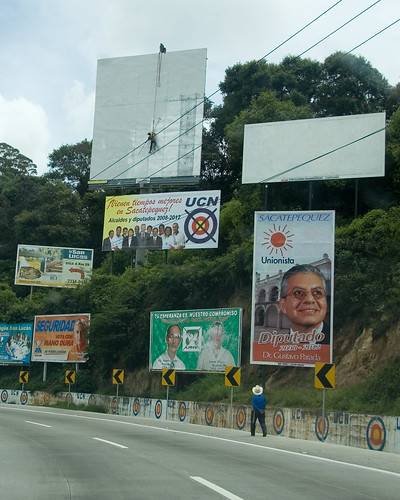
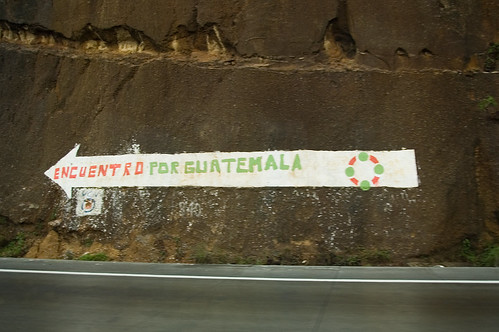
The key to this style of campaign is the simple set of identifiers attached to each campaign. Almost every party has one primary color associated with it, although there is a little overlap. For example, the Patriotas are orange, and the UNE is green. So all you have to do is see that a stretch of highway has its rocks painted yellow to know that the PAN party has been there. On top of this, each party has a simple logo:
The outgoing ruling party, the GANA, uses a Mayan pyramid. Somehow, we failed to take an interesting picture of one, though. The symbols are so well-known that the party's name doesn't necessarily need to appear -- and they need to be. The ballot features the party's logo, so the voter doesn't need to do any reading, they just need to mark the red triangle if they want to vote for the DIA or the Pepsi logo-turned-into-a-fish for the Bienestar party. Local parties are in the mix, too, with more stenciled lavender cowboy hat or tractor symbols. One personal favorite is the "Mixco Renewal Movement," which appropriately chose a broom as their symbol.
Since the graffiti are illegal in the first place, nobody seems to be regulating one party painting over another's logos. There was occasional re-use of spaces, but some sort of code of graffiti artist honor seems to have sprung up, as many parties seem to put their tags side-by-side rather than covering each others' stuff. Of course, rogue hooligans throw trash or tar or paint at opposing parties' graffiti, but no more frequently than they deface the billboards.
For a few more exciting pictures of Guatemalan political advertising in its many forms, see the full set of pictures at flickr. Disclaimer: This is intended to present to non-Guatemalan audiences a unique element of Guatemalan campaign season. In no way is any of this intended to endorse any party. Every party does this stuff, about equally.
Thursday, September 06, 2007
Coming Soon
Our first big post-departure project is about to become a lot less timely. Above is a quick preview of a bunch of material from the photo department about political grafitti in the run-up to the Guatemalan elections on Sunday; we're hoping to have a further photo essay of sorts up by Saturday. So when you see the banner headlines on the Guatemalan election results on the front page of your local paper on Monday, think of us.
Wednesday, September 05, 2007
Back from August Recess

Somehow we survived the terrible hardship of having to spend an entire month of vacation in the U.S. during August, and somehow you survived a full month of the Holla not posting a thing -- not even a random picture here and there.
Well, we're back. Our final leg, a trek from Colorado to DC via Kansas (as pictured above: The Lovely Katherine contemplating the somewhat-pricey-but-definitely-worth-it glory of "Prairie Dog Town," a legitimate tourist attraction in Oakley, Kansas), Boston and New York, concluded a mere 16 hours before classes were set to begin yesterday. Now we are starting the long slog through eight months of Latvian. (Your correspondent can already refer to his faithful traveling companion as "my little heartflower" in Latvian; it remains unclear what remains for the balance of the eight month course.)
It is our hope that the combination of being stationary and certain budget overruns over the last month will inspire the editors to dedicate significant evening and weekend time to the Holla over the next few weeks. And we hope not all of our five loyal readers have totally forgotten us or assumed that we would cease publication upon our departure. We certainly have some tales to tell and, we think, several months' worth of pictures that we hope you'll like as much as the staff photographer does.
Sunday, August 05, 2007
Home Leave
We apologize for jumping ahead in the script a bit, but the staff is currently on Home Leave in Colorado and quite enjoying it. The staff photographer took approximately one million pictures on the way through Mexico of which 999,990 will need to be discarded, and your correspondent hasn't written a word about the trip. But we took a much more manageable number of pictures on a trip out onto the Eastern Plains of Colorado, to such exotic Colorado locations as Brush, Anton, Akron, and a town that is literally no-joke called Last Chance.
For those who are curious, "Home Leave" is a required month of vacation in the United States between Foreign Service Officers, so that we don't forget what's so great about the country we're out there representing or go native or start identifying with the terrorists or what-not. We're struggling through.
Anyway, if you want to see what the staff photographer has been up to since our arrival, and get to know the part of Colorado that doesn't look like Aspen, check out this quick slideshow at Flickr.
Thursday, August 02, 2007
Of Moving
We are filing this report from beautiful Windsor, Colorado. It has been a superb week of travel by land from Guatemala through colorful, beautiful Mexico and less colorful, but still beautiful, Texas and New Mexico. Further reports and photos of the journey coming soon in this space.
But starting at the beginning, we had to first get ready to get out of Guatemala. It got off to a rocky start when the moving company "forgot" to show up at the appointed hour, but it was all uphill from there. The State Department generously allows employees to skip work while the moving company is packing up their belongings. While it might be more useful to have a couple days off for preparation before the movers showed up, your correspondent can't complain about his days spent alternately observing the moving company to make sure they didn't accidentally put any of our super-valuable household items in their pocket instead of the boxes (no problems observed) and reading a history of the Baltic Revolution against Soviet rule in preparation for future assignment in Latvia (problems definitely encountered in the somewhat dry text, but we soldiered on).
Having a moving company pack up all your stuff is, to use one of our favorite words, awesome. It doesn't mean that moving isn't a pain in the ass. It is still a massive pain in the ass. But it does transfer a lot of the physical labor to someone else. I don't know what we'll do when we have to actually move ourselves again someday, although with all the moving we've done over the last few years, we're considering becoming those shut-in types who don't move for fifty years once we land back in the U.S. for good.
Anyway, watching the moving guys work is also impressive. Everything - and we mean everything - is wrapped in paper before it goes in a box. So when unpacking you find things like paperback books carefully protected in a newsprint. This is not a complaint, because the thorough job the Guatemalan packers do should mean very little breakage. We hope. In any case, everything must be wrapped, which means even the odd-shaped pieces of furniture are mummified in paper-bag brown paper. It was almost like watching a master artisan at work seeing the old moving guy whip out a perfectly coffee-table-shaped package for our coffee table. It wound up being, truly, exactly the shape of the coffee table, tightly bundled in a half-inch of cardboard. For example, our couch, as seen from our balcony on the way to the truck:
In all, the army of guys needed just over one work day to completely pack up all our worldly belongings and put them on their truck. We were left with a few suitcases for the trusty Nissan Sentra's trunk as our only possessions for the next month, when we hope to be reunited with in our nation's capitol.
Coming next (and hopefully soon): Driving through Chiapas.
Tuesday, July 24, 2007
Adios
Wednesday, July 18, 2007
Of the Medio Maraton Las Rosas
Your correspondent's dedication to aerobic exercise while in Guatemala has been a bit spotty. Guatemala isn't really an ideal location for running or biking, although that doesn't seem to stop some small portion of Guatemalans who are out running or biking in full regalia as if they were doing the Boston Marathon or the Tour de France, except on busy highways with no shoulders and clouds of diesel fumes everywhere. As such, there are occasional tests of athletic skill, such as the recently contested "Las Rosas" half marathon in Antigua.
Several co-workers of The Lovely Katherine decided that this would be a fantastic team-building opportunity to do the half marathon together, allowing everyone to participate by walking if they wished. Your correspondent agreed to participate as well, under some delusion that such a goal would motivate him to actually get some exercise to run the race. That delusion dispelled after a month of no training of any significance, your correspondent decided to go ahead and walk the race with the rest of the group.
It turns out that the idea that one might want to walk in a half-marathon race is foreign to many Guatemalans. The race started in a tight pack that took a while to thin out, so even the people who hoped to be running couldn't. But before long the runners sped ahead, putting some distance between themselves and the walking participants. And by "walking participants," I mean The Lovely Katherine, about six of her co-workers, and your correspondent. Through the early going, we enjoyed a symphony of honking horns as cars grew frustrated that the race route was still closed despite the fact that there didn't seem to be any runners on it. Before long, the gap between us and the main pack grew too great to ignore, and they reopened roads to traffic and we moved to the shoulder. A healthy crowd had turned out along many populated sections of the route, and reactions to our efforts were mixed. The majority of observers cheered us on, clapping and yelling "animo!" In the early going, some observers offered kind encouragement, saying "You've just started - you can keep running!" Others were more direct, with "cheers" such as "What are you doing?" or "You already lost!" One kindly woman listening to a radio report told us that we should take the shortcut to the town square, lopping off the last six or seven miles of the race, because the winners were just about to get to the finish line anyway.
Your correspondent will admit that he just about died of embarrassment in many of these stretches. Fortunately, the enthusiasm of the staff photographer for wandering through some of Antigua's outlying neighborhoods in a large group with a mostly understanding crowd won the day. We carried on through the full 13 miles, minus a couple short shortcuts, and returned to the main square to find that they had long since disassembled the finish line timer.
Sunday, July 08, 2007
Plenty of Egg, Needs More Nog

The Holla offices are getting a bit hectic as we pack up our reams of meticulously filed notes from various field studies, the presses, the massively disorganized payroll department -- everything -- so we can decamp for Washington in a couple weeks. We of course have a few vital research items to accomplish. Last night, we hosted a going-away party, which the Spanish-speakers of the world, with uncharacteristic efficiency, simply call a "despedida." It was a fantastic evening, with solid representation from chapines and gringos alike, from both the Embassy and Common Hope (where The Lovely Katherine works).
Of course, in our relentless quest to uncover every bit of inside knowledge Guatemala has to offer, and pass it on to you, the loyal reading public, we knew this was our moment to finalize a long delayed task. Guatemala has many legitimate claims to fame, but the sad truth is that their culinary prowess is not among them. But even the cultures with the least enticing cuisine manage to come up with unique potent potables. Some time ago, your correspondent was dispatched to the Highlands of Quetzaltenango and Huehuetenango. In reaching Quetzaltenango, one must pass through the smaller town of Salcajá. There are many towns this size through the country with nary a bibulous product to their name, but somehow, Salcajá is famous for producing two different varieties of distinctive local booze. Your correspondent returned with a bottle of each caldo de fruta ("Fruit Stew") and rompopo. The latter seems the more dangerous, as its primary ingredient is -- no joke -- eggs, which provide its distinctive yellow hue. There are several signs in town advertising rompopo for sale, and after choosing the sincerest rompoperÃa to be seen, your correspondent entered to find a simple room with two glass cases filled with bottles of the vaguely nog-like product, a picture of Jesus, and nothing else. However, the caldo de fruta was sold at the same establishment, but the customer had to specifically as for it, prompting the employee to disappear into a back room and bring out the fruit-filled crimson bottle. In the end, your correspondent could not be sure if he purchased illegal moonshine caldo de fruta or legal moonshine caldo de fruta, but we applaud his willingness to take the risk in the name of journalism.
In the end, the purchased beverages were a bit too vibrantly colored and, in one case, a bit too eggy, to tempt our tastebuds on any given evening. That ended last night, when we shared with our guests/victims the two delicious concoctions. (The rompopo actually says "Delicious Rompopo" right on the label.) Despite the fact that they had languished for about a year in our liquor cabinet, several brave souls stepped up to give them a try.
The verdict? Caldo de fruta tastes exactly like 80-proof Robitussin. And the rompopo? As the winning smile on the face of our test subject shows, rompopo is an acquired taste. You might be able to come close by mixing egg nog with cream of wheat, blending, and then adding some more eggs. Suffice it to say that while we will be returning to the U.S. with a small supply of a number of Guatemalan delicacies, such as coffee and Zacapa rum, we will not be sneaking any bottles of rompopo across the border. Special thanks to Todd, who was perhaps the most willing of many who risked their lives by drinking rompopo last night. We hope to see him at work on Monday.
Friday, July 06, 2007
Jugando el Golf
Nearly two years ago, we packed up everything we own and shipped it to Guatemala. Much sporting equipment has languished in our "maids' quarters"/sporting goods graveyard since that time. Somehow, the skis just didn't come in handy. But as the final weeks of our engagement in Guatemala tick away, your correspondent finally found an in to do some vital research on the links of the Land of Eternal Spring.
My co-worker Carlos's family is now a member at the tony San Isidro Club Campestre, which is a really old-school country club. I would guess that they would allow American diplomats of any shade into their clubhouse, but I'm not sure that there has been a test case.
They have a full locker room with wood-paneled lockers and complimentary shaving cream.
They have a bar that is actually, literally called "The 19th Hole," with a sign and everything, and, as near as we can tell, no women allowed. (Women are allowed to be members, and to participate in the primary 18 holes of the facility, but I guess men need to be able to tell sexist jokes in peace over a drink. Maybe there's a women's 19th Hole that we didn't see, decorated in pink or some such.)
They have caddies. Our first trip out, one of the caddies told us we had enough time to play out holes 1 and 2, and then play number 18 back, and then it would rain for the rest of the afternoon. We did as he advised, and literally as we were walking off the 18th green it started to pour. Smart caddie. And since we carried our own bags, he wasn't even getting a tip out of it. The downside of the caddies were a few holes where we saw literally 10 people milling about one green, as four or five guys and their various attendants all shuffled about -- and they had golf carts to carry the bags. I guess the caddies are really just there to let people know how many more holes before it rains.
On the 4th of July, we actually made it out early enough to get in a full 18 holes before the rainy season's afternoon storms ended our day. Of course, daily afternoon downpours left the course in middling condition -- I had a couple nice drives into the fairway that plugged into the dreaded fried-egg formation in the rain-softened ground. No matter; the course was beautiful, set in the rolling hills above the city (which city you can see over the horizon in the above picture), and while our host was not an excellent golfer (which you can see by him missing the ball in the above picture), he was an excellent host.
Monday, July 02, 2007
Of the Kaibiles

Some of our more attentive readers, or perhaps just the emotionally needy ones, will recall that in a previous, slightly jumpy (ok, we admit it, schizophrenic) post about Belize, your faithful correspondents promised you more detail about a contact working on a special assignment training with the Guatemalan version of the Green Berets. We weren't kidding. Upon further reflection, however, we have determined that given certain exigencies of our other, more lucrative, employment, we should not in this forum editorialize about the Kaibiles, or Guatemalan Green Berets.
So, just the facts. Apparently, in training to work as the Defense Attaché in a Latin American Embassy, many of our men in uniform actually go through the officers' training classes of our Latin American allies. Guatemala is one of those allies, and so, a Major friend of ours from the Embassy has spent his months here training with the Guatemalan army. One of their tasks, as it was described to this civilian, involved hanging out in the jungle for a couple days, running up mountains in the middle of the night, swimming down rivers, and such. I would have imagined these to be tasks more befitting an enlisted man, but I will again caveat my complete ignorance of such matters.
Anyway, on our way up to Belize by road, all of four weeks ago at this point, we stopped to pick our Major friend up from his jungle outpost, which happened to be on the way. Said outpost (see illustration, supra) features castle-turret themed guard posts along the perimeter, and a sign that translates as: "The Kaibiles of Guatemala / Respected by their adversaries / Loved by their people / Have a nice trip."
Sunday, July 01, 2007
Unusual Visitor
The Holla offices are too busy preparing for our pending return across the continent to be exploring Guatemala as fully as our loyal readers have come to expect. But we did find this guy hanging out on our sixth-floor balcony, flat on his back, creepy little legs waving helplessly. Not unlike previous creepy visitors we're a bit baffled how he got up six floors and then fell over on our balcony. Being lovers of life as we are, we tried to set him aright and let him go on his way, but he promptly flopped back over on his back, apparently suffering from a cramp from climbing six floors up our apartment building. Guatemalan folk wisdom does claim that all variety of bugs try to gain access to human habitations when the rainy season starts, but that was well over a month ago now. In any case, since he was too wounded to wander away, we had no choice but to photograph his predicament in a warning to any other insectoid intruders contemplating scaling our building.
Wednesday, June 27, 2007
Water Hazard
Sunday, June 24, 2007
On Language
All the Americans in our Embassy are trained and tested in Spanish before they are shipped to post. Most of us have what you would probably call "functional" Spanish upon arrival, moving into "proficient" Spanish after a couple years here. Some few colleagues who served in the Peace Corps or grew up speaking Spanish are better-off, but most of us come to a point where we can hold our own.
The Guatemalan employees, who outnumber the Americans by a significant degree, almost all speak fluent English.
It makes for an interesting workplace. I can carry on a pretty fluent conversation in formal Spanish. And I can mostly get by with more colloquial Spanish, guessing slang words or run-together words on context. But in either case, I still have to think about it. Imagine your average cube-farm sort of workplace where you can overhear the conversations of your ten closest neighbors. It's pretty hard to concentrate. And whenever you go by the water cooler, you're going to pick up a little of what everyone's talking about. You can't avoid it, short of covering your ears and yelling "la la la la I can't hear you," because the language you've spoken since you were two drifts by your ears, and you would have to be completely transfixed by something else to not hear what your neighbors are saying. understanding spoken English for me is unconscious, and even if I would rather not be distracted, it takes some effort to stay focused on work if there's another conversation in earshot.
In a mostly-Spanish-speaking environment, the script is reversed entirely. I can walk into our little kitchen where several colleagues are chatting in Spanish and unless I make an active decision to listen to them, it's just as easy to fill up a glass of water and leave, blissfully ignorant of the latest gossip. And when we're all at our little government-cube desks, everyone else in the place can be chattering away and I can maintain constant focus on my work (or my personal e-mail, while we're being honest).
It's definitely a big plus for productivity. Of course, in a managerial sense, one begins to realize how much there is to be learned by just picking up bits of conversation from colleagues. The "management by eavesdropping" strategy is a little harder when the boss has to drop everything and actively listen to the speaker to tell if she's whining about her husband or if she's whining about the boss.
The Guatemalan employees, who outnumber the Americans by a significant degree, almost all speak fluent English.
It makes for an interesting workplace. I can carry on a pretty fluent conversation in formal Spanish. And I can mostly get by with more colloquial Spanish, guessing slang words or run-together words on context. But in either case, I still have to think about it. Imagine your average cube-farm sort of workplace where you can overhear the conversations of your ten closest neighbors. It's pretty hard to concentrate. And whenever you go by the water cooler, you're going to pick up a little of what everyone's talking about. You can't avoid it, short of covering your ears and yelling "la la la la I can't hear you," because the language you've spoken since you were two drifts by your ears, and you would have to be completely transfixed by something else to not hear what your neighbors are saying. understanding spoken English for me is unconscious, and even if I would rather not be distracted, it takes some effort to stay focused on work if there's another conversation in earshot.
In a mostly-Spanish-speaking environment, the script is reversed entirely. I can walk into our little kitchen where several colleagues are chatting in Spanish and unless I make an active decision to listen to them, it's just as easy to fill up a glass of water and leave, blissfully ignorant of the latest gossip. And when we're all at our little government-cube desks, everyone else in the place can be chattering away and I can maintain constant focus on my work (or my personal e-mail, while we're being honest).
It's definitely a big plus for productivity. Of course, in a managerial sense, one begins to realize how much there is to be learned by just picking up bits of conversation from colleagues. The "management by eavesdropping" strategy is a little harder when the boss has to drop everything and actively listen to the speaker to tell if she's whining about her husband or if she's whining about the boss.
As Promised: More on Belize
Following the Holla's usual production schedule, we are exactly one week late in bringing you a report on our trip to Belize. Hopefully you'll find that the extra time has allowed for further reflection and refinement of the ideas inspired by our time in Belize.
Which would be a surprise, since your correspondent is struggling to come up with much to say about Belize beyond a catalog of things we did. We scuba'd. We snorkeled. We consumed island delicacies. We soaked in the Caribbean atmosphere.
As regards the scuba, it was pleasant. The reef there is magnificent. The most exciting (and really, only) major animal sighting was a few huge spotted eagle rays gracefully swimming by. We also saw an abundance of what are technically known as Pretty Tropical Fish in formats that we're pretty sure we hadn't seen before. But further taxonomic precision escapes us.
As regards the snorkeling, it continues to surprise your scuba-snobby correspondent. I have been snorkeling a total of two times in my life, both after I was already scuba certified, and have thoroughly enjoyed it both times. Assuming one is doing it in appropriately shallow water, one gets just as close to the sea life as one does diving. You'll never see some of the really magnificent stuff snorkeling, but you'll see other really magnificent stuff. In this case, there were more Pretty Tropical Fish. But also at one of our snorkeling sites, the sound of the boat is associated with fisherman dumping off unwanted fish entrails (or so we're told) and so a whole swarm of stingrays (and one huge barracuda) show up whenever the boat does. It sort of felt like cheating. Then again, watching stingrays swim is so cool, it was worth cheating for. Thus, the photo department's first attempt at just-barely-underwater photography, seen above. Obviously still a few kinks to work out of the system.
Which brings us to the matter of the island delicacies, of which there are apparently two. First, June 15th brought the beginning of lobster season to Caye Caulker, so every restaurant in town had a cheap lobster special. I'm not so into lobster and the attendant labors of eating it that I would ever order it in a restaurant in the U.S. But on the opening weekend of lobster season, a $15 full-lobster dinner is hard to turn down, so I had two. The other island delicacy is a drink known as the "Panty Ripper," which is a simple mix of coconut rum (in the States, you could use Malibu, I think the Belizeans use something that one of their fellow islanders distills in his bathtub) and pineapple juice. Your correspondent does recommend the combination, although he couldn't bear too many as they are a bit too sweet and fruity for his masculine pride. In any case, such a simple combo shouldn't be exclusive to Belize, but if you do a Google search on "Panty Ripper," several of the top hits are about Belize. (At least, that is, if you've set Google to filter out all the pornography.) If any loyal reader is a Malibu fan who enjoyed this drink under a different name, perhaps in your sorority days, do let us know.
Lastly, there is the Caribbean atmosphere. If you haven't been, the rumors are true. The ocean is gorgeous turquoise. There are lots of guys selling rasta-themed souvenirs. There is way too much reggae music, though it was a nice break from the reggaeton music that is inescapable in Guatemala. There is no rush to do anything at all. In fact, the motto of Caye Caulker, inlaid in mosaic on the dock where the water taxi drops you off upon your first arrival, is "Go Slow." We met one guy who had moved from Florida to Belize for the express purpose of going slow. Well, that and because there were too many Mexicans in Florida, so he moved to Belize so he wouldn't have to learn Spanish. Anyway, he now makes his living slowly, selling barbecued shrimp kebabs from a hibachi on the beach. Many fugitives from all over the world come to Belize based on the understanding that the police there will also go slow. As for your correspondents, we have a hard time with going slow, especially when we've only got a three-day weekend minus travel time to cram in as much sightseeing as we can. But you don't really have a choice sometimes on Caye Caulker, so we went as slow as we could.
Saturday, June 23, 2007
Truth in Advertising
Subscribe to:
Posts (Atom)