Sunday, September 09, 2007

Big Money Political Advertising

Guatemalan elections happened on Sunday, September 9. The Holla staff hasn't been in Guatemala for well over a month at this point, so we can't provide any first-hand information about the election or the winners. As of this writing, no results are available, but the expected result is a run-off between the center-left UNE candidate and the right-wing Partida Patriota, which will mean weeks more campaigning.
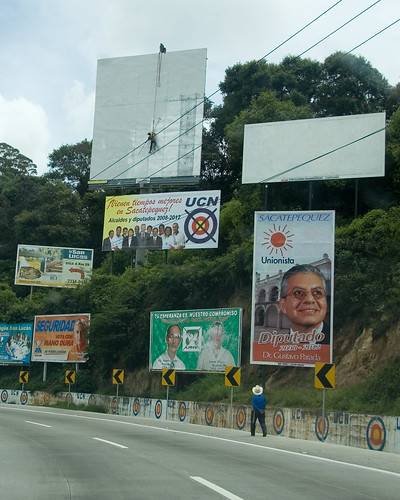
As in the U.S., the campaign in Guatemala includes television ads (clearly lower budget, the ones I saw were mostly just the candidate speaking to the camera); radio ads, often featuring full-length jaunty theme songs (particularly fun was a peppy Patriota salsa number with a cheery chorus refrain of Mano Dura!, literally "firm hand," but "iron fist" wouldn't be a bad translation); and billboards (uniformly basic with often unflattering pictures of the candidates, a name, and maybe a slogan). As in the U.S., it seems that every commercial space during campaign season is filled with a political ad -- the perilously dangling worker here is probably putting up an ad for the GANA, the biggest party not represented in the other billboards in the picture (click on the picture for a better view of the surely not-at-all-unsafe job).

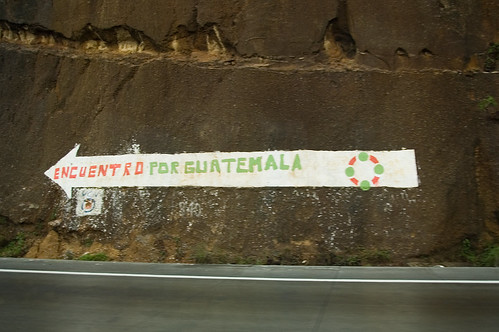
One local campaign tactic that you don't see so much in the U.S. is official graffiti. The political graffiti in Guatemala is ubiquitous. These are not simple spray-painted slogans; many are wall-sized murals, and all are clearly the result of party-sponsored efforts, despite the fact that such graffiti is technically illegal. There are stretches where every tree or rock (as above, on a road to Belize in the middle of nowhere) for hundreds of yards on end is painted with the logo of one political party. The law-and-order candidates endorsed by the graffiti are perhaps not fans of the "broken windows" approach to tackling big crime by first showing zero tolerance for little crimes.

The key to this style of campaign is the simple set of identifiers attached to each campaign. Almost every party has one primary color associated with it, although there is a little overlap. For example, the Patriotas are orange, and the UNE is green. So all you have to do is see that a stretch of highway has its rocks painted yellow to know that the PAN party has been there. On top of this, each party has a simple logo:

The Patriotas have their fist (as you can see, not all the sign-painters are highly trained pros; the monstrously large thumb here is by no means the worst attempt at a fist that your correspondents saw).

The UNE features a pair of hands making a bird.

The Unionista party uses a shining sun as their symbol ("Fritz" is the name of their candidate. His running mate is named "Quique".)

The UCN has a target.

The FRG has a hand holding out three fingers.

The PAN uses a blue italicized arrow.

Rigoberta Menchú's Encunetro por Guatemala party has a circular red-and-green symbol that this viewer thought of as a Christmas wreath and that isn't usually blurry except when photographed from a moving car.

The outgoing ruling party, the GANA, uses a Mayan pyramid. Somehow, we failed to take an interesting picture of one, though. The symbols are so well-known that the party's name doesn't necessarily need to appear -- and they need to be. The ballot features the party's logo, so the voter doesn't need to do any reading, they just need to mark the red triangle if they want to vote for the DIA or the Pepsi logo-turned-into-a-fish for the Bienestar party. Local parties are in the mix, too, with more stenciled lavender cowboy hat or tractor symbols. One personal favorite is the "Mixco Renewal Movement," which appropriately chose a broom as their symbol.


Since the graffiti are illegal in the first place, nobody seems to be regulating one party painting over another's logos. There was occasional re-use of spaces, but some sort of code of graffiti artist honor seems to have sprung up, as many parties seem to put their tags side-by-side rather than covering each others' stuff. Of course, rogue hooligans throw trash or tar or paint at opposing parties' graffiti, but no more frequently than they deface the billboards.

For a few more exciting pictures of Guatemalan political advertising in its many forms, see the full set of pictures at flickr. Disclaimer: This is intended to present to non-Guatemalan audiences a unique element of Guatemalan campaign season. In no way is any of this intended to endorse any party. Every party does this stuff, about equally.

Thursday, September 06, 2007

Coming Soon


Our first big post-departure project is about to become a lot less timely. Above is a quick preview of a bunch of material from the photo department about political grafitti in the run-up to the Guatemalan elections on Sunday; we're hoping to have a further photo essay of sorts up by Saturday. So when you see the banner headlines on the Guatemalan election results on the front page of your local paper on Monday, think of us.

Wednesday, September 05, 2007

Back from August Recess


Somehow we survived the terrible hardship of having to spend an entire month of vacation in the U.S. during August, and somehow you survived a full month of the Holla not posting a thing -- not even a random picture here and there.

Well, we're back. Our final leg, a trek from Colorado to DC via Kansas (as pictured above: The Lovely Katherine contemplating the somewhat-pricey-but-definitely-worth-it glory of "Prairie Dog Town," a legitimate tourist attraction in Oakley, Kansas), Boston and New York, concluded a mere 16 hours before classes were set to begin yesterday. Now we are starting the long slog through eight months of Latvian. (Your correspondent can already refer to his faithful traveling companion as "my little heartflower" in Latvian; it remains unclear what remains for the balance of the eight month course.)

It is our hope that the combination of being stationary and certain budget overruns over the last month will inspire the editors to dedicate significant evening and weekend time to the Holla over the next few weeks. And we hope not all of our five loyal readers have totally forgotten us or assumed that we would cease publication upon our departure. We certainly have some tales to tell and, we think, several months' worth of pictures that we hope you'll like as much as the staff photographer does.

Sunday, August 05, 2007

Home Leave


We apologize for jumping ahead in the script a bit, but the staff is currently on Home Leave in Colorado and quite enjoying it. The staff photographer took approximately one million pictures on the way through Mexico of which 999,990 will need to be discarded, and your correspondent hasn't written a word about the trip. But we took a much more manageable number of pictures on a trip out onto the Eastern Plains of Colorado, to such exotic Colorado locations as Brush, Anton, Akron, and a town that is literally no-joke called Last Chance.

For those who are curious, "Home Leave" is a required month of vacation in the United States between Foreign Service Officers, so that we don't forget what's so great about the country we're out there representing or go native or start identifying with the terrorists or what-not. We're struggling through.

Anyway, if you want to see what the staff photographer has been up to since our arrival, and get to know the part of Colorado that doesn't look like Aspen, check out this quick slideshow at Flickr.

Thursday, August 02, 2007

Of Moving


We are filing this report from beautiful Windsor, Colorado. It has been a superb week of travel by land from Guatemala through colorful, beautiful Mexico and less colorful, but still beautiful, Texas and New Mexico. Further reports and photos of the journey coming soon in this space.

But starting at the beginning, we had to first get ready to get out of Guatemala. It got off to a rocky start when the moving company "forgot" to show up at the appointed hour, but it was all uphill from there. The State Department generously allows employees to skip work while the moving company is packing up their belongings. While it might be more useful to have a couple days off for preparation before the movers showed up, your correspondent can't complain about his days spent alternately observing the moving company to make sure they didn't accidentally put any of our super-valuable household items in their pocket instead of the boxes (no problems observed) and reading a history of the Baltic Revolution against Soviet rule in preparation for future assignment in Latvia (problems definitely encountered in the somewhat dry text, but we soldiered on).

Having a moving company pack up all your stuff is, to use one of our favorite words, awesome. It doesn't mean that moving isn't a pain in the ass. It is still a massive pain in the ass. But it does transfer a lot of the physical labor to someone else. I don't know what we'll do when we have to actually move ourselves again someday, although with all the moving we've done over the last few years, we're considering becoming those shut-in types who don't move for fifty years once we land back in the U.S. for good.

Anyway, watching the moving guys work is also impressive. Everything - and we mean everything - is wrapped in paper before it goes in a box. So when unpacking you find things like paperback books carefully protected in a newsprint. This is not a complaint, because the thorough job the Guatemalan packers do should mean very little breakage. We hope. In any case, everything must be wrapped, which means even the odd-shaped pieces of furniture are mummified in paper-bag brown paper. It was almost like watching a master artisan at work seeing the old moving guy whip out a perfectly coffee-table-shaped package for our coffee table. It wound up being, truly, exactly the shape of the coffee table, tightly bundled in a half-inch of cardboard. For example, our couch, as seen from our balcony on the way to the truck:


In all, the army of guys needed just over one work day to completely pack up all our worldly belongings and put them on their truck. We were left with a few suitcases for the trusty Nissan Sentra's trunk as our only possessions for the next month, when we hope to be reunited with in our nation's capitol.

Coming next (and hopefully soon): Driving through Chiapas.

Tuesday, July 24, 2007

Adios


It´s been two great, and very fast, years. We´ll be back after a week of driving through Mexico with new material about Guatemala published from our new headquarters in the U.S. and other exotic ports of call.

Wednesday, July 18, 2007

Of the Medio Maraton Las Rosas


Your correspondent's dedication to aerobic exercise while in Guatemala has been a bit spotty. Guatemala isn't really an ideal location for running or biking, although that doesn't seem to stop some small portion of Guatemalans who are out running or biking in full regalia as if they were doing the Boston Marathon or the Tour de France, except on busy highways with no shoulders and clouds of diesel fumes everywhere. As such, there are occasional tests of athletic skill, such as the recently contested "Las Rosas" half marathon in Antigua.

Several co-workers of The Lovely Katherine decided that this would be a fantastic team-building opportunity to do the half marathon together, allowing everyone to participate by walking if they wished. Your correspondent agreed to participate as well, under some delusion that such a goal would motivate him to actually get some exercise to run the race. That delusion dispelled after a month of no training of any significance, your correspondent decided to go ahead and walk the race with the rest of the group.

It turns out that the idea that one might want to walk in a half-marathon race is foreign to many Guatemalans. The race started in a tight pack that took a while to thin out, so even the people who hoped to be running couldn't. But before long the runners sped ahead, putting some distance between themselves and the walking participants. And by "walking participants," I mean The Lovely Katherine, about six of her co-workers, and your correspondent. Through the early going, we enjoyed a symphony of honking horns as cars grew frustrated that the race route was still closed despite the fact that there didn't seem to be any runners on it. Before long, the gap between us and the main pack grew too great to ignore, and they reopened roads to traffic and we moved to the shoulder. A healthy crowd had turned out along many populated sections of the route, and reactions to our efforts were mixed. The majority of observers cheered us on, clapping and yelling "animo!" In the early going, some observers offered kind encouragement, saying "You've just started - you can keep running!" Others were more direct, with "cheers" such as "What are you doing?" or "You already lost!" One kindly woman listening to a radio report told us that we should take the shortcut to the town square, lopping off the last six or seven miles of the race, because the winners were just about to get to the finish line anyway.

Your correspondent will admit that he just about died of embarrassment in many of these stretches. Fortunately, the enthusiasm of the staff photographer for wandering through some of Antigua's outlying neighborhoods in a large group with a mostly understanding crowd won the day. We carried on through the full 13 miles, minus a couple short shortcuts, and returned to the main square to find that they had long since disassembled the finish line timer.

Sunday, July 08, 2007

Plenty of Egg, Needs More Nog


The Holla offices are getting a bit hectic as we pack up our reams of meticulously filed notes from various field studies, the presses, the massively disorganized payroll department -- everything -- so we can decamp for Washington in a couple weeks. We of course have a few vital research items to accomplish. Last night, we hosted a going-away party, which the Spanish-speakers of the world, with uncharacteristic efficiency, simply call a "despedida." It was a fantastic evening, with solid representation from chapines and gringos alike, from both the Embassy and Common Hope (where The Lovely Katherine works).

Of course, in our relentless quest to uncover every bit of inside knowledge Guatemala has to offer, and pass it on to you, the loyal reading public, we knew this was our moment to finalize a long delayed task. Guatemala has many legitimate claims to fame, but the sad truth is that their culinary prowess is not among them. But even the cultures with the least enticing cuisine manage to come up with unique potent potables. Some time ago, your correspondent was dispatched to the Highlands of Quetzaltenango and Huehuetenango. In reaching Quetzaltenango, one must pass through the smaller town of Salcajá. There are many towns this size through the country with nary a bibulous product to their name, but somehow, Salcajá is famous for producing two different varieties of distinctive local booze. Your correspondent returned with a bottle of each caldo de fruta ("Fruit Stew") and rompopo. The latter seems the more dangerous, as its primary ingredient is -- no joke -- eggs, which provide its distinctive yellow hue. There are several signs in town advertising rompopo for sale, and after choosing the sincerest rompopería to be seen, your correspondent entered to find a simple room with two glass cases filled with bottles of the vaguely nog-like product, a picture of Jesus, and nothing else. However, the caldo de fruta was sold at the same establishment, but the customer had to specifically as for it, prompting the employee to disappear into a back room and bring out the fruit-filled crimson bottle. In the end, your correspondent could not be sure if he purchased illegal moonshine caldo de fruta or legal moonshine caldo de fruta, but we applaud his willingness to take the risk in the name of journalism.

In the end, the purchased beverages were a bit too vibrantly colored and, in one case, a bit too eggy, to tempt our tastebuds on any given evening. That ended last night, when we shared with our guests/victims the two delicious concoctions. (The rompopo actually says "Delicious Rompopo" right on the label.) Despite the fact that they had languished for about a year in our liquor cabinet, several brave souls stepped up to give them a try.

The verdict? Caldo de fruta tastes exactly like 80-proof Robitussin. And the rompopo? As the winning smile on the face of our test subject shows, rompopo is an acquired taste. You might be able to come close by mixing egg nog with cream of wheat, blending, and then adding some more eggs. Suffice it to say that while we will be returning to the U.S. with a small supply of a number of Guatemalan delicacies, such as coffee and Zacapa rum, we will not be sneaking any bottles of rompopo across the border.

Special thanks to Todd, who was perhaps the most willing of many who risked their lives by drinking rompopo last night. We hope to see him at work on Monday.

Friday, July 06, 2007

Jugando el Golf


Nearly two years ago, we packed up everything we own and shipped it to Guatemala. Much sporting equipment has languished in our "maids' quarters"/sporting goods graveyard since that time. Somehow, the skis just didn't come in handy. But as the final weeks of our engagement in Guatemala tick away, your correspondent finally found an in to do some vital research on the links of the Land of Eternal Spring.

My co-worker Carlos's family is now a member at the tony San Isidro Club Campestre, which is a really old-school country club. I would guess that they would allow American diplomats of any shade into their clubhouse, but I'm not sure that there has been a test case.

They have a full locker room with wood-paneled lockers and complimentary shaving cream.

They have a bar that is actually, literally called "The 19th Hole," with a sign and everything, and, as near as we can tell, no women allowed. (Women are allowed to be members, and to participate in the primary 18 holes of the facility, but I guess men need to be able to tell sexist jokes in peace over a drink. Maybe there's a women's 19th Hole that we didn't see, decorated in pink or some such.)

They have caddies. Our first trip out, one of the caddies told us we had enough time to play out holes 1 and 2, and then play number 18 back, and then it would rain for the rest of the afternoon. We did as he advised, and literally as we were walking off the 18th green it started to pour. Smart caddie. And since we carried our own bags, he wasn't even getting a tip out of it. The downside of the caddies were a few holes where we saw literally 10 people milling about one green, as four or five guys and their various attendants all shuffled about -- and they had golf carts to carry the bags. I guess the caddies are really just there to let people know how many more holes before it rains.

On the 4th of July, we actually made it out early enough to get in a full 18 holes before the rainy season's afternoon storms ended our day. Of course, daily afternoon downpours left the course in middling condition -- I had a couple nice drives into the fairway that plugged into the dreaded fried-egg formation in the rain-softened ground. No matter; the course was beautiful, set in the rolling hills above the city (which city you can see over the horizon in the above picture), and while our host was not an excellent golfer (which you can see by him missing the ball in the above picture), he was an excellent host.

Monday, July 02, 2007

Of the Kaibiles


Some of our more attentive readers, or perhaps just the emotionally needy ones, will recall that in a previous, slightly jumpy (ok, we admit it, schizophrenic) post about Belize, your faithful correspondents promised you more detail about a contact working on a special assignment training with the Guatemalan version of the Green Berets. We weren't kidding. Upon further reflection, however, we have determined that given certain exigencies of our other, more lucrative, employment, we should not in this forum editorialize about the Kaibiles, or Guatemalan Green Berets.

So, just the facts. Apparently, in training to work as the Defense Attaché in a Latin American Embassy, many of our men in uniform actually go through the officers' training classes of our Latin American allies. Guatemala is one of those allies, and so, a Major friend of ours from the Embassy has spent his months here training with the Guatemalan army. One of their tasks, as it was described to this civilian, involved hanging out in the jungle for a couple days, running up mountains in the middle of the night, swimming down rivers, and such. I would have imagined these to be tasks more befitting an enlisted man, but I will again caveat my complete ignorance of such matters.

Anyway, on our way up to Belize by road, all of four weeks ago at this point, we stopped to pick our Major friend up from his jungle outpost, which happened to be on the way. Said outpost (see illustration, supra) features castle-turret themed guard posts along the perimeter, and a sign that translates as: "The Kaibiles of Guatemala / Respected by their adversaries / Loved by their people / Have a nice trip."

Sunday, July 01, 2007

Unusual Visitor


The Holla offices are too busy preparing for our pending return across the continent to be exploring Guatemala as fully as our loyal readers have come to expect. But we did find this guy hanging out on our sixth-floor balcony, flat on his back, creepy little legs waving helplessly. Not unlike previous creepy visitors we're a bit baffled how he got up six floors and then fell over on our balcony. Being lovers of life as we are, we tried to set him aright and let him go on his way, but he promptly flopped back over on his back, apparently suffering from a cramp from climbing six floors up our apartment building. Guatemalan folk wisdom does claim that all variety of bugs try to gain access to human habitations when the rainy season starts, but that was well over a month ago now. In any case, since he was too wounded to wander away, we had no choice but to photograph his predicament in a warning to any other insectoid intruders contemplating scaling our building.

Wednesday, June 27, 2007

Water Hazard


I guess it proves that I'm American and will never truly understand the beautiful game that I don't know what the ruling is if the ball lands in small inland sea that has formed in the middle of the playing field.

Sunday, June 24, 2007

On Language

All the Americans in our Embassy are trained and tested in Spanish before they are shipped to post. Most of us have what you would probably call "functional" Spanish upon arrival, moving into "proficient" Spanish after a couple years here. Some few colleagues who served in the Peace Corps or grew up speaking Spanish are better-off, but most of us come to a point where we can hold our own.

The Guatemalan employees, who outnumber the Americans by a significant degree, almost all speak fluent English.

It makes for an interesting workplace. I can carry on a pretty fluent conversation in formal Spanish. And I can mostly get by with more colloquial Spanish, guessing slang words or run-together words on context. But in either case, I still have to think about it. Imagine your average cube-farm sort of workplace where you can overhear the conversations of your ten closest neighbors. It's pretty hard to concentrate. And whenever you go by the water cooler, you're going to pick up a little of what everyone's talking about. You can't avoid it, short of covering your ears and yelling "la la la la I can't hear you," because the language you've spoken since you were two drifts by your ears, and you would have to be completely transfixed by something else to not hear what your neighbors are saying. understanding spoken English for me is unconscious, and even if I would rather not be distracted, it takes some effort to stay focused on work if there's another conversation in earshot.

In a mostly-Spanish-speaking environment, the script is reversed entirely. I can walk into our little kitchen where several colleagues are chatting in Spanish and unless I make an active decision to listen to them, it's just as easy to fill up a glass of water and leave, blissfully ignorant of the latest gossip. And when we're all at our little government-cube desks, everyone else in the place can be chattering away and I can maintain constant focus on my work (or my personal e-mail, while we're being honest).

It's definitely a big plus for productivity. Of course, in a managerial sense, one begins to realize how much there is to be learned by just picking up bits of conversation from colleagues. The "management by eavesdropping" strategy is a little harder when the boss has to drop everything and actively listen to the speaker to tell if she's whining about her husband or if she's whining about the boss.

As Promised: More on Belize


Following the Holla's usual production schedule, we are exactly one week late in bringing you a report on our trip to Belize. Hopefully you'll find that the extra time has allowed for further reflection and refinement of the ideas inspired by our time in Belize.

Which would be a surprise, since your correspondent is struggling to come up with much to say about Belize beyond a catalog of things we did. We scuba'd. We snorkeled. We consumed island delicacies. We soaked in the Caribbean atmosphere.

As regards the scuba, it was pleasant. The reef there is magnificent. The most exciting (and really, only) major animal sighting was a few huge spotted eagle rays gracefully swimming by. We also saw an abundance of what are technically known as Pretty Tropical Fish in formats that we're pretty sure we hadn't seen before. But further taxonomic precision escapes us.

As regards the snorkeling, it continues to surprise your scuba-snobby correspondent. I have been snorkeling a total of two times in my life, both after I was already scuba certified, and have thoroughly enjoyed it both times. Assuming one is doing it in appropriately shallow water, one gets just as close to the sea life as one does diving. You'll never see some of the really magnificent stuff snorkeling, but you'll see other really magnificent stuff. In this case, there were more Pretty Tropical Fish. But also at one of our snorkeling sites, the sound of the boat is associated with fisherman dumping off unwanted fish entrails (or so we're told) and so a whole swarm of stingrays (and one huge barracuda) show up whenever the boat does. It sort of felt like cheating. Then again, watching stingrays swim is so cool, it was worth cheating for. Thus, the photo department's first attempt at just-barely-underwater photography, seen above. Obviously still a few kinks to work out of the system.

Which brings us to the matter of the island delicacies, of which there are apparently two. First, June 15th brought the beginning of lobster season to Caye Caulker, so every restaurant in town had a cheap lobster special. I'm not so into lobster and the attendant labors of eating it that I would ever order it in a restaurant in the U.S. But on the opening weekend of lobster season, a $15 full-lobster dinner is hard to turn down, so I had two. The other island delicacy is a drink known as the "Panty Ripper," which is a simple mix of coconut rum (in the States, you could use Malibu, I think the Belizeans use something that one of their fellow islanders distills in his bathtub) and pineapple juice. Your correspondent does recommend the combination, although he couldn't bear too many as they are a bit too sweet and fruity for his masculine pride. In any case, such a simple combo shouldn't be exclusive to Belize, but if you do a Google search on "Panty Ripper," several of the top hits are about Belize. (At least, that is, if you've set Google to filter out all the pornography.) If any loyal reader is a Malibu fan who enjoyed this drink under a different name, perhaps in your sorority days, do let us know.

Lastly, there is the Caribbean atmosphere. If you haven't been, the rumors are true. The ocean is gorgeous turquoise. There are lots of guys selling rasta-themed souvenirs. There is way too much reggae music, though it was a nice break from the reggaeton music that is inescapable in Guatemala. There is no rush to do anything at all. In fact, the motto of Caye Caulker, inlaid in mosaic on the dock where the water taxi drops you off upon your first arrival, is "Go Slow." We met one guy who had moved from Florida to Belize for the express purpose of going slow. Well, that and because there were too many Mexicans in Florida, so he moved to Belize so he wouldn't have to learn Spanish. Anyway, he now makes his living slowly, selling barbecued shrimp kebabs from a hibachi on the beach. Many fugitives from all over the world come to Belize based on the understanding that the police there will also go slow. As for your correspondents, we have a hard time with going slow, especially when we've only got a three-day weekend minus travel time to cram in as much sightseeing as we can. But you don't really have a choice sometimes on Caye Caulker, so we went as slow as we could.

Saturday, June 23, 2007

Truth in Advertising


From Caye Caulker, Belize, where advertisers apparently favor the direct approach. More on Belize coming soon.

Thursday, June 14, 2007

Inclusivity


We went to an all-inclusive resort. We drank fruity cocktails. We lounged.

One of your correspondent's colleagues departed Guatemala for good today, and to send her off in style, a crowd of hearty diplomats rushed the Royal Decameron Resort in Salinitas, El Salvador. For your correspondent, and his faithful traveling companion, this was something of a change of pace. We're more accustomed to $20 middle-of-nowhere lodges where one prays there is hot water. Many in our traveling party raved about how great the price was at the Decameron, whereas your correspondent was suffering a bit of sticker shock. Traveling party responded to any hesitation with the irrefutable reply: "But it's all-inclusive!"

Faithful readers may recall our previous visit to a resort-style destination. But that trip was Scuba-focused. This resort is rather more for the "sit in a beach chair and drink Mai-Tais" inclined. Which suited us mostly fine, and we had a great time sitting in the pool and chatting with our friends and enjoying ridiculously named drinks like the Banana Mama and the Pasión Tropical.

Ridiculous activities were available for the more active set, such as water aerobics done to deafening 180 beat-per-minute techno music (which appeared to be mostly just an excuse to have one extremely fit "instructor" of each sex to girate rhythmically at poolside for the viewing pleasure of participants and non-participants alike (mostly non-participants)), or some game where teams of two use towels to toss volleyballs around a circle. We, despite considering ourselves "active," declined to participate.

This is apparently not a top-notch, five-star resort, as evidence by certain online reviews bemoaning the lack of "towel art" in the rooms. I would guess at the really pricey resorts of the Caribbean, you needn't leave your lounge chair to order another Makers on the rocks. That was not true here. This resort's tactical response to all-inclusivity was a three-pronged attack of cheap plastic-bottle booze, dixie cup servings, and no waiters. Here, we counter-attacked by bringing our own Big-Gulp sized cups to minimize trips to the bar and befriending the bartender so we could without hesitation ask for just a bit more vodka and tabasco in that Bloody Mary. (By Sunday, your correspondent had consumed as much rum and citrus juice and pre-mixed colada as he could handle and had to stick to vodka, perhaps a positive sign for Northeastern European days to come.)

In any case, your correspondent values the rich tapestry of personalities that makes the human experience so varied and interesting. But people who choose to go to places like this for their whole vacations leave me baffled. Though the staff photographer did enjoy the near-studio light on our balcony, as seen above, your correspondent was getting a bit itchy about all the doing nothing on day two. A whole week would be fatal.

Monday, June 11, 2007

Belize, Part Two

We now present part two of this unintentionally serialized story of our brief trip to Belize. When we last left your correspondent, we was describing the group's arrival in Belmopan...

... Maybe we were just punchy from the drive, but we laughed and laughed. Such is the result of wandering off into the jungle for hours, only to reach the exotic post of assignment that would, in fact, not look out of place along the interstate beltway circling any American sun-belt city. Except that instead of having a highway next to it, it had a dirt road cutting through scrubby secondary growth. To some extent, the joke was on us, as in our 90 minutes in Belmopan we ate at a Chinese restaurant that was far, far better than anything in Guatemala City, and actually would give most any option in Washington, DC a run for its money; coupled with beer that proved without a doubt that Belize was a British colony, not a Spanish possession (despite some continued Guatemalan opinion to the contrary).

After this delicious feast, we really had seen just about everything there is to Belmopan. Our traveling companion shuttled us through Belize City and off to the airport in her beau's stylish Jeep. And, as we were getting the autograph of legendary Belize City airport bartender named "Jet," our friend was driving said Jeep back to her sleepy little gated community. And as we were possibly in the air on the way to Guatemala via El Salvador, she blew out a tire (or something) on the wide Belizean highway, flipped said Jeep and rolled it several times on the Nebraska-flat landscape near Hattieville, totalled the S.O.'s Jeep, and walked away while various Belizean on-lookers gathered to dig through the glove box for anything portable and valuable. She spent a night in the hospital and a week away from work, but the bigger tragedy is that now she's trapped in Belmopan without a car, despite all our efforts, and nothing to do but eat the best Kung Pao Chicken this side of California.

Thursday, June 07, 2007

Belize

It has indeed been forever since I rapped at ya. There has been some amount of nothing happening. And I've been laid low by some of the things that have happened. But this last weekend, we checked off one of the final Central American destinations we had yet to visit, the erstwhile 22nd province of Guatemala.

Many think of Belize as a destination for lazing on the beach or snorkeling from one of its many Caribbean islands. Not your intrepid correspondent. One of our dear friends from the Embassy is being temporarily assigned to Belmopan, Belize for six weeks while they are desperately understaffed. Recognizing the islands as the primary attraction of the location, she was dedicated to driving so as to avoid being trapped and car-less in the jungle interior. This involves some amount of remote highway frequented by brigands and highwaymen. So we agreed to pile in the 1998 Chevy Lumina with her and trek down the mountains, across the desert, through the jungle, and on to Belize, seeing some of the Guatemalan countryside we had not yet enjoyed. The Lumina was a late scratch, and a gentleman friend of our colleague agreed to loan her his Jeep (for the whole six week assignment!). Slightly later than originally planned, we set off down the treacherous mountain. Hours of highway driving stretched on, and we eventually met the owner of the Jeep in the remote jungle lair where he was training with the Guatemalan equivalent of the Green Berets. (No, really. More on this later.)

After a day of not really that many hours on the road, we were nevertheless drained by the challenging road conditions upon our arrival in Flores, Peten. The travelling party was dedicated to enjoying our last evening together for six weeks, and so managed to drink a variety of tasty beverages while barely keeping our eyes open. The next morning, we met up with our police escort for the notorious final two hours to the border, crossed into Belize with just about the expected amount of hassle, bought Belizean car insurance, and pushed on for the capital city of Belmopan.

The exhausting weekend of driving was proved entirely worthwhile upon seeing Belmopan. The city was created in the middle of nowhere when the government grew weary of the capital, which was then located on the coast in Belize City, getting knocked over by every hurricane that passed by. As capitals go, you might say it is a little sleepy. There may be as many as 15,000 inhabitants, but I doubt it. There is a modest city center, a few blocks of small residential developments, and then a few blocks of scrubby undeveloped land split by dirt roads, and then one runs into the massive, thoroughly modern U.S. Embassy. Then, after a few more blocks of scrub and jungle and dump, one finds the U.S. Embassy employee housing complex, built half a mile away from the nearest development, surrounded by a 10-foot-high, bright yellow wall and containing 14 identical tract houses. Maybe we were just punchy from the drive, but we laughed and laughed. Such is the adventure of venturing off into the jungle for hours to reach the exotic post of assignment that could possibley

Saturday, May 19, 2007

Technical Difficulties

It has been brought to the editor's attention that the slideshow link in the previous post is not working for some and maybe all viewers. We regret the inconvenience. If you're not seeing any pictures on the slideshow link, perhaps you would like to just go to a page where you can click on each picture? Probably not. Better luck next time.

Wednesday, May 16, 2007

Capabilities

A few years ago, they came out with one of those studies that they do apparently for the sole purpose of landing a crazy story in the newspaper. Scientists discovered that people's self-assessment of how good they are at a given task is inversely related to how good they are at the task. I.e., enthusiastic amateurs who know just enough to be dangerous think they are pretty darn good at stuff; whereas near-masters have a deep understanding of just how far they are from true mastery. I loved that study.

From a world of less rigorously tested yet more certain knowledge, it's easy to get bored looking at other people's vacation photos.

Flying in the face of these two important lessons: I think I take more interesting vacation pictures than a lot of people. And Flickr just released a significantly improved version of their slideshow viewer. So if you've got 30 seconds to kill please breeze throught 18 pictures from Mexico.

Tuesday, May 15, 2007

Holla Staff Lavished with Further Awards

Guatemalans love recreational sports leagues. I actually don't have any evidence to support that claim, but it sounds better than the statement I can support: Guatemalans who play recreational sports leagues get really into them. Your correspondent is now proud owner of a medal, awarded by the appropriate sanctioned authorities. The obverse of this medal reads, in its entirety: "Gatorade" with the little Gatorade lightning-bolt logo. The reverse reads, in part, "Pollo Rey" with a little picture of a chicken wearing a crown; then, smaller, "Champions, Group C." I earned this prize for playing sporadically on 7-man soccer team, which won the title for the entry-level division.

I guess I haven't really played organized sports as an adult in the U.S. But most leagues I'm aware of might involve everyone chipping in for a team t-shirt, and the teams might win a chintzy trophy at the end of the season. In this, and several other Guatemalan leagues I'm aware of, the rec league is like a full-blown pretend version of the real thing. There are full teams of referees (of questionable quality), medals for the winners (?!), games happen during prime evening and weekend hours, and most unusual of all, everyone has to buy full-on matching uniforms. For example, a friend joined up with the Embassy-associated softball team and was not allowed to play at first because he didn't have full-on sliding pants. The uniforms that the softball team have to invest in are ridiculous Triple-A caliber getups with matching socks and everything.

The soccer league your correspondent (sporadically) participated in was particularly funny because you need to buy a full uniform, but apparently nobody could think of a uniform that didn't already exist. Or maybe everyone just wanted to play out their fantasies of being on a famous international soccer team. As a result, all the teams in the league had uniforms that were direct copies of Real Madrid, Juventus, or in one case, the English national side, with the little St. George's Cross and everything. In one particularly storied evening, your correspondent's team, decked out like a little 7-man version of FC Barcelona in their blinding yellow alternate kit. We faced off against our hated rivals, a less talented 7-man version of FC Barcelona in their blinding yellow alternate kit. After a full (short) half of very confusing football, someone pulled out seven of those pull-over tank top things that you use to designate the second team at a practice where everyone is normally on the same team and therefore wearing the same uniform on purpose. Despite an especially hard-fought game, with the blinding yellow unis of our oppenents topped with hunter-safety blaze-orange tanks, the only injuries were to the eyes of unfortunate spectators. And the lesson (hopefully) learned is to not pick the uniform of last year's European Champions for your team kit.

Sunday, May 13, 2007

Of Acatenango


There are three major volcanos (or four, really) visible from Guatemala City on a clear day: Agua, Pacaya, and Fuego/Acatenango (twin peaks, one active volcano and one dormant volcano, connected by a small saddle). As previously reported, your faithful correspondent has summited the first two of these. The latter was conquered this past weekend.

It was a fairly early start, a steep climb, cold weather, and some nice scenery. The best part was the opportunity to camp at the (almost) top of the mountain, doing the last half hour of climbing at dawn to watch sunrise from the summit of dormant Acatenango. From there, one could look down at the smoldering cone of active Fuego, poking out of the early-morning clouds. Of course, the staff photographer didn't get any shots of it; he brough only the cheap back-up camera due to concerns about robbery of the expensive primary camera, which back-up camera, of course, failed prior to reaching the top.

Given reports of theft on the trail, we hired a capable guide at the tiny town at the bottom of the hill -- as with most climbing expeditions in Guatemala, the primary purpose of the guide is to carry a machete and scare off possible theives. He hiked to the top in his loafers, apparently bringing nothing more than a little white bread and an orange to eat. Each time we pulled out snacks or dinner, we offered him some, which he gratefully accepted, and then as near as we can tell, squirreled away in his pack to give his family when we got back to the bottom, content to mostly just eat white bread. Exactly why we were carrying all this food to the top of the mountain for him didn't quite make sense, but it was probably a better workout that way.

Sunday, May 06, 2007

DF


Sometimes better things come in bigger packages. Guatemala City is estimated to have a population around 2 or 3 million people. But it punches below its weight compared to smaller cities culturally, culinarily, architecturally, &c. While it is the firm belief of the Holla that the rest of Guatemala more than makes up for the capital's shortcomings, the city's failings are not uncommon among developing-world metropolies. Millions of rural immigrant laborers moving to the city don't necessarily make up a market for great pad thai. Except maybe in Bangkok.

In any case, on our recent trip to Mexico City, I wasn't sure if we would find a city of 20 million people subsisting on beans. Any fears were misplaced. While Guatemala is a fantastic place to visit if you have some time to get out into the sticks, Mexico City (or "the D.F." as those in the know call it) is a fantastic location for a long weekend visit. It has varied neighborhoods, amazing museums, a rich street life, and an actual middle class and the attendant restaurants, bars and cafés. Since we explored only the center of the city and a few of the nicer outlying neighborhoods, we can't rule out the possibility that there are still 18 million people outside the center subsisting on beans, but there is a Guatemala City-sized core that ranks alongside Buenos Aires at the top of the Latin American city list.

Of course no city of 20 million people is without its attendant difficulties. On wour way into the city from the airport, traffic delays were signifcant. The airport taxis have a central-dispatch system, and when the dispatcher assigned us, and our city-center destination, to the cabbie, he complained loudly that it would take him several days to get there and back. Each time the traffic report came on the radio, he cranked the volume to full blast, possibly to glean any route-finding details possible, but it seemed to be more to make a point that we were idiots to have reserved a hotel downtown. The radio reported that there was a quinceañera parade making its way to the central square, jamming traffic all over. A quinceañera is a girl who is turning 15, which is a huge deal in Latin American cultures - beyond a huge deal. The same way Americans spend ridiculous sums of money on weddings, latinos do the same for 15th birthday parties. We asked the driver who was having a quinceañera parade big enough to shut down most of the city. "Everyone," he replied. We later saw open-top double decker buses packed to bursting with girls in prom dresses being carted into the main square for whatever the event was.

Fortunately, traffic was aviodable because the city has a clean, efficient, and -- as far as our experience went -- safe, Metro. It even provided entertainment, of a sort. On many trains, people hawk their wares on the train cars, always waiting until the second the doors close to start and stopping the second they open again, giving the impression that the law didn't smile on their activities. Nonetheless, we had one ride where over the course of a few stops we had someone trying to sell sharpie markers (two for a dollar!), then someone trying to sell a small radio (this amazing small radio comes with its own earphones!), then someone selling compact discs (with a little backpack sound system blasting), and finally DVDs (actually holding a portable DVD player over her head as she made her way up the train car to demonstrate the quality videos on offer).

Among the tourist-attractions of note, the pyramids at Teotihuacán are magnificent, and very different from the Mayan ruins in Chiapas and Guatemala -- although they do share the crowds and junk peddlers of Mexico's Mayan ruins. The museum of anthropology is an amazing collection in a world-class facility. We overheard one guide lecturing his Hungarian charges about how certain Aztec artifacts were damaged in the "American Invasion." Which of course each side will have a different view of the war, but he went on to emphasize for his Magyar guests: "You are Hungarian. Germany invaded Hungary. The same way, the U.S. invaded Mexico in 1847." Deciding discretion in correcting flagrantly off-base analogies the better part of valor, your correspondent wandered to another of the myriad displays rather than pursue the issue. On the other side of the American-baiting coin were Diego Rivera's masterpiece murals in the public buildings of the city. They were almost uniformly magnificent, although I don't remember from Art History 102 the one with the happy laborers gleefully crushing capitalist skulls with hammers and chopping them up with scythes. Maybe better to stick with Siquieros.

Friday, May 04, 2007

Nothing to See Here


We haven't published anything in a while. We ran off to Mexico. But we're back, and will tell you all about it soon.

Tuesday, April 17, 2007

Fulfilling our Obligation to Cultural Exploration


Your intrepid correspondent and his trusty traveling companion take very seriously our commitment to serving international understanding by reporting on the subtle differences in culture between Central America and the United States. It is the small wrinkles that make the tapestry of our continent so rich. In Panama, when trying to purchase ourselves some watery local lager to enjoy in the hammocks on our balcony, we were reacquainted with the joy of buying loose cans of beer for 50 cents apiece. But more importantly, just next to all the essentially equivalent brands of beer, we saw a Unique Cultural Experience we had to try: Cuba Libre (TM) Original Formula Rum and Cola Prepared Alcoholic Beverage, pre-mixed and sold in pop-top cans for your drinking convenience.

Do we do this in the U.S.? Maybe I've just never shopped in the right package shops to do all the cultural investigation I should have back in my native land. Or maybe I just walk right by it on the way to the cooler with the Sierra Nevada in it. The only equivalent I can think of is something like wine coolers or pre-mixed mudslides or something girly like that. But how can the homeland of consumer convenience have been bested by its one-time de facto colony in providing a product for people who don't have it in them to mix their own Bacardi and Coke? I demand a Congressional investigation!

There is also an economic angle, of course, as the price point on Cuba Libre (TM) Original Formula Rum and Cola Prepared Alcoholic Beverage suggests that they may not be using top-shelf Zacapa rum, nor true high-test Coca-Cola. (Although since it is billed as "Original Formula," perhaps they had a New-Coke-style failed rejiggering of their secret ingredients at some point.) Your correspondent, having dutifully experienced the joys of said beverage and allowed its cultural significance to fill his senses briefly, moved on to research on the local beer and delegated his trusty traveling companion to do the further required investigation of the effects of consuming an entire can of Cuba Libre brand beverage. Both investigators somehow fell asleep in their hammocks, leaving scant written record to document the encounter fully. The Holla pledges to strive to avoid such lapses in the future, to the extent that seems appropriate at any given locale.

Tuesday, April 10, 2007

Yeah, We're Running a Little Bit Hot Tonight


Your correspondent recently returned from a gruelling nine-day expedition to Panama, and after the preceeding one-note entries, has finally completed the traditional too-long Holla trip report.

While our trip to Panama seems to fit into the mission of this journal, because it's sort of Central American (although, historically, and in many ways, culturally, a lot more South American), it really was a week of vacation. The editorial board is somewhat distressed by the fact that Guatemalan life has become so routine that this journal has become little more than a record of our weekend trips, but until we find some more talented writers, that may be unavoidable. In any case, a full week of vacation run-down may be more than all but the most patient and closely-blood-related of readers can bear, so we'll endeavor to hit the highlights of general interest.

First, and quite possibly foremost, Guatemala finally has a competitor for the coveted title of "worst national beer in Central America." Panama Lager is just as watery and flavorless yet aftertaste-ridden as Gallo. And yet, Gallo still holds the title as the worst because Panama lager was usually $1.00, except in happy hour, when it was 75 cents, which is a much fairer price than what one shells out for a Gallo.

With that sad discovery taken care of in our first night in Panama, we were ready to do further exploring, and took a boxy prop-plane to the Bocas del Toro islands, on the Caribbean side of the isthmus, near Costa Rica. After getting the lay of the land and taking care of important business such as re-confirming that the local beer was not noteworthy but was cheap, checking the functionality of the hotel hammocks, and eating a couple delicious meals, we rented bikes to head for the beach.

Although the bike that The Lovely Katherine was stuck with dropped its chain every five minutes, and your correspondent chivalrously took a turn on said bike only to have the chain pop off on the steepest dirt-road downhill of the trip, rendering the coaster brakes useless and forcing an emergency braking procedure courtesy of a knee-deep puddle at the bottom of the hill, the travelling party survived to find a beautiful deserted beach of soft sand and pleasant surf an hour from town. The joy of finding a deserted beach such a short flight from hundreds of millions of North American beach-seekers was immense; of course, there is a multi-story luxury condo development planned for Bocas del Toro town starting any day now. In any case, it was good to be there when we were. The tourist infrastructure was enough to offer a Thai restaurant and two competing dive shops, but not so bad that everything felt manicured yet.

Other activities over the next few days included scuba diving, kayaking, and snorkeling. Animals spotted included tiny red tree frogs, sharks, stingrays, dolphins, and the elusive (no, really) ocellated frogfish.

We moved on to Boquete, a smallish town in the Panamanian Highlands. We went for a hike that turned out to follow a road past endless lots that were either for sale, or featured a huge, modern home with an SUV parked in the drive, or in some cases, both. This was not the only place along our trip where we calculated that given different circumstances we would definitely buy property, as the market was clearly going nowhere but up. There are apparently a lot of Americans buying retirement homes in Boquete, or rich Panamanians buying second homes there, or probably, both. As such, there is a new mini-mall in town, including a wine shop selling Wente Zinfandel from beautiful Livermore, CA. We sat out on our deck, gazing at the Pacific tens of miles away and enjoying the first California wine we've purchased in Central America. The Panamanian Highlands may not have much on the Guatemalan highlands, but they do have good wine, and they have the national bird of Guatemala. We went on a hike specifically to spot the elusive (no, really) Resplendent Quetzal, on a trail specifically called the "Trail of the Quetzales." We were pretty sure we would be let down, as we've heard of many foiled attempts to find quetzals in Guatemala. I literally gasped with suprise and excitement when we managed to track down a group of a few quetzals based solely on the approximation of their call that the ranger had given us. The Staff Photographer provided more excuses about photographic conditions than he did good pictures of quetzals.

Nonetheless, we considered our mission accomplished and climbed onward to the scenic viewpoint and allowed the photographer to focus on more stationary subjects. We started in on our picnic lunch and it began to rain, so we took shelter and waited for it to pass. It did not pass. The "cloud forest" did its best impression of a full-on "rain forest" as it poured on us the whole way down. Being experienced hikers, we would have been fine with a little rain, but the Panamanian philosophy of trail maintenance was a bit shy of American standards. The trail was eroded into a gully the whole way down, which flooded with running water, becoming possibly the largest river in the department. We hiked down in several inches of rushing water, and arrived at the bus stop back to town soaked to the bone.

Luckily, we didn't have to wait long for a collectivo bus to come by, and we were soon cheered by the thoughts that we would soon be warm in our hotel room with another bottle of delicious California wine. We enjoyed and/or endured the views on the bus trip back into town, and apologized that we were still dripping water on the floor when we went into the gourmet deli to select a vintage for the evening. They, in turn apologized that the mayor of town had banned all liquor, beer, and wine sales from Holy Thursday through Easter Sunday in order to ensure that all residents showed proper respect for the highest of high holy holidays. We literally had to have them explain it to us a couple times, and they showed us where the mayor's decree was posted on the wall near the wine section.

There is a popular theory that life in the Foreign Service leads to high levels of alcoholism due to job demands including regular cocktail parties, on top of the isolation and boredom of living in certain remote posts. I don't think your correspondent is contributing to that statistic just yet, but after hiking for hours in the rain and then being told they would not be allowed a celebratory tipple to top it off, the entire travelling party was perhaps irrationally upset about the situation. Our vacation - ruined! What on earth were we going to do in Boquete for an evening if not split a bottle of wine? What kind of self-defeating mayor bans alcohol in a tourist town in one of the busiest travel weeks of the year? And what kind of liquor store puts up with it -- and doesn't even bother to tell customers on Wednesday that this is their last chance to stock up for the next few days? Resourcefulness prevailed and disaster was averted as we eventually found an Italian restaurant where the waitress was either ignorant of the law or rebellious enough to break it and we managed to have some wine with our saltine-crust pizza in the end, without having to knock over any convenience stores.

We'd had enough, and decamped the next morning for a long bus ride to Panama City, featuring a brief spell of sitting on the floor of the aisle in the middle of the sold out bus, and a not-so-brief spell of sitting on milk crates in the aisle that the bus driver helpfully stopped to pick up.

We got to Panama City, picked what seemed like a couple good restuarants in the bustling, cosmopolitan city, and discovered that they had one-upped Boquete by closing down entirely for Good Friday. Apparently pizza places are the least pious eateries in Panama, as we once again were saved by middling pizza, although this time they would not relent on the liquor. We spent Friday, a day of our precious vacation, entirely alcohol-free. As you know because I'm writing this now, we survived for a final day of sightseeing at the Canal
(pictured above) and other sites, but I swear I don't know how we did it.

Gonna Fly Now


Another one-off photo from Panama. Somehow the photo doesn't look quite as much like it's Jesus flexing his biceps as it did in person. The staff photographer obviously needs a more expensive camera.

Monday, April 09, 2007

Mr. Peanut, I presume?


Not so. As the copy is finished on the epic Holla missive on Panama, one small item of note. The Holla editorial board would like to express our hopes that the potential free trade agreement between the U.S. and Panama does not lead to any ugliness between Mr. Peanut and Don Pistachio. We have our suspicions as to who was the original nut-based gentleman, but who is to say for sure? Surely this world is big enough for both.

Note: TheHolla editors searched in vain for a word meaning "of or relating to nuts" to use in lieu of the somewhat clunky "nut-based." If any of our more lexicographically inclined readers have any suggestions, please do not hesitate to suggest them.

Sunday, April 08, 2007

Honduras


Did we mention that the Holla staff, accompanied by the Staff Mum, went to Honduras two weeks ago at this point? We regret the error. But we haven't had a moment to spare of late, what with the visit of the Staff Mum, and other visitors, and our recently completed trip south, which will be detailed shortly. It didn't help efforts to get an account of the trip to Honduras published that the Staff Photographer didn't bring all the gear he needed to effectively complete his assignment in Honduras, and thus there were no photos to augment what would have been a fairly brief dispatch to begin with. Above appears an archival image from a previous trip.

Wednesday, March 21, 2007

Gaia Theory


We went back to the beach last weekend. (Note: It's been over a week since this was composed - ed.) The beach here is kind of an un-Guatemalan experience. Which can't really be true, because technically, we were in Guatemala. But the beach in Guatemala feels a lot more like Getting Away from It All than the beach in the U.S. often does, as many sunny beaches in the U.S. are overflowing with people Getting Away from It All and the people selling things to the people Getting Away from It All.

Here, the beach at Las Lisas is pleasantly close to the middle of nowhere. Maybe because the sea helps to keep fellow leisure-seekers at bay by killing someone in the undertow a few times a year. Nevertheless, the stars at night were fabulous, and there wasn't much to do except lounge around and take pictures of the wrecked buildings that would never fall into such disrepair on a prime stretch of beachfront property back home.

Of course, it was too good to last, and on the way home, we got to get back into it all with a taste of Guatemalan traffic. In one stretch of a few miles, the two city-bound lanes merged into one three separate times, but rather than just close one lane and leave it closed, they let the traffic un-merge each time, causing yet another bottleneck as impatient drivers refused to yield. To add insult to injury, the last merge was the result of a "police checkpoint" that served no ostensible purpose and was right next to a twenty-foot wide shoulder that would have worked just as well. Somebody needs to get to work on a teleportation device so relaxing beach weekends aren't instantly dissolved by traffic jams on the way home.

Wednesday, March 14, 2007

The Boss's Boss's Boss (and the Boss's Boss)


It has been a somewhat busy ten days here in Guatemala.

The media here have been pretty much wall-to-wall on coverage of President Bush's visit to Guatemala. In the U.S., with some other news stories taking precedence, the Guatemala stop on the Latin American tour seemed to be treated almost as a day off. Or maybe that's just me being defensive because I've been working like a dog, living in a rinky-dink cabin with three roommates for a week, all to put together the President's visit to the rural hamlet of Santa Cruz Balanya. And it didn't even make the front page of the New York Times. I guess I'll settle for inside the front section.

It actually was a very interesting lesson in the difference between what happens at a press-worthy event and what actually gets reported, but those comments will have to wait for another time. It's a bit of a challenge to write, in a forum where I'm not supposed to say much about work, about two weeks that were dedicated almost exclusively to work . And even more difficult when the work regards something so politically sensitive as a Presidential visit, where writing anything untoward might seriously land me in some heap of trouble. But I'll venture a few comments none-the-less, even if they won't add up to any kind of coherent thought:

The President (or POTUS, as he is actually no-kidding called for short in any number of meetings and such) does not often go to the sticks in a foreign country, and Santa Cruz Balanyá is seriously the sticks. The town has a population of about 6,000, and is surrounded by lettuce fields as far as the eye can see. The challenges of safely getting the President in and out of such an area were substantial. My most important function was serving as a translator not just between English and Spanish, but between the perspectives of a (very) young White House staffer and the mayor of a small Guatemalan farming town. They're even less similar than you might think.

I also had the pleasure of having a conversation that went something like:
Me: "These pots are very nice."
Guy selling pottery on the town square: "Thanks."
Me: "Did you make them yourself?"
GSPotTS: "Yes."
(uncomfortable silence)
Me: "So, do you want to come to Santa Cruz Balanya on Monday and show your pottery to the President of the United States?"
GSPotTS: (stares for a moment then starts talking to the potential customer next to me).
Next time the voice of experience will surely help me come up with a more natural segue.

The day of the trip, I was within ten feet of Bush and Condi, and found myself with nothing but my camera-phone. So I captured a few shots of vaguely Bush- and Condi-shaped blobs, which the photo department has determined to be sufficiently vague as to be unpublishable. The Staff Photographer did manage to get some more traditional but ultimately boring shots in the controlled environment of the Embassy Meet 'n' Greet, wherein grown Embassy employees, both Guatemalan and American, had a chance to possibly shake the President's hand, and treated the event like teenage girls trying to get Ringo's autograph in 1966.

As cool as it was spending a few fleeting minutes hanging around the Prez, the undisputed highlight of the visit was the twenty minutes we spent coming back from our rural site courtesy of the United States Army. I don't know why it was so cool to ride in a Chinook, other than for those of us lucky enough to not have had to serve in our Armed Forces, riding in a tandem-rotor "helo" (anyone who says "helicopter" around the White House staff is roundly derided) is one of those things you figured you'd only ever see in movies. Also, they leave the ass end hanging open, so you get some crazy views if you're in the way back.

And that's it. Maybe more next time he swings by Santa Cruz Balanya.

Sunday, February 25, 2007

Of the Ixil Triangle


The Ixil Triangle is a great place name. While many Guatemalan place names are nice because they seem goofy to us, "The Ixil Triangle" sounds exotic and mysterious. And to a certain extent, it is. Your correspondent will not be so brash as to claim that we were charting new territory unspoiled by tourism, but Ixil is definitely a fair stretch off the main Guatemalan tourist trail. The steep hills and plunging valleys that make the region so beautiful are also the reason it is so hard to get to, and you have to spend several hours driving off the main highway to arrive. It is developing a reputation for that beauty, and for hiking in the nearby hills, and as with many places Guatemalan, as a spot to (perhaps rudely) gawk at the unique clothes worn by the many steadfastly traditional denizens. But it is most famous as the area where many of the very worst attrocities of the long, brutal internal conflict occurred.

In fact, as soon as we got into town on Saturday, we went hiking up and over a mountain ridge and down to the town in the next valley. Acul was founded at the height of the war as a "pole of development," which was the euphamism for a resettlement camp for the people whose entire villages were destroyed by the Army out of suspicion that they may have provided some support to the guerrilla groups that mostly lived out in the hills. Of course, the guerrillas were busy with their own ways of making life hard for the subsistence farmers of the region, too.

On our way up the ridge, we met a guy coming down with his granddaughter. He was dragging behind him a long pole -- a tree limb he had just cut down for firewood or fenceposts or who knows what. It was at least 25 feet long, and five inches in diameter at the wide end. His granddaughter was doing her part, dragging her own pole, which was only half as long and half as wide, but a lot more than I would have been willing to haul down a mountain at age five. As we approached, we asked the guy if we were on the correct path to reach Acul, and he turned off his transistor radio and sat down to chat for a spell. I would guess he mostly wanted an excuse to rest for a bit, but we nevertheless enjoyed chatting with him about how much we liked Guatemala, and then about how hard things were when the Army was bombing the area during the civil war, and then about his son (and the little girl's father) who was in the U.S. working illegally, having paid Q35,000 (about $4,500) for a coyote to smuggle him up there. The gentleman, like others your correspondent talked with over the course of the weekend, was very interested in how we came to Guatemala, and how long does a plane ride to the US last, and how much would it cost? And a bus ride through Mexico, how long is that?

Once we arrived in Acul, we were greeted by many people with at least a polite "Buenas Tardes," and even the occasional "Bienvenidos! (Welcome!)" It was a bit odd, given that Guatemalans are almost all extremely polite in a formal sense, but almost never very warm in an outgoing way. There isn't much to Acul, but getting there is a nice hike and is described in a popular guidebook, so it was nice to see that the flow of tourists wandering through their town hadn't worn them down yet.

For the following day, we planned to continue to take advantage of the lovely setting and the unusual chance to go hiking without fearing for one's life, as one must in some of the hills nearer to the capital. Unfortunately, the weather did not accommodate us. A thick fog descended over the region, bringing drizzle and cold. Those reading this from the wintry climes of United States may scoff -- surely it couldn't be that cold in the tropics! That is precisely the mistake we made. We packed as if we were visiting a tropical locale in the dry season. Of course, we were at 7,000 feet of elevation, so it can rain any time. And yet, being remote and desperately poor, heating for the cinder-block buildings of Nebaj was a luxury not many had invested in. For the portion of the afternoon that we spent in a cafe, hands wrapped around mugs of hot chocolate, we were each wearing every scrap of clothing we had packed -- a couple shirts, a sweater, a fleece vest -- and were still shivering with cold. We could see our breath indoors. Your correspondent calculated that it could not have been more than 40 degrees Fahrenheit. It got even worse when we your correspondent, perhaps suffering from the judgement-impairing effects of frostbite, decided he could not stand hot chocolate any more and switched to cold beer.

Prior to settling in to wallow in the cold, we took a trip from our base camp in Nebaj, largest town of the Triangle, to San Juan Cotzal and Chajul, the Triangle's other two points. The pom-poms in the women's hair were slightly different, and it was pleasant to see the charming towns and to imagine what the views might have been like on a different day. But there was still the fog. And the cold. And after driving for 45 minutes and rarely seeing another car on the road, we managed to get stuck in the closest there may ever have been to a traffic jam in Chajul, as one of the political parties brought in a dozen trucks and buses loaded with "supporters" for a rally in town. It is possible that these were all true devotees of the Partido de Acción Nacional. But it would not be unheard of in Guatemala if they had all been given the equivalent of two or three dollars to spend their Sunday visiting a couple small towns and cheering for the PAN on command.

The final day of our trip was sunny again. We wished for more time to go for another hike, but the long road back called our names anyway. The staff photographer spent the morning trying to catch pictures of Ixil life at the market from a respectful and unobtrusive distance, with middling success on the unobtrusiveness. While standing around snapping photos, a young guy with a handtruck stopped by to chat with the staff photographer. After a friendly talk about, among other things, how much a plane ticket to the US costs, and how long it would take to get there, they parted ways, only to meet again a couple blocks away. At this point, the Ixil interlocutor (named Geronimo) asked if the staff photographer (henceforth "SP") would take his picture. The SP explained that he would be delighted to take Geronimo's photo, but that he could not possibly print a copy until he returned to Guatemala City, and that the odds of his return to Nebaj were very small. Geronimo was undeterred, as any number of his church friends would be coming to Guatemala City over the next few weeks. The SP said he wasn't sure that would work, but agreed to take Geronimo's picture and trust the Guatemalan mail system to deliver it appropriately -- a fair but still shaky proposition. Geronimo found it satisfactory, and asked the SP to follow him to his preferred portrait location, which turned out to be the evangelical church where he works and lives. (One of many, many, evangelical churches in Nebaj, by the way, from which issue all manner of hymns and generally unpleasant music at all hours of the day.)

Geronimo lives in a small cinder block room, sleeps on a wooden pallet, and had, as decoration, only a single 8"x11" frame, bearing four items: A postcard with a picture of Jesus; a scrap of paper with some names on it; a commercial photo of three cute babies (unclear why this was selected for inclusion); and a picture of Geronimo himself, withe his handtruck, wearing a giant blue sequined sombrero, as one might wear when being photographed after too many margaritas in Tijuana. Geronimo went on to explain his vision, to one day acquire enough photos (apparently of himself) to cover all the walls of his room. This story was far too sympathetic to deny.

Your correspondent realizes now that it may appear that he is making sport of Geronimo, but please accept assurances that I only do so in order to maximize reader interest. Well, and also the whole room-full-of-self-portraits thing was weird. But Geronimo was embarrasingly kind, painfully sincere, and while his vision struck me as odd, who am I to tell a guy who clearly works hard and yet still sleeps on bare wooden pallet what kind of simple dreams he should be reaching for? So Geronimo took off his work shirt, put on his best coat, grabbed his framed pictures, and stepped into the sunny courtyard. Here is the result. I can only assume that he wanted to be pictured with his own framed picture, not out of some post-modern vision of one day having a picture of himself holding a picture of himself holding a picture of himself (etc), but because it was perhaps his proudest possession. Or maybe there wasn't a giant blue sombrero available. In any case, your correspondent is ordering a print of the picture for Geronimo, and hoping the Guatemalan mail system can get speed it to its destination. But if any reader is planning a trip to Nebaj anytime soon, please speak up and I'll get you a copy and directions to the church where he lives.

Tuesday, February 20, 2007

Nooks and Crannies


We kicked a month-long spell of Guatemala City-based languor and headed for the hills in the Quiché department. Our destination was the remote Ixil Triangle, one of the places that remained on our must-see list with only three or four long weekends left in our time in Guatemala. It's not easy to get to, but we've already done easy to get to -- and often twice. Well worth the trip, where we saw dapper hats which are de riguer for the gents, and colorful hair-weaving pom-pom things -- the seasonal must-have for the ladies -- as pictured above. But even better was the warmth and friendliness of the people who have every reason to not think much of strangers after being abused by various out-of-towners for most of the last few centuries. Details to follow...

Saturday, February 10, 2007

Work


Once again, it's been a while since I rapped at ya. Since that has become more the rule than the exception, I guess I should stop commenting about it. But I do appreciate those of you who keep checking in every once in a while even when the site goes for a couple weeks without updates.

Outside of work, there hasn't been too much Guatemala-centric excitement of late. Your correspondent has been filling his weekends with movies that people in America saw five months ago and occasional dinner parties with fellow gringos. But that's the same stuff he'd do in the US, so it doesn't seem worth reporting on.

Work has been a different story, though for reasons of the potential for reader interest and reasons of not wanting to get fired for blabbing about work on the internet, I generally can't go into too much detail here.

The big exciting news, which was on the front page of the paper here Thursday, and thus has a pretty firm foothold on "unclassified" at this point, is that my boss's boss is coming to town. For some reason, he feels it necessary to visit Brazil, Uruguay, Colombia, and Mexico, as well, although we all suspect that Guate is the driving force behind the trip. I'm not to tell you much more beyond what's in the press release, but I will divulge that a visit from the Big Cheese tends to send an Embassy from "busy" into "bonkers" mode.

Prior to the arrival of full-scale bonkers mode, I had been working on some other projects for the economic section of the Embassy, which gave me a couple chances to get out and about. There was a weekend trip to the south side of Lake Atitlán, which is one of the loveliest spots in Guatemala, but has already been thouroughly described in these pages. On previous tourist trips, your correspondent did not visit any of the temporary shelters built to house the residents of entire towns that were destroyed by mudslides in Hurricane Stan. That has now been rectified.

The other, shorter trip I went on was to the small town of Pachalum. This is a town of only about 10,000 people -- except about half of the male population now lives in the greater Newark, NJ region. An interesting place, and one day perhaps the double-top-secret report of the visit there will be declassified, or obtained by the New York Times in a Freedom of Information Act request. I'm sure the loyal readership will manage to wait. In the meantime, enjoy the above picture, taken on a previous trip to Santiago Atitlán, demonstrative of the fact that no matter how long one lives in Guatemala, he may never tire of seeing people carry crazy stuff on their heads.

Sunday, January 28, 2007

Staff Photographer's Wife Actually Better Photographer than Staff Photographer


The internationally recruited staff of the Holla is generally proud of the work we produce for the eight or nine people who read our fine publication. But every now and again, we have to give credit where it is due. Such is the case with the above photo, taken not by our snobby staff photographer, but by his wife. The photo editor's wife thought the photo department as a whole was selling itself short, but one can't really argue with results. The Holla staff photographer's wife serves on the board of a non-profit group that built a school (along with a number of other community services) for the girls pictured above. She took this photo during a recent site visit. The Holla thinks it is great, and would encourage readers to click on the picture to see a larger version.

Saturday, January 20, 2007

Big Changes at the Holla


Among other cosmetic changes here at the Holla, we are proud to announce that we actually found the spot where (we think) we can allow comments from readers who do not have a special Blogger log-in. So if any of the two or three readers out there who don't comment already have been aching to "Holla Back," but have been stymied, you might give it another try.

And as a bonus for our readers, here's a photo of the fireworks from the Quema del Diablo. Fireworks season has pretty much come to an end. Christmas eve is the huge fireworks day, way more than Quema del Diablo or New Year's Eve, but we missed our second consecutive Christmas here. The New Year's Eve fireworks were just as raucous as the Quema del Diablo event, if not more so. Supposedly the celebration of the Feast of the Christo Negro (a famous (in Guatemala) image of Christ and supposed site of miracles) in mid-January is the end of fireworks season, but apparently some of our neighbors have a found a few extras lying aroundt the garage.