Tuesday, December 27, 2005

I Feel a Long Way From the Hills of San Salvador


It was no Windsor, not even an Acton, but now that we're married and all, we decided we could officially be considered to be passing the Yuletide with family regardless of our location. Being the rational agents we are, the obvious course of action was to while away the three-day weekend sunning ourselves and drinking beer marginally better than that available in Guatemala. A hasty trip to the beach in El Salvador was clearly in order.

It seems like we were following a noble winter tradition and heading South, but we were in fact heading East as much as anything. You can look on a map if you want. I was surprised, too.

Our shoddy sense of continental geography aside, we found our way to Sunzal beach, home to what are rumored to be "gnarly" surf breaks and "a big crazy shaped rock" (additional illustration above, click to see it way big). The place was dead during daylight on Christmas Eve, which is the big family-gathering holiday in Central America, except for the young gentlemen ogling my lovely wife as she sat on the beach in her not-really-that-provocative swimwear. (Which ogling in fact grew all the more concerted when the beach grew more crowded the next day. I grew up in Colorado, and thus may not be the most well versed in beach etiquette, but even at the topless beaches that I have been lucky enough to patronize, it seems that a certain level of tact, if not outright guile, is required in the ogling department; the beaches of El Salvador are free of such boundaries of circumspection.)

Then, at sunset, the fireworks started. (Rest assured, I'm no longer talking about the inter-gender discourse on the beach, but rather literal pyrotechnics.) Really, fireworks have been visible from our balcony in Guatemala City just about every night for the last month -- and not just sparklers and bottle rockets but Greeley Independence Stampede Fourth-of-July Spectacular-caliber fireworks, which apparently anybody who's anybody in Guatemala City buys for their own personal backyard amusement. Or at least those who think their kids have too many fingers do. Sadly, the fireworks on the beach were not up to that level, but they were a constant background presence for hours and hours, both on Christmas Eve and Christmas Day. As was the reggaeton smash "Gasolina," which the surf-bum hangout next door played at high volume on constant loop by night, which was in turn not unlike their treatment of Bob Marley's "Legend" by day.

(Alas, it's more entertaining to nitpick about minutiae than to make general sweeping statements like "the beach was beautiful and relaxing, and the water was perfect swimming temperature," but that doesn't make the latter any less true. Really, the beach in El Salvador was fantastic. I hope to return.)

Wrapping up our Salvadoran adventure on our way out of town Monday, we made two stops: The standard Central American market in the nearby port town and the "Mayan Pompeii" of Joya del Cerén, where typical Mayan dwellings have been preserved in volcanic ash. The market was a fun diversion, with the jerry-rigged gear of the local fishermen and the ready availability of sipping coconuts and vodka bottles filled with shark oil, which many claim has curative effects for all manner of household maladies and masculine failures. We bought a coconut; we passed on the Aceite de Tiburon.

The Mayan Pompeii, it turns out, is closed on Mondays.

Monday, December 19, 2005

Of the "hash"

When bidding on which exotic port of call I would be spending this two years, one invaluable resource was "Tales from a Small Planet." Among a bunch of other less valuable stuff, the site offers "Real Post Reports," which provide a refreshing alternative to the stuffy State Department dossiers on each post. The RPP's are a little more candid, and answer questions like "What's morale like at post?" or "What would you ship from home if you could?" or "What kind of social activities are available?" One key was that you could recognize the true pits when the answer to this last question is, "Well, there's always the Hash."

Just about every country that has foreign embassies has a chapter of the Hash House Harriers. This is a group that gets together on weekends to go for a run and then have a beer. They universally refer to themselves as "A drinking club with a running problem." Whether one thinks that little malapropism is hilarious or not is probably a fairly reliable indicator of how much one would appreciate the Hash.

The run is not just a pleasant bit of exercise, but involves a course laid out in advance, marked out Hansel-and-Gretel style with bits of flour left behind and hopefully not licked up by stray dogs. At various spots the trail of flour spots will fork, and one or more forks will be a false trail that one must follow until it runs out to discover it's false. This leads to a lot of standing around and waiting for someone else to figure out which trail is real. It also leads to most people on the course having no idea where they're going until they get there.

Yesterday, in my inaugural run, we ran down into one of the ravines that cuts into the city. It was alternately gorgeous and disgusting. Once down along the stream in the bottom of the ravine, it was hard to believe we were still so close to the crowded city. The walls of the ravine were pure green, with only occasional swathes in the bottom wide enough to support a patch of beans or corn. Of course, the Guatemalans have somewhat lower hygenic standards for waste disposal than those to which most Americans are accustomed. Mostly this meant frequent signs of discarded plastic containers, clothing, toys, tricycles, and so much more. At the frequent criss-crossings of the stream, it involved a higher danger element in slipping into the river due to the certain presence of what one might politely call organic waste. The final straw came as we climbed the tiny steps carved out of rock on the side of the ravine to get back to civilization. The terrain began to flatten out slightly near the top, where one could admire truly gorgeous views across the ravine behind. And it was advisable to look behind, because aparently the lip of a ravine near a city of two million people without regular trash service is too tantalizing a disposal site to resist. Of course, if you just dumped all your trash there, it would pile up and block your view and get smelly, so even the most slow-witted of readers will recognize that the only solution is to light the trash on fire. So, we finished our "run" gingerly stepping through the smoldering ashes of yesterday's tabloids, banana peels, and various dyed plastics that were surely engineered for safe incineration and inhalition, with the flames still roaring on today's trash a few yards away. On the bright side, it was a valuable, up-close look at the lifestyle the vast majority of the people in Guatemala have no alternative but to endure. On the down side, I walked through a burning trash dump.

Once safely back at home, the hash group sings a bunch of goofy songs and while drinking beer, in a format that punishes those who don't participate in the forced making of merry by making them drink more beer, a trade-off I'm willing to bear every time. I've been promised that your typical hash run involves a lot less standing around and near-zero levels of walking through smoldering refuse; we'll see if that's enough incentive to endure the goofy songs next time.

Friday, December 16, 2005

In which I make my triumphant return to the airwaves

What with the runaway success of my publishing career, as evidenced by the fact that you are reading these words, the time seemed right to solidify my push to become a multi-media sensation. As such, I scheduled another appointment on the radio to take my message straight to the people of Guatemala.

Fortunately, this time I didn't have to look up the word for "cranberry sauce," because I was a guest on a show with the thrilling topic of "How to apply for an American visa." For reasons that the market research department is still trying to pin down, there was slightly more public interest in my tips on how to punch your ticket to the land of baseball, apple pie, and plentiful jobs working construction than my tips on how to cook a turkey. This one was a 90-minute call-in show that was almost entirely filled with actual calls from actual Guatemalans, apparently mumbling questions through several handkercheifs while steadfastly refusing to turn their radios down while they were speaking on the air.

Most of the questions did not require the level of sophisticated knowledge of the Immigration and Nationality Act with which we Vice Consul and Third Secretaries are equipped. Really, they didn't even require the level of sophisticated knowledge of immigration policy that you could get by reading a cover story in USA Today. But I guess that's standard for radio, as even on NPR they host distinguished professors of political science to answer questions from the shut-ins and conspiracy theorists who have time to call talk radio in the middle of a work day.

Usually this kind of session would be rife with questions in the vein of, "My parents and two brothers have lived in the US for years, and I'm unemployed so I don't even have to ask for time off to visit them, yet I was denied a visa. Why? It seems totally unfair." Luckily these questions were either screened out or randomly unable to get through to the hosts. So, my fellow Vice Consul and Third Secretary and I mostly fielded questions along the lines of, "I've had a visa for twenty years and it just expired. Do I really have to come wait in line to renew my visa?" (Answer: Yes, Really.) We also got a few questions of the form, "This company said if I pay them $500 they would get me a work visa without an interview. What is the procedure for these kinds of cases?" (Answer: The procedure is you give them $500 and then you never see them again.)

Anyway, I have not yet been able to crack the Gutemalan television industry, which seem to focus less on the opinions of Vice Consul and Third Secretaries and more on the close-ups of dancing girls (again not so different from back home), but it's only a matter of time.

Monday, December 12, 2005

Everywhere with Helicopter

Every once in a while the guy upstairs throws us a bone. (I.e. the Ambassador, who literally is on the third floor of the embassy, whereas the Consular section is on the first floor. Just wound up that way by random chance, I'm sure.)

This time, the Ambassador was going out to inspect our facilities at El Pino and there happened to be an extra seat on the helicopter, and I was lucky enough to go. The first, and perhaps most important, order of business is to note that the word for "helicopter" is "helicoptero," as if it was translated by a junior-high student guessing on a Spanish exam. "El helicopter-o flies-o dentro los cloud-o's."

With that settled, it is my further duty to report that riding in a helicopter is really cool. I know that some small percentage of the devoted readership of this newspaper have surely been in helicopters before, whether circling Niagra Falls for kicks, or under government orders on less pleasant errands. For those who haven't, it's sort of like riding on a chairlift or the Sky Ride at Elitch's, except that every once in a while the Guatemalan gale-force winds push it around and suddenly it feels like you're fishtailing on black ice. We cruised over the city -- I hadn't realized how close we are to a giant barranca, or ravine, one of many that jut into the city.

Where exactly were we going? The El Pino Medfly Program Mass Rearing Facility! It's basically a big factory that makes literally billions of irradiated sterile male fruit flies, which are then dropped off in California, Florida, or along the border between Guatemala and Mexico. Then when your wild female fruit fly is looking for love, she finds it with a male who is now impotent, thanks to our friend Cesium-137, and you have one less litter of fruit fly babies. It's a smelly business, but that's what we does best.

Sunday, December 11, 2005

Chichicastenango!

If that's not one of the funnest place names in the world, I don't know what is. Chichicastenango! Say it out loud -- if you can!

As you might guess, we went there this weekend. The whole idea was to visit what everyone says is one of the best Sunday markets in Guatemala and get our Christmas shopping done. We bought a lot of nice stuff. For ourselves. So if you were really hoping to get a fine hand-woven huipil like those crafted by the indigenous Guatemalans for centuries, or the masks used in the traditional holiday story play at the local church/Mayan temple, or even a turkey, you're out of luck this year.

Anyway, the market was a lot of fun. It was great walking through the peaceful town and the rabbit-warren of stalls in the main square while people were still setting up and the place wasn't overrun with shoppers. By mid-morning the place was a zoo; to some extent fellow gringos, but mostly so many Guatemalans that you could barely push your way through to feel up the roosters to see if they're too scrawny to be worth your time.

The real fun was the night before. First we climbed a nearby hill to the shrine of Pascual Abaj, which is a vaguely (very vaguely) face-shaped rock, flanked by crosses and surrounded by smoldering fires. The spot is one of the best examples of how the native Mayan religions have blended with catholicism -- despite the crosses, some evidence of the ancient art of chicken sacrifice was present. Unfortunately, most of the fires looked to have been untended for some time, so we just had to imagine from the voluminous trash left behind what had transpired before our arrival.

Moving swiftly from the sublime to the ridiculous... we went back to relax after the strenuous twenty-minute hike with a cool beer. We went to a restaurant with a balcony so we could watch the town going by. Before too long we noticed people lining up on the sidewalk. Soon, it was too many people to just be a bus stop. And not much after that, the people in giant cartoon-character costumes started coming through. Apparently as part of their town's annual festival, there is one night of Mickey, Minnie, Cruella DeVille, and thirty other comic-book characters dancing the merengue and salsa. After a few numbers, the crowd broke up, only to reassemble a little while later at the church to salute the people who risked heatstroke by dancing in a giant plastic/fur suit all night. (Just like many a young American visitor to Disneyland, some of the local kids had a hard time resisting the urge to take a whack at the giant puffy entertainers, thus demonstrating the common bonds that unite our two peoples, or at least the universality of eight-year-old boys' violent instincts.) On the drive back today, there was an even tinier town with about twice as many cartoon costumes dancing salsa in a line on the highway. It was never made explicit whether this tradition also dates back to the ancient Mayans or not.

Turkish Delight

The Consular Section christmas party was on Friday -- I guess here in Guatemala, even the US Govvernment doesn't have to call it a "Non-Denominational Holiday Party." Anyway, a fine time was had by all. Especially fine was when I was one of only 15 or 20 people who won a door prize -- in my case, a trinket from the big boss's previous post. It's a Turkish Evil Eye. Actually, the trinket is a charm that keeps the Evil Eye away from you. But, to make it more confusing, it looks like an eye. So I guess it's the Good Eye that keeps an eye on the Evil Eye. But the "Good Eye" just doesn't roll off the tongue, so "Evil Eye" it is.

P.s. Ayca and Ozge: Please don't hate me for mocking the proud and noble traditions of Turkey, a nation I continue to hold in the utmost respect.

Sunday, December 04, 2005

Bonus Holla by Request!

Yes, we here at the executive offices of the Guatemala Holla aim to please our loyal reading public, and when the public relations department receives a request, it is quickly forwarded for prompt consideration by the editor-in-cheif. In this case, the people have spoken, and they have demanded an update on the agricultural bounty of our balcony. The staff photographer took a break from taking boring artsy shots and snapped a couple quick photos: As you can, see those who want a delicious thimble of fresh orange juice with their leftover tamales will be well served by our foray into horticulture. Those who prefer something a little more caffeinated with their morning meal may need to take a trip down to the local Cafe Barista. We also had a fleur de lis sighting, but it was quickly buffeted into submission by the gale-force winds of our balcony. The remaining plants are not available for viewing at this time, as they are suffering from exhaustion after surviving an extended drought. Of sorts. The groundskeeping department promises photos will be forthcoming once the plants are feeling a little perkier.

Of Weddings and Hot Tamales

The embassy staff is probably about 70% Guatemalan. The Officers cycle through, and the Guatemalans stick around, providing institutional memory and making the place run. One of the women who works with me got married yesterday, so I ventured off to Mixco to attend the ceremony. Being from Colorado, rather than say, South Boston, I've never had the pleasure of attending a Catholic wedding before. But I take it on the authority of many other guests that the wedding wasn't too different from the Catholic ceremony you'd see in the US, aside from a figure-eight double-rosary thing that bride and groom wore jointly during a chunk of the ceremony and the Our Fathers being en español. It may tell you something about the amount of preaching that was involved that the bride and groom also sat at a table at the front of the church when possible, which was kind of a more official cue for those of us who would generally have no idea when to stand or sit or kneel or whatnot. It's hard enough to pay attention to a sermon and pick up all the cues when it's in your first language.

The only other fun cultural differnce is that the less-developed ornithological sensibilities here still permit the throwing of rice. And being in Guatemala, they also throw dried beans and corn. Also, any time more than five people get together in Guatemala, a guy with an ice-cream cart and a cowbell shows up, a trend that the solemnity of holy matrimony was powerless to deter.

Being in a more typical Guatemalan neighborhood, I thought I'd take advantage -- across the street was a residence with a red balloon on the door and a sign saying "Today Delicious Tamales." Knowing there is nothing like a home-made taste of real local cuisine, I ambled over and paid my $1.85 and picked up four chicken tamales, steaming hot. I got them home, unwrapped one from the entire banana leaf that they use in lieu of a corn husk, and dug in. It turns out that the promised chicken in this tamale was the pointy end of a drumstick. You know, the half that doesn't have any meat on it. I ate the rest and tried another, and while there was more chicken, there were also little bits of chopped up bone mixed in, which was maybe even less desirable than the whole chunk of legbone in the first one. Anyway, there are still two wrapped tamales in the fridge; they'll probably still be there, dear reader, should you ever stop by to visit and want a late-night snack.

Monday, November 28, 2005

Thanksgiving on the Rio Dulce

We've been all over the place over the last ten days. KO's parents were in town for Turkey Day, and I guess we felt obliged to show them the whole country in that span. After returning from Tikal, they headed up to Antigua, where we joined them on Wednesday. We stayed at the fabulous Meson Panza Verde, which just may be the nicest hotel I've ever been to. I think the sink there was bigger than our bathtub. I'm not sure whether having a really big sink is actually recognized as a mark of opulence, but the Panza Verde did it with such panache that I'm guessing that anything they did, they were doing it right.

From there, we headed off to join a bunch of embassy types having Thanksgiving dinner in Livingston, on the Carribean coast. Which is the opposite direction from Antigua. I managed to show off how well we know Guatemala City by taking a wrong turn on the way back through town and practically driving us into the heart of the Gallito neighborhood, where the local constabulary is afraid to set foot. Fate smiled on us and we popped back out onto the main square, no worse for the wear, ready to haul ass down the mountains to the sweaty Caribbean, to the extent that any ass-hauling is possible down a windy mountain road following trucks in low gear.

We made a brief stop in Livingston where the kind folks at the Posada El Delfin cooked us a Thanksgiving dinner complete with turkey, stuffing, cranberry sauce (jellied, if you're curious) and green pumpkin pie. The owners are a Guatemalan couple who lived in New York for thirty years, and therefore were steeped in the necessity of thick turkey gravy, but still Guatemalan enough to serve fiambre and Caribbean enough to have hired a Garifuna guy to play reggae-tinged Sinatra on a giant casio keyboard throughout the meal.

On Friday, the Onoratos made their way up the Rio Dulce in a swift boat, while I returned to the lovely town of Puerto Barrios to pick up our car and shuttle it up to the town of Rio Dulce, where the river meets Lago Izabal. If you ask nicely, KO may be willing to share some of the exotic tales of their Conradian journey upriver. I, on the other hand, killed a little time taking pictures of colorful buses and umbrellas and such.

At Rio Dulce town, we got our first taste of that panacea of Central American sustainable development, Ecotourism. We did a kayak trip at dawn to see Howler Monkeys, did one of those nature walks where they've built bridges through the jungle canopy, and abused the long-suffering Nissan with an hour-long drive over crumbling dirt roads to a thermal waterfall/swimming hole. In a more Mr. Rogers vein, we saw where bananas and rubber come from.

Lastly, on the way back to Guatemala City, we stopped at Quirigua, last of the major Mayan sites in the area -- now that we've seen them all, I guess we'll have to start looking at stuff from contemporary Guatemala or something. Quirigua is not much on the pyramids and architecture, but has the biggest and best-preserved stelae of the area, showing ancient kings and with glyphs on the sides reporting of their top 10 beheadings and such.

I think a good time was had by all, although KO's parents might generally prefer the dining options that were available when they visited us in San Francisco to the culinary delights of Cheesy Bread and refried frijoles available in the jungle.

Monday, November 21, 2005

No Time for Love, Doctor Jones

Well, it's been just over three months now, and we've officially exhuasted the tourist potential of Guatemala: We saw the crown jewel of Guatemalan tourism, Tikal.

The fun started at 0-dark-hundred on Saturday, when we headed off to the fabulous Aurora airport to jet to the jungle. The line to check in was painfully slow, as is standard here, as they apparently filled out our boarding passes by hand. The security procedures were not up to international standards -- they just open up each carry-on bag and look in. If you happened to put a gun right on the top of your bag, you'd be totally busted. The flight was well worth it though, as it lasted about 30 minutes, whereas driving would take at least 8 hours through jungle roads reportedly infested with highwaymen and brigands.

The Flores/Tikal "Mundo Maya International Airport" is basically a big corrugated tin warehouse, with a little kiosk for every hotel and tour guide in the area crammed in. We hopped a shuttle with a friendly guide named Noel (prone to jokes about how monkeys like to throw poo at blonde tourists) and headed out to the hotels near the park. The Jungle Lodge was originally the housing for the archaeologists digging the temples out of the overgrown jungle. It is now the premier lodging option in Tikal, which isn't saying too much, but it is right next to the ruins.

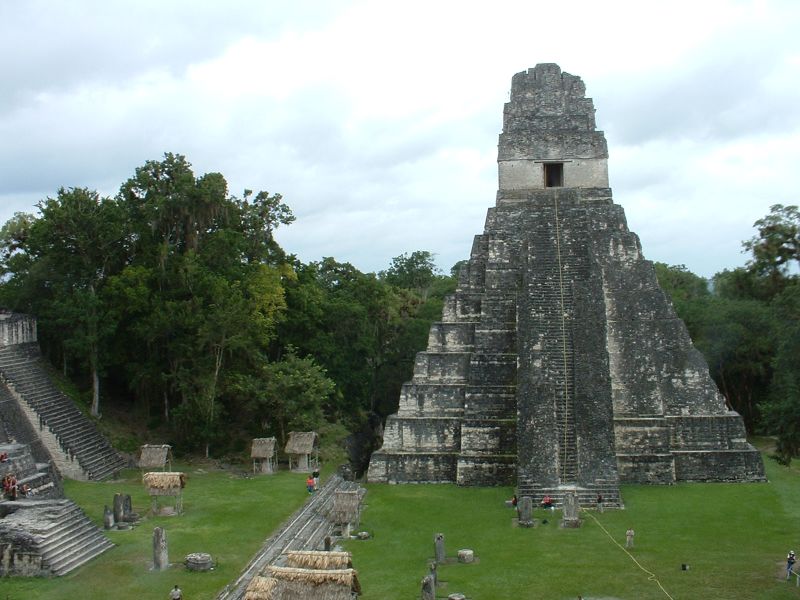
Tikal itself is surprisingly different from Copán, which you may recall from a post on this very journal a month ago. I was really surprised at how much the "Tikal is New York, Copán is Paris" analogy seemed to fit, as clunky as it is. Tikal has truly towering pyramids -- up to 200 feet tall, and quite a climb. But for some reason the rain and jungle have been less kind to the art there, and the limestone stela and altars are almost entirely worn away. The coolest thing about Tikal is the I'm-in-an-Indiana Jones-movie feeling you get with the jungle still covering the majority of the temples, with only their straight vertical tops peeking out of the greenery (or maybe the Yavin Base feeling you get, if you're a real dork); and the wildlife that comes with being basically in the middle of nowhere. The highlight for me was seeing a couple big green loros fly by at about twenty yards away when I was all alone on top of one of the pyramids. There are also spider and howler monkeys all over, "ocellated turkeys," and a bunch of weird rat-rabbit-hamster rodents. Hearing all the weird bird calls and hearing that KO's dad saw a couple toucans almost makes me understand the hobby of birdwatching. Almost.

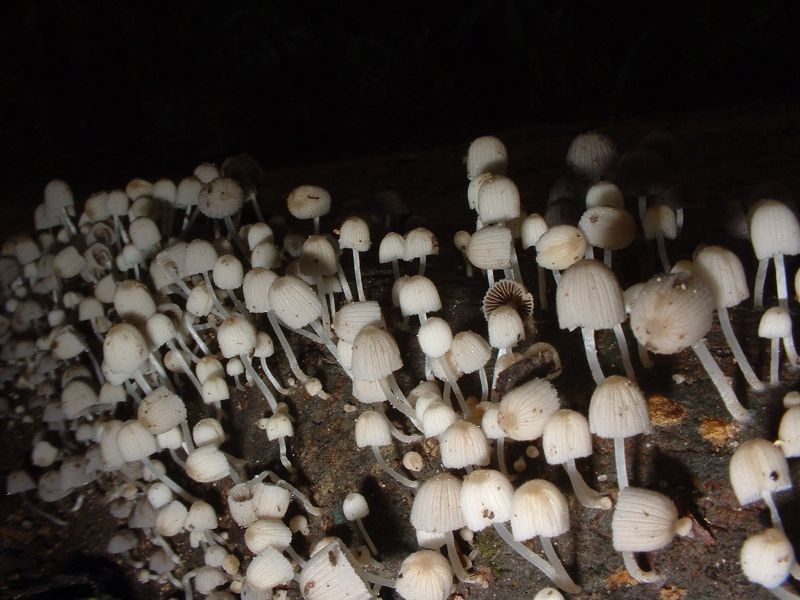
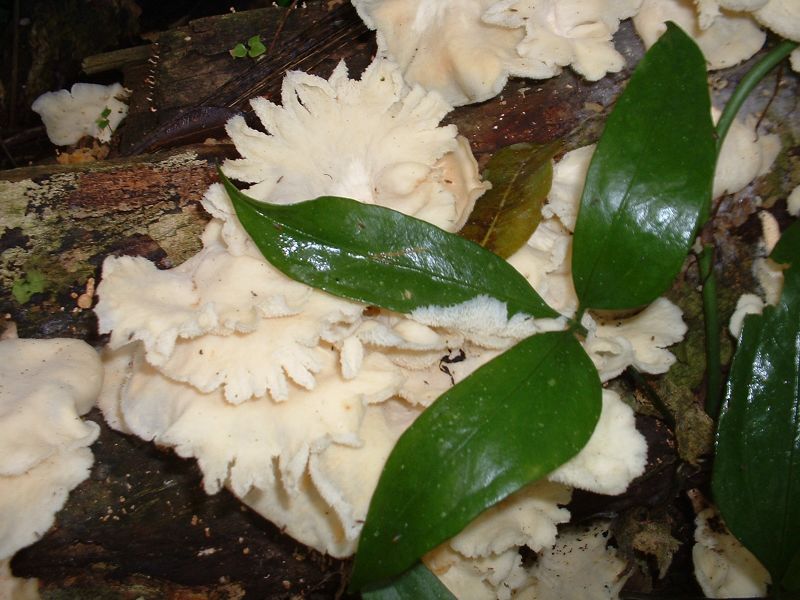
Unfortunately, my lens-work is more apt to photography of mushrooms and other fungi, which move a bit slower than the loros do. I couldn't even take a focused picture of a caterpillar, and they only barely move at all.

We made a quick swing through Flores on the way back, which is a charming little town of gringo bars, travel agents, and tchotchke shops. And one weird bridal shop, I guess. Someone should do the regression analysis on whether towns in Guatemala that are charming attract tourism or if the presence of tourism in a town inspires efforts to increase the charmingness of a town.

Friday, November 18, 2005

I've got the face for it

Well I'm now a bona fide media celebrity here.

Earlier this week the public affairs office found themselves stretched too thin and asked for a volunteer to do a radio interview about Thanksgiving, so Guatemalans could get to know a bit more about our traditions. I volunteered, and got a little more than I bargained for. It turned out to be a live, hour-long show that allowed calls or e-mails from the audience. In Spanish. (In case you've missed some of the key background info from previous posts). You could say I was a little nervous.

I spent a good long while last night learning how to say "Pilgrims" (peregrinos), "jellied cranberry sauce" (salsa de arándano en gelatina), and "biggest shopping day of the year" (el dia de compras mas atareado del año!). The interview was at nine, and when I got to work at eight and found an email waiting for me saying that one of the themes of the show would be "Thanksgiving recipes." It turns out it was a show called "Estilo y Hogar" (Style and Home). I scrambled to find a recipe for stuffing on the internet, which I would have no hope of being able to explain in Spanish anyway, before heading off to the glamorous downtown high-rise that houses the studios of Radio Punto FM 90.5 Guatemala.

The host was a very friendly guy, one of the more metrosexual guys I've met in Guatemala, which I guess shouldn't be a surprise for the host of a show called "Style and Home." It turned out that the first twenty minutes of the show were all him, in this case discussing three important topics:

1. The meaning of the names "Miguel" and "Marcel" (Fun fact: Marcel supposedly comes from a combination of the words "sea" (mar) and "sky" (cielo) in Spanish or Latin or something. Or so claimed our host.)

2. Some things you can do around the house to save money, like not leaving the refrigerator door standing open for too long. He also claimed that the fuller your fridge is, the healthier it is. I either missed the reasoning behind this entirely due to language difficulties or because I was mentally practicing translations of "add a tablespoon of thyme and stir" into Spanish.

3. Freckles: what causes them; their relative merits in the attractiveness of a person; creams, salves, and tonics you might use to avoid/cover them up; etc.

After 20 minutes of that, we got to the special guest: me. He kept saying that we were going to talk about the "gastronomia" of the US, but he did manage to ask me a few of the questions I had been expecting, allowing me to let loose soliloquies that would sound like this, if translated directly:

"There was one the first thanksgiving. In the year 1620 one group of these colonies that some call themselves the Pilgrims would to come from England. They had arrived at a month of December and had arrived to Massachusetts, where snow is. The winter there very bad. The Pilgrims are not knowing how they growed the foods, and there are some indians that are nice. The Indians given the Pilgrims a food. Many the pilgrims died, but some did not. The next summer, and autumn, there is a harvest of good harvest, and so the pilgrims would be happy because this would mean that the pilgrims to survive the winter, which is in Massachusetts very bad. So they had a party for three days, and that was the first thanksgiving. And they invited the indians."

The Guatemalans I talked to afterwards, including the host, were very complimentary about my Spanish, possibly out of charity and/or pity.

He asked me for my favorite recipes for Thanksgiving, but not being up to the quick translation of a recipe that I didn't really know anyway, I just said that my Grandma was the master chef of the family, and I just knew that the Turkey went in the oven for something like six hours. I completely forgot that I had prepared ahead of time a clever answer about "Papallo: Un Pollo dentro de un Pato dentro de un Pavo," which was my own translation of "Turducken: A chicken stuffed in a duck stuffed in a turkey." A moment for cultural exchange lost!

The Guatemalans I work with were most amused by my response to the question "What foods have you tried here in Guatemala that you like?" which caught me totally off guard, so I said the steak was really good here, which was not a lie. I just couldn't call up the names of any of the more elaborate/typical dishes I'd tried. So then the host said, "Well what about beans?" I said that of course the beans here are very tasty, but the tortillas are not as big as the ones in the US. He agreed that the tortillas here are too small to wrap anything in. Other questions that kind of took me aback included: What is the traditional food to eat on New Year's Eve? and What is a real American hamburger like?

The call-in portion of the show was the part I was most nervous about, as telephone communication is always more difficult than face-to-face, and who knows what kind of crazy questions callers might ask? It turns out that I was boring enough that the phones were not ringing off the hook. The only question came in via e-mail, and referred back to the important topic of what kind of creams you might use to cover up freckles. The host kindly did not ask for my input.

Anyway, the woman in the public affairs office seemed happy with my performance, said my Spanish was fine and that I came off as having a friendly rapport with the host, which was a good message for Guatemalan-US relations. If only we could spend less time arresting the head of their drug enforcement agency for smuggling drugs into the US, and more time discussing cranberry sauce.

Saturday, November 12, 2005

Sorry, Charlie

You haven't lived until you've eaten a spicy tuna roll made with Chicken of the Sea.

Friday, November 11, 2005

Sound advice, indeed.

Heard this advice on the radio today while dropping KO off at work, since her Guatemalan employer has the audacity to make her work on Veteran's Day:

"A soccer game is 90 minutes. Even the best soccer games, the ones that will be remembered as classics, are 90 minutes. Once those 90 minutes are over, the game is finished. Beating up the fans of the other team doesn't change what happened in that 90 minutes. It doesn't give your team any more time to change the result."

The commentator stopped short of coming right out and stating that it was actually a bad idea to beat up the opposing team's fans. Then they went to a commercial, and when they came back they were playing music. No idea if there was some sort of soccer riot that precipitated this commentary, or if it was just general advice.

Tuesday, November 08, 2005

The Postal Service

Apparently Hurricane Wilma focused its destructive force with laser-like precision and eliminated the Army Post Office facility in Miami with extreme prejudice. Our incoming mail has been disrupted, our outgoing mail collection has been suspended until further notice, and we have been encouraged to find other means of sending mail. Like, I guess, the Guatemalan postal system? Anyway, don't let this stop you from sending us letters, packages, etc. (but as always, checks or money orders only; no cash). Normal mail service should resume far sooner than the Guatemalan mail system could probably get us anything.

Sunday, November 06, 2005

Of Football, American Style

One of the small pleasures of being posted to Guatemala is that I don't have to entirely miss out on the football season. The cable system here included WSEE, the CBS affiliate from Erie Pennsylvania. Not only does that mean seeing every Cleveland Brows game and often a Sunday double-header, it also means I don't completely lose touch with such critical American cultural signifiers as Coors Light ads. As a bonus, I am thoroughly up-to-date on any important storm systems coming through the Lake Erie region. As an extra bonus, for some reason, WSEE of Erie, Pennsylvania bills itself as "your vacation station," and also provides a vicarious nightly weather forecast for St. Croix and Jamaica (not so many hurricanes now, if you were curious).

There is also a "Fox Sports Latin America" channel, and "ESPN Deportes," which broadcast NFL games, with the Fox and ESPN video, but with Mexican announcers. Whenever they cut to the sideline reporter, the announcers in the booth vaguely translate. More amusingly, whenever they show an on-screen ad for an upcoming show, the Mexican producers put a bigger promo of their own over the top. Occasionally John Madden or whoever uses the magic pen to draw some diagrams on the screen, and the Mexican guys don't really know what he's getting at until it's too late, so they just talk about something else while some magic yellow circles and arrows appear on the screen. The sad part of both of these channels: The ads in the US might seem repetitive, but there are literally only three or four ads on Mexican sports television: Whatever the next soccer game is; the one for the soccer highlight show; and the one for the show where they debate the "most polemic" events from the last weeks soccer games. It's almost enough to make me quit spending all day Sunday watching football. Almost.

Saturday, November 05, 2005

The National Palace

Took a work-sponsored trip to the National Palace yesterday. It's a fairly interesting building, with murals in the main entryways depicting the blending of Mayan and Spanish cultures. There are two "main entrances," each with a big mural. One of them shows a Mayan princess marrying a guy in a conquistador get-up, and below them a mestizo or ladino guy working with a motor -- symbolizing technology and progress and such. Just so you don't go away thinking that the Mayan people are all convinced their relations with the Spanish were all sunshine and lollipops, the other mural shows the Spanish army kicking buts and taking names in battle with the Mayans. It's also pretty cool to see gold-leafed ceilings and chandeliers in the national palace of a country with about a 75% poverty rate.

Tuesday, November 01, 2005

In which we hang out in a graveyard for six hours


Once again, today was a Guatemalan holiday. Somehow the Guatemalan and United Statesian calendars have been coordinated so that both have a bunch of holidays this time of year and a long dry spell in March and April. Thus it's imperative that we take advantage while we can.

Many Americans (or at least Americans who took Spanish in high school) are familiar with some elements of the Day of the Dead as it celebrated in Mexico. Basically they make lots of crazy little crafts of skeletons playing in jug bands and what not. Here in Guatemala, many celebrate Day of the Dead by spending the day at the cemetary with their departed loved ones, having a picnic around the flower-strewn graves. In a few towns, the traditions are a bit more elaborate.

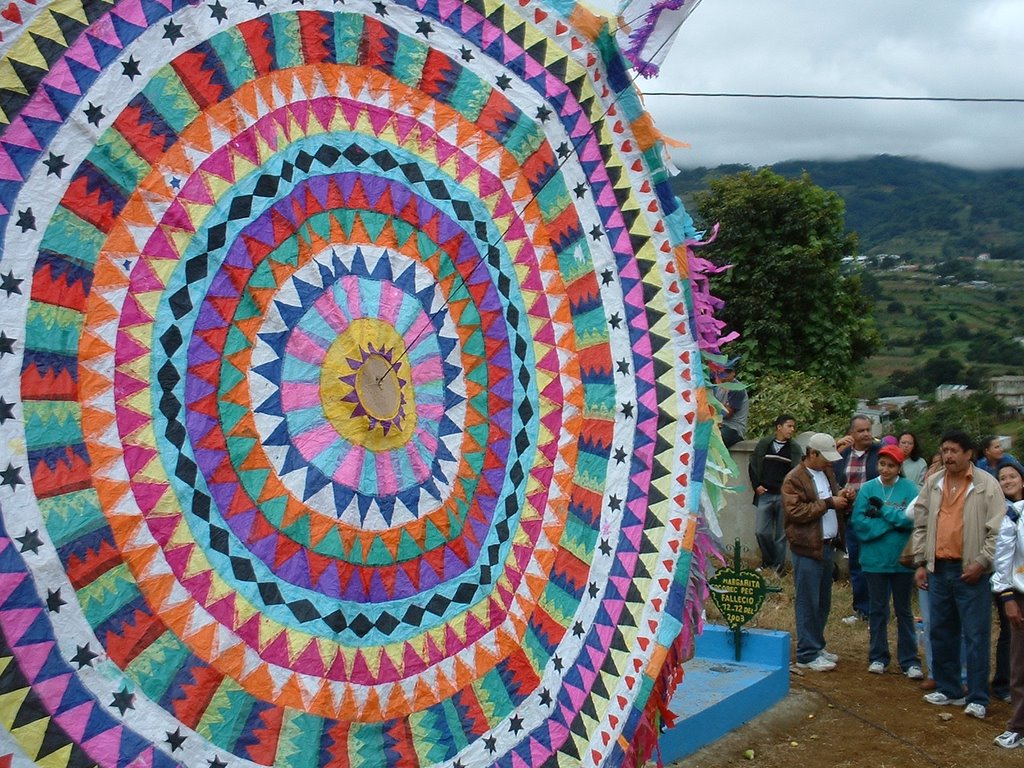
We went to the daringly-named town of Santiago Sacatepéquez, where they go to the graveyard and fly giant kites as a symbolic way of reaching out to the spirits of the deceased. We essentially left at dawn, in order to get there while parking wasn't impossible. Fortuitously, this meant we got to see the tidying-up of the gravesites, which mostly involves making the dirt piles orderly and then covering them with a bed of pine needles, stripes of marigolds and a few aloe-like plants. Great care is taken to pay appropriate respect by making each grave very pretty a couple hours before hordes of ten-year olds trample them in frenetic attempts to get their not-exactly ultra-light kites aloft.

The main road leading to the cemetary was lined with market stalls selling food or small kites (or kite supplies). It was almost like watching a parade seeing the bamboo rods, colored papers, and giant balls of rope heading up the hill; along with many of the women carrying flowers for the graves on their heads, which just doesn't get old no matter how many times you see it.

Later in the morning, they started flying the kites, which seemed to get progressively larger and more elaborately decorated. While there were many small kites, there were always a few of the really big ones -- I'd guess most around 10 or 12 feet across -- ready to launch. All the kites are circles of tissue or newsprint on a frame of bamboo spokes. Some of the kids would hold the kite up on top of one of the cement tombs or on a pile of hay, then a team of five or ten other kids would try to run fast enough to pull the kite up to where the serious wind would take hold. More often than not, the flights were brief, and the kite would come crashing down into the crowd causing roller-coaster-style screams. But after a few tries, many of the kites got up, and eventually a few of them disappeared into the clouds, at least until one of the subsequent kites crashed into the high-fliers' ropes and brought them down, too.

The grand finale was the raising of the five-story kites along one side of the cemetary. They (perhaps obviously) didn't fly (although it didn't seem like the 12-footers would fly, either). Mostly they just showed scenes of Mayan history or current life, including messages about pride in tradition and the importance of education.

In all, this was one of the coolest things we've seen in Guatemala. Too often, these kinds of traditions seem to be continued as a shell of their former selves, mostly to suck money out of tourists. Not that we weren't accompanied by a healthy contingent of fellow camera-toting gringos, but the kite-flying did seem in some way genuine -- it was still a community event, not a show for the interlopers, at least for now.

Sunday, October 30, 2005

Pacaya

Yesterday we climbed one of Guatemala's three active volcanoes. Volcan Pacaya is an easy drive from Antigua, where we stayed overnight. We got up at sunrise (more or less) and hopped on a crummy micro-bus that stalled out twice on the road up to San Francisco, the tiny town halfway up the mountain that is home to the National Park entrance. We were lucky to have a small group that was able to get prepared quickly and keep up a decent pace -- you never know with tour groups if you're going to have the whiner that slows down the whole group.

The climb was only two hours or so: The first hour is through the forest at the base of the mountain. Then you emerge onto the barren fields of volcanic rock, which is cool at first, but eventually turns into slogging up a field of pulverized lava rock. It was not unlike walking up a beach that happens to be at a 30-degree slant for half an hour or so.

The reward was the opportunity to choke on toxic sulphuric gas in gale-force winds and near-zero visibility at the summit. Despite those conditions, it was very cool to look down into the crater and see the glow of molten lava at the bottom, and to see the fields of twisted knots that are actaully hardened lava from the last eruption. I'd love to share them with you, but our staff photographer was having some technical difficulties, so all extant pictures are on old-fashioned 35mm-wide strips of color negative film, and are thus not yet available for viewing. At least they weren't deguerrotypes.

The whole thing was one of those things you could never do in America, as the guide allowed us to peer right over the edge of the crater where you could feel the heat of the lava fifty feet down and suck in the fumes as if you were sticking your head in the oven. As if that level of safety-obliviousness weren't enough, the guide helped some of our fellow hikers frame a better shot for their "us on top of a volcano" photo by kicking in several feet worth of the crust at the very rim of the crater. This not only demonstrated a certain devil-may-care attitude toward preserving the attraction that is his bread and butter, but also a certain devil-may-care attitude toward the lives of the people standing on the lip of the crater a few feet away as he chipped away large chunks of the wall holding them up. I guess he's not responsible for paying the National Park liability premiums.

Also part of the reward for the slog up was the trip back down those same ash-covered slopes, which was not unlike skiing or walking on the moon. We ran down the mountain at full speed, taking giant leaps with each landing cushioned by the fluffiest rocks you can imagine. I imagine this is what skiing was like back in the days before rope-tow lifts -- an hour of hiking up for three minutes of racing down, but still worth it.

Monday, October 24, 2005

Of The Damned Guatemala City Luxury Housing Boom

Some weeks ago, we were torturing ourselves over some decisions about apartment living in the glitzy apartment towers of Guatemala's star-studded Zones 10 and 14. It came down to two options: The one that was closer to work, restaurants, shopping, etc, but had a big construction site next to it (The Tiffany, with the Tiffany II going up next door); or the one that was a bit farther away, but would be quiet on Saturday mornings. In the end, we chose the farther away one, as nothing is really that far away in Guatemala City. Readers with a keen sense of irony, or perhaps just a healthy appreciation for Murphy's Law, can probably already guess what's happening right next door, as of last week.

The number of high-rise apartment towers going up in this city is absolutely bonkers. I have no idea who lives in them. I mean, we're getting a ridiculous housing stiped from Uncle Sugar to pay for our full-floor flat. There is a sizeable elite in Guatemala, but I think they all live in palatial mansions in the hills we can see from our balcony. Of course, we can also see several huge apartment towers that almost never seem to have any lights on in 90% of the units at, say, 7:30 on a Tuesday night. Maybe they're all empty because the owners are summering at their cottages on the Cape, but it seems more likely that they're just un-rentable given what they ask and what 99% of Guatemalans can pay. Yet we can see new buildings going up in every direction. Shortly, we'll be able to see one more, a mere twenty feet away.

Sunday, October 23, 2005

Of Copán, Honduras

We're back from a swell four-day weekend in Copán, Honduras (henceforth known as "Copan" because it's easier to just type it than inserting the technically necessary accent on the "a" each time). We were worried Wilma would make Copan a soggy mess, but fortunately nature decided to cut us a break this time and focus on kicking Mexico's ass this time. And besides, how could we resist our first big chance to flash around our Diplomatic Passports at some dusty border post?

Anyway, Copan is one of the four or so most important known Mayan cities. As we heard multiple times while there, Tikal was the New York of the Mayans, with tall buildings and impressive scale, but Copan was the Paris of the Mayans, a center of art and poetry. Unfortunately, all their amazingly precise astronomy and mathematics didn't help them figure out that in a millenium or so, acid rain would come and eat away all their limestone masterpieces. So now the originals are all under tin roofs, giant tarps, or in the case of most of the truly impressive pieces, they're in a museum to be preserved for future generations. Perhaps due to ironic intervention of the death-obsessed Mayan gods, it turns out the museum roof leaks and isn't doing such a swell job of protecting the art. So, the museum is closed, and apparently has been for some time.

Luckily, they have replicas in all the original locations, so you can still get some sense of how the city was set up back in 700 AD. Of course, the jungle has had its way with Copan for a thousand years or so now, and most everything is a reconstruction of what modern scientists guess it looked like back when. The outlying residential area still mostly looks like grassy mounds, which have the jumbled blocks of former middle-class Mayans' homes underneath.

Also in Copan, we enjoyed some well-maintained "nature." There's the home of the "Butterfly Guy," who apparently is just really into butterflies and has built a giant butterfly-arium on his land. It was educational and had a charmingly home-spun vibe to it, like the guy was out personally mending holes in his butterfly shelter and collecting cocoons from the jungle with all his spare time.

Presenting an interesting but not unpleasant contrast was "Macaw Mountain,"(FULL DISCLOSURE: The linked picture was not taken at Macaw Mountain (TM) but it is a legitimate Macaw resident elsewhere in Copan) which has fliers in every gringo watering hole and hotel in town, and is the kind of place that makes sure you have time to stop by the snack bar during your guided tour and leaves you at the gift shop when you finish. Much slicker than the Butterfly Guy, but they also had a lot of really cool birds in aviaries, all of them rescued from various states of avian servitude or malady. I never was exactly clear where these birds were being "rescued" from, but it made the whole thing sound very noble. (NOTE: On further reflection, they probably rescue the Macaws from whatever agency keeps the above-pictured Macaw at the entrance to the ruins. I personally witnessed some giant-tailless-rat-looking rodent making off with the Copan Ruinas macaws' food!) And if rescuing injured Toucans wasn't enough, Macaw Mountain takes advantage of all their leafy acerage to produce shade-grown coffee. Take that, Starbucks!

In all, we give Copan two big thumbs up. Cool stuff to do on the whole range from touristy to "authentic," good restaurants, relatively safe, and perhaps most importantly, they have THREE different beers. Capitalism at work!